
Color blindness is usually an inherited condition that makes it difficult to distinguish between shades of color. Color blindness occurs when the cones of the eye lack certain light-sensitive pigments.
Research suggests that color blindness is more common in Caucasian men. There are different types of color blindness, including red-green, blue-yellow, and total color blindness.
The most common form is red-green color blindness, which affects up to 8 percent of Caucasian males and up to 0.4 percent of Caucasian women.
In this article, we examine the in detailed information about Deuteranopia but first of all we should know about the different types of color blindness, and what color blind people see and how many kinds of color vision test are there?
Types of color blindness
Humans have three types of light-sensing cones in the eyes: red, blue, and green. With color blindness, also known as color vision deficiency, the pigments in these cones may be dysfunctional or missing. In these cases, the eyes have trouble differentiating between different colors. This leads to color blindness.
Although there are some nongenetic causes of this condition, the primary cause of color blindness is genetics. Color blindness results from an X-linked recessive gene that can pass down from a parent to a child on the X chromosome.
Color blindness is, therefore, statistically more likely to affect males, who only need to have one X chromosome with the gene on it to have the condition. Each type of color blindness has a different effect on how your eyes see color.
Red-green color blindness
Red-green color blindness is the most common form of the condition. This type of color blindness makes it difficult to differentiate between shades of red and green. There are four types of red-green color blindness:
Deuteranomaly occurs when the M-cones (medium wavelength cones) of the eye are present but dysfunctional. It causes green to look redder.
Protanomaly happens when the L-cones (long wavelength cones) of the eye are present but dysfunctional. It causes red to look greener.
Protanopia occurs when the L-cones of the eye are missing. Missing M-cones are responsible for deuteranopia. Both conditions cause trouble differentiating between red and green.
The Deuteran (green) and Protan (red) inefficiencies are the most common ones:
- Deuteranomaly : malfunctioning green cone (common)
- Deuteranopia : missing green cone (rare)
- Protanomaly : malfunctioning red cone (rare)
- Protanopia : missing red cone (rare)
Blue-yellow color blindness
Blue-yellow color blindness is less common than red-green color blindness, though red-green color blindness often accompanies it. With this type of color blindness, you have trouble differentiating between blue and green, as well as between yellow and red.
- Tritanomaly occurs when the S-cones (short wavelength cones) of the eye are present but dysfunctional. If you have tritanomaly, blue and green will look alike, and red and yellow will look alike.
- Tritanopia occurs when the S-cones of the eye are missing, which causes colors to look dampened. It also makes it difficult to differentiate between colors with attributes of blue and yellow, such as green, purple, red, and pink.
Blue-type colorblindness is also possible, but very rare:
- Tritanopia : missing blue cone (very rare)
- Tritanomaly : malfunctioning blue cone (very rare)
Complete color blindness
Complete color blindness is rare. This type of color blindness, also called achromatopsia, occurs when all the cones of the eye are either dysfunctional or missing.
Some experts consider another type of color blindness, blue cone monochromacy, to be a form of achromatopsia since it involves a partial or total lack of color vision.
What colorblind people see in images
What you’ll see in images if you have color blindness depends entirely on its type and severity. If you have red-green color blindness, you’ll generally have more color acuity than you would if you had blue-yellow or complete color blindness.
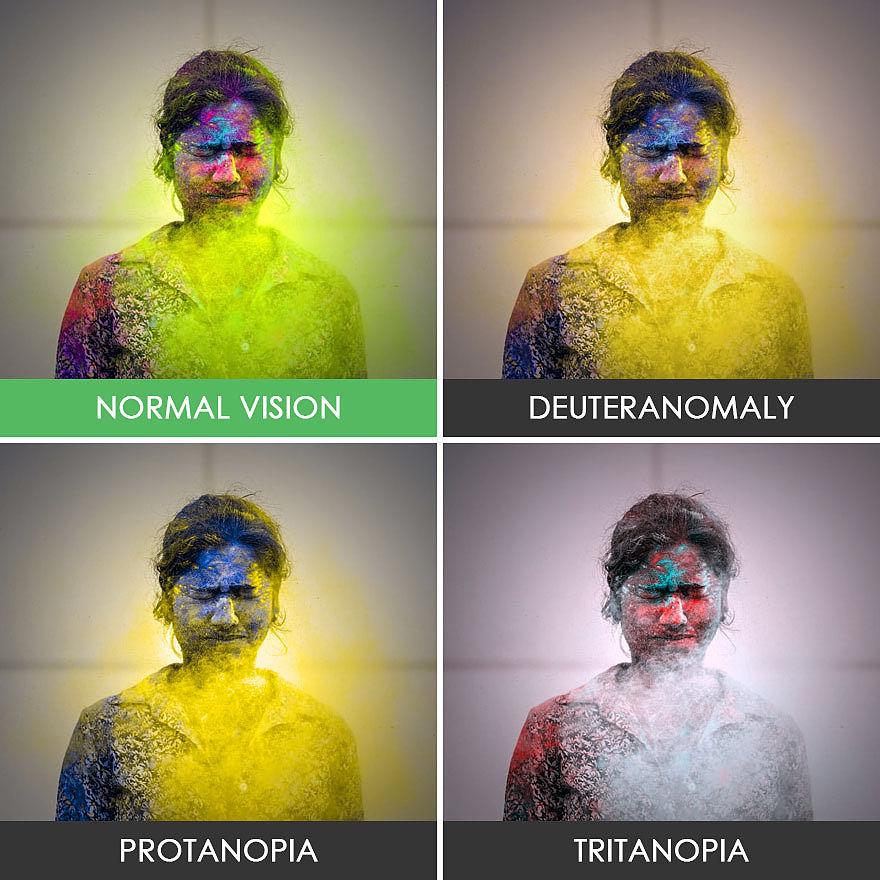
Below are a few examples of how images might look with each of the types of color blindness.
- Normal vision vs. protanopia : If you have protanopia, you’re “red-blind,” which makes red colors look greener.
- Normal vision vs. deuteranopia : If you have deuteranopia, you’re “green-blind,” which makes green colors look redder.
- Normal vision vs. tritanopia : If you have tritanopia, you’re “blue-blind” and have trouble differentiating among blue-associated colors.
- Normal vision vs. achromatopsia : If you have complete achromatopsia, you have monochromatic vision, which makes everything look like different hues of gray.
Deuteranopia(Red-Green Color Blindness)
Deutan color vision deficiencies are by far the most common forms of color blindness. This subtype of red-green color blindness is found in about 6% of the male population, mostly in its mild form deuteranomaly.
Deutan color vision deficiencies are by far the most common forms of color blindness. This subtype of red-green color blindness is found in about 6% of the male population, mostly in its mild form deuteranomaly.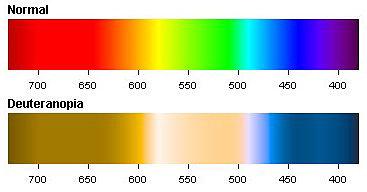
When you have a look at the color spectrum of a deuteranopic person you can see that a variety of colors look different than in a normal color spectrum. Whereas red and green are the main problem colors, there are also for example some gray, purple and a greenish blue-green which can’t be distinguished very well.
The well known term red-green color blindness is actually split into two different subtypes. On one side persons which either lack or have anomalous long wavelength sensitive cones (protan color vision deficiency), which are more responsible for the red part of vision. And on the other side deutan color vision deficiencies, which again are split into two different types:
- Dichromats: Deuteranopia (also called green-blind). In this case the medium wavelength sensitive cones (green) are missing at all. A deuteranope can only distinguish 2 to 3 different hues, whereas somebody with normal vision sees 7 different hues.
- Anomalous Trichromats: Deuteranomaly (green-weak). This can be everything between almost normal color vision and deuteranopia. The green sensitive cones are not missing in this case, but the peak of sensitivity is moved towards the red sensitive cones.
In the midst of the last century there were different researches published concerning unilateral deuteranopia. Some persons were found which had trichromatic vision in one eye and dichromatic vision in the other. The eye with dichromatic vision had a color specturm related to a deuteranopia color spectrum.
The one-eyed color blindness is definitely not the common case, whereas deuteranopia and especially deuteranomaly are the most observed cases of all color vision deficiencies.
In 75% of all occurrences of color blindness it is a defect caused by the green sensitive cones. The following list shows the approximative rates of deutan defects in our population:
- Deuteranomaly, Male Population: 5%
- Deuteranopia, Male Population: 1%
- Deuteranomaly, Female Population: 0.35%
- Deuteranopia, Female Population: 0.1%
These numbers don’t change much, because deutan color blindness as one form of red-green color blindness is a congenital disease. Red-green color blindness is a sex-linked trait and therefore encoded on the X chromosome.
Because women have two X and can overcome the handicap of one, men have only one and are therefore more often affected.
More details about the concrete inheritance pattern can be found at The Biology behind Red-Green Color Blindness.
The Biology behind Red-Green Color Blindness
Red-green color blindness is in the majority of cases provoked through a defective X-chromosome. Human beings have 23 different pairs of chromosomes whereof one pair is the so called sex-chromosome.
This pair consists of two X-chromosomes on women and one X- coupled with one Y-chromosome on men. Color vision in the red-green area is coded on the X-chromosome which is called a sex linked trait.
This concludes if a man is a carrier of a defective X-chromosome he will suffer from color blindness. On women the not defective chromosome is in charge and therefore she is not colorblind but a carrier for color blindness. Because a women needs two defective X-chromosome to be affected this symptom is called X-linked recessive.
A very interesting conclusion of this: If you are male and your father suffers from a red-green color vision deficiency you can not inherit it from him. Only women can be carriers for color blindness who pass it on to their sons.
Let’s have a look at some illustrations. On the left you can see how the disorder is passed on from an affected father to his children. The sons are unaffected and do not have the mutation. The daughters are not affected but are both carriers of the disorder because they inherited the defective X-chromosome from their father.
The illustration on the right side shows a mother which is a carrier and a father which is unaffected. Their son is at a rate of 50% affected i.e. red-green colorblind and their daughter is at the same rate either are carrier or unaffected.
In the last illustration we coupled an affected man with a women which is a carrier. As you can see their children are at a rate of 50% affected. This is the only case shown here, where a women can be affected i.e. suffering from a red-green color blindness.
If the children are unaffected the daughter is anyway a carrier of the disorder. The not shown combinations where man and women are either both affected or both unaffected are left to the reader…
I hope this could give a better insight into the biology behind color blindness. It has to be noted that these remarks are only true for red-green color blindness. Blue-yellow color blindness (tritanopia) is linked to the chromosome pair 7 and therefore sex independent.
If you are colorblind there is a big chance that you are red-green colorblind, usually green-weak and male. And specially if you are suffering from deuteranomaly, this condition is not as rare as you might think and you even might find some of your friends who’s also suffering under this color vision deficiency.
The bottom line
Color blindness is a common hereditary condition that primarily affects males, although it can also affect females. There are several types of color blindness, and these differ depending on which cones of the eyes are dysfunctional or missing.
The most common type of color blindness is red-green color blindness, with blue-yellow color blindness following it. Complete color blindness is a much rarer form of color blindness.
If you have color blindness, making small changes to your daily routine can help improve life with this condition.