
Businesses are looking for practical ways to control electricity costs, improve energy reliability, and make better use of renewable power. However, electricity generation and consumption do not always occur at the same time. This can create challenges for facilities with variable renewable generation, changing production schedules, or periods of high electricity demand.
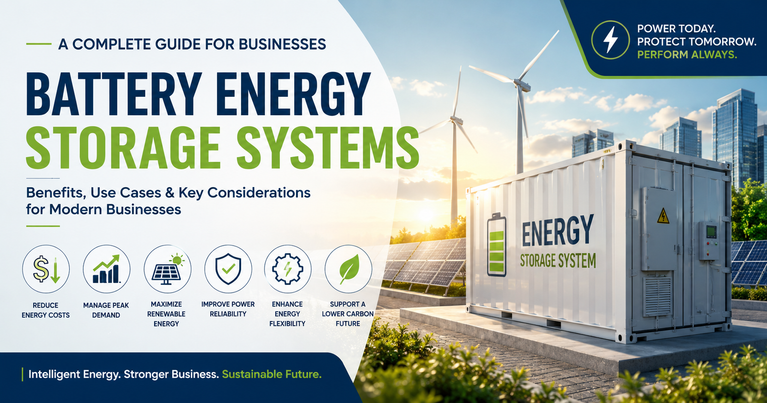
A battery energy storage system can help businesses manage this imbalance by storing electricity when it is available and supplying it when demand increases. Depending on the facility and its energy profile, storage can support peak-demand management, renewable energy utilisation, backup capability, and more flexible electricity consumption.
The benefits of battery storage are not the same for every business. Factors such as electricity tariffs, operating hours, renewable generation, required backup capacity, and the duration of energy storage all influence whether a system makes financial and operational sense.
This guide explains seven key benefits of battery energy storage systems for businesses and the factors organisations should consider before investing in one.
1. How Can Battery Storage Reduce Peak Electricity Demand?
One of the most important benefits of commercial battery storage is its ability to help businesses manage periods of high electricity demand.
Electricity charges are often influenced by more than the total amount of energy a facility consumes. In some markets, businesses may also face demand charges based on their highest level of grid electricity consumption during a billing period.
A battery system can discharge stored electricity when facility demand rises. This can reduce the amount of power drawn from the grid during short periods of high consumption, a strategy commonly known as peak shaving.
For example, a manufacturing facility may experience a temporary increase in electricity demand when several production systems start simultaneously. Instead of meeting the entire increase through grid electricity, stored energy can supply part of the additional demand.
2. How Can Businesses Make Better Use of Renewable Energy?
Many businesses are investing in on-site renewable energy to reduce electricity costs, improve energy independence, and lower emissions. However, renewable generation is not always available when a facility needs electricity.
Solar power, for example, typically produces the most electricity during daylight hours. A business may generate more electricity than it needs at certain times and then require additional power later when solar generation falls.
Battery storage can help address this mismatch by storing surplus electricity and making it available when needed. This allows businesses to increase their use of the renewable power they generate instead of relying entirely on immediate consumption or exporting excess electricity.
For businesses with on-site solar or other renewable generation, storage can help:
-
Increase renewable energy self-consumption
-
Reduce dependence on grid electricity
-
Make renewable power available beyond generation hours
-
Improve the value of existing renewable-energy investments
-
Better align electricity supply with operational demand
The effectiveness of this approach depends on factors such as the facility's generation profile, electricity consumption patterns, battery capacity, and operating schedule. A properly sized system can therefore help businesses make better use of renewable generation while maintaining greater control over when electricity is consumed.
6. Can Battery Storage Help Businesses Reduce Their Carbon Footprint?
Battery storage can support emissions reduction by helping businesses make greater use of cleaner electricity and reduce their reliance on fossil-fuel-based generation.
When paired with renewable energy, a battery can store surplus electricity and make it available when renewable generation is lower. This can help businesses use more of the clean electricity they generate rather than relying on conventional grid electricity or fossil-fuel backup during periods of lower renewable output.
Energy storage can also support broader industrial decarbonization efforts by helping businesses:
-
Increase renewable energy utilisation
-
Reduce dependence on fossil-fuel-based backup generation
-
Support electrification of business operations
-
Improve control over electricity consumption
-
Integrate variable renewable generation more effectively
The emissions benefit depends on how the storage system is charged and operated. A battery does not automatically reduce emissions simply because it stores electricity; the source of the electricity used to charge it and the operating strategy both matter.
For businesses pursuing lower-carbon operations, battery storage can therefore serve as one part of a broader energy strategy alongside efficiency improvements, renewable generation, electrification, and intelligent energy management.
What Should Businesses Consider Before Installing a Battery Energy Storage System?
Although battery storage can provide significant operational and financial benefits, the right system depends on the specific requirements of each business. Installing a larger battery does not necessarily produce better results. System capacity, power output, operating duration, and control strategy should all match the facility's energy profile.
Before investing, businesses should evaluate:
-
Electricity consumption patterns — when and how much electricity the facility uses.
-
Peak demand — when the highest grid demand occurs and how long those peaks last.
-
Renewable generation — how much on-site renewable electricity is available and when it is generated.
-
Required storage duration — whether the system needs to provide power for short periods or several consecutive hours.
-
Backup requirements — which critical loads need to remain operational during an outage.
-
Electricity tariffs — whether demand charges or time-based pricing create opportunities for storage.
-
Available space and infrastructure — including electrical connections, installation requirements, and site conditions.
-
System lifespan and maintenance — how the technology will perform over the expected operating period.
-
Total cost of ownership — including installation, operation, maintenance, and potential replacement costs.
Businesses should also consider whether conventional lithium-ion storage or a vanadium redox battery is more appropriate for their operating requirements. Different technologies are suited to different combinations of power, energy capacity, discharge duration, cycling frequency, and project objectives.
The best approach is to begin with the facility's actual energy profile and then select a storage system around the business's operational needs rather than choosing a technology first.
View Original Source: 7 Benefits of Battery Energy Storage Systems for Businesses