
Introduction
Machine learning is no longer only a data science activity. Today, many companies are using machine learning models in banking, healthcare, retail, manufacturing, telecom, SaaS, cybersecurity, logistics, and customer support.But one big challenge remains: how do organizations manage machine learning work in a reliable, secure, measurable, and business-focused way?This is where MLOps management becomes important.
The Certified MLOps Manager certification is designed for professionals who want to lead machine learning operations, manage ML teams, build governance processes, measure business value, and connect technical ML work with real business goals.
About Certified MLOps Manager
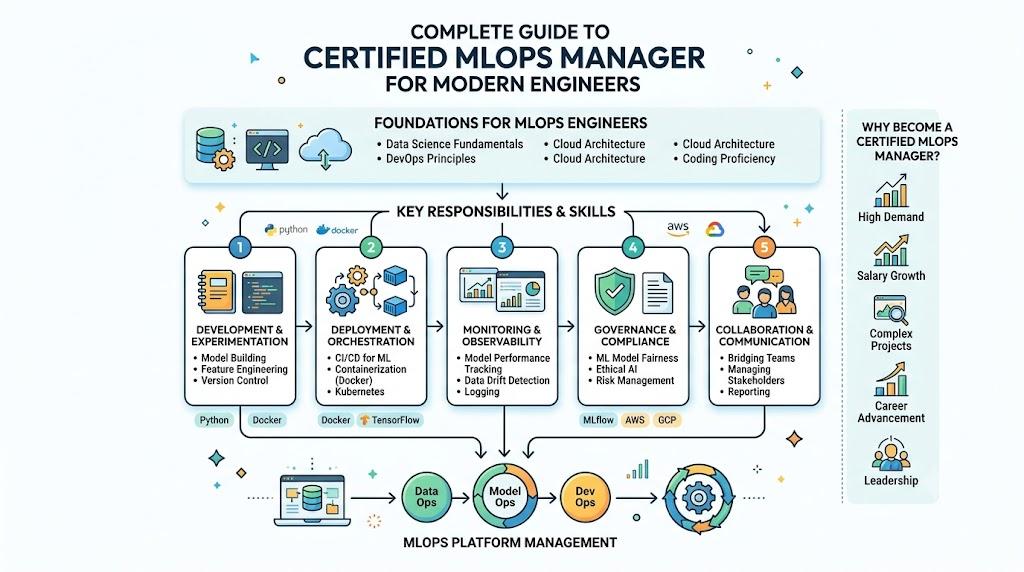
The Certified MLOps Manager certification focuses on the leadership side of machine learning operations. It is not only about tools or coding. It is about managing ML initiatives, teams, governance, strategy, ROI, stakeholder communication, and responsible AI practices.
For a manager or senior engineer, this certification can help build confidence in leading production ML programs.
Certification Overview
| Area | Details |
|---|---|
| Track | AIOps / MLOps / AI Engineering Management |
| Level | Management-Level Certification |
| Who it’s for | Engineering managers, software engineers, ML leads, DevOps managers, data science leads, product managers, platform leaders |
| Prerequisites | Basic understanding of software delivery, machine learning lifecycle, cloud/platform concepts, and team management experience |
| Skills covered | MLOps strategy, team structure, model governance, ROI measurement, stakeholder management, responsible AI |
| Recommended order | MLOps basics → ML lifecycle → DevOps for ML → governance → management strategy → Certified MLOps Manager |
What Is Certified MLOps Manager?
The Certified MLOps Manager is a management-level certification for professionals who lead machine learning initiatives, ML teams, or AI-driven programs.
It helps learners understand how to plan MLOps strategy, build the right team structure, govern models, measure ROI, communicate with stakeholders, and apply responsible AI practices in production environments.
This certification is useful for people who may not write code daily but need to make strong technical and business decisions around ML systems.
Why MLOps Management Matters
Many machine learning projects fail not because the model is weak, but because the organization is not ready to operate it.
Common problems include:
- Models work in notebooks but fail in production.
- Data changes but nobody monitors model quality.
- Teams do not know who owns deployment, monitoring, retraining, or rollback.
- Business leaders cannot measure the value of ML investment.
- Compliance, privacy, bias, and audit requirements are ignored.
- Data scientists, DevOps engineers, software teams, and managers work in silos.
A Certified MLOps Manager should understand these problems and create a structured way to solve them.
The role is not only technical. It is also about process, ownership, communication, governance, and business impact.
Who Should Take Certified MLOps Manager?
This certification is suitable for professionals who are involved in managing, leading, or supporting machine learning operations.
Software Engineers
Software engineers who want to move into AI engineering, ML platform leadership, or MLOps management can benefit from this certification. It helps them understand how ML systems differ from traditional software systems.
DevOps Engineers
DevOps engineers already understand CI/CD, automation, deployment, cloud, and monitoring. Certified MLOps Manager helps them extend those skills into ML pipelines, model governance, and ML lifecycle management.
Engineering Managers
Engineering managers responsible for AI or ML teams need to understand team structure, delivery risks, business alignment, and governance. This certification gives them a practical management framework.
Data Science Leads
Data science leads who want to manage production ML programs can use this certification to understand operational ownership, model deployment, monitoring, and cross-functional collaboration.
Product Managers
Product managers working on AI-enabled products need to understand what is realistic in ML delivery. This certification helps them manage expectations, timelines, risks, and business outcomes.
SRE and Platform Leaders
SRE and platform leaders can use MLOps management knowledge to support reliable, scalable, monitored, and compliant ML systems.
Skills You’ll Gain
After completing Certified MLOps Manager preparation, you should understand the following skills:
- MLOps strategy planning
- ML lifecycle management
- ML team structure and role definition
- Model governance and approval workflows
- Model versioning and audit processes
- Risk management for production ML
- Responsible AI and ethical AI practices
- ROI measurement for ML projects
- Stakeholder communication
- Vendor and tool evaluation
- ML platform adoption planning
- Collaboration between data science, DevOps, product, and business teams
- Model monitoring and operational readiness
- Budgeting and business case preparation for ML initiatives
These skills are important because modern ML projects need more than technical talent. They need leadership, structure, and measurable outcomes.
Real-World Projects You Should Be Able to Do After It
After learning the concepts covered in this certification, you should be able to contribute to or lead projects such as:
- Build an MLOps adoption roadmap for an organization.
- Define roles and responsibilities for ML teams.
- Create a model governance process for production ML systems.
- Design approval workflows for model deployment.
- Prepare a business case for an ML project.
- Measure ROI and value from ML initiatives.
- Build a stakeholder communication plan for AI projects.
- Create responsible AI guidelines for internal teams.
- Define model monitoring and retraining ownership.
- Evaluate MLOps tools, platforms, and vendors.
- Plan collaboration between data science, engineering, DevOps, SRE, and product teams.
- Create a risk checklist for ML models before production release.
These are the types of activities managers and senior engineers often handle in real companies.
Detailed Certification Mini-Sections
What It Is
Certified MLOps Manager is a management-level certification focused on leading machine learning operations. It covers strategy, governance, team structure, ROI, stakeholder management, and responsible AI.
It is designed for professionals who want to manage ML systems from a business and operational perspective.
Who Should Take It
This certification is ideal for:
- Engineering managers
- Software engineers moving toward AI leadership
- DevOps managers
- MLOps leads
- Data science leads
- Product managers working on AI products
- Platform engineering leaders
- SRE managers
- IT leaders managing AI transformation
It is also useful for professionals in India and global markets who want to build a career in AI operations leadership.
Skills You’ll Gain
- MLOps roadmap planning
- ML team management
- Model governance
- ROI measurement
- Responsible AI implementation
- Stakeholder management
- ML risk management
- ML project planning
- Business communication for AI programs
- ML platform evaluation
Real-World Projects You Should Be Able to Do After It
- Create a complete MLOps strategy for a company.
- Build a model approval and governance framework.
- Plan an ML platform adoption roadmap.
- Define responsibilities for data scientists, DevOps engineers, ML engineers, and managers.
- Build a dashboard for measuring ML project value.
- Create an ethical AI review process.
- Prepare an executive report for ML business impact.
Preparation Plan
7–14 Days Plan
This plan is suitable if you already have experience in DevOps, ML projects, or engineering management.
Days 1–2: Understand ML lifecycle, MLOps basics, and why ML needs operations.
Days 3–4: Study MLOps strategy, team structure, and common organizational models.
Days 5–6: Learn model governance, approval workflows, model versioning, and compliance basics.
Days 7–8: Study ROI measurement, business case creation, and stakeholder reporting.
Days 9–10: Learn responsible AI, bias, fairness, transparency, and ethical review processes.
Days 11–12: Review case studies and management scenarios.
Days 13–14: Practice mock questions and revise weak areas.
30 Days Plan
This plan is best for working professionals who can study one hour daily.
Week 1: Learn MLOps foundation, ML lifecycle, deployment challenges, and operational risks.
Week 2: Focus on MLOps strategy, team roles, hiring, collaboration, and platform planning.
Week 3: Study model governance, monitoring, auditability, compliance, and responsible AI.
Week 4: Practice case studies, ROI frameworks, stakeholder communication, and exam revision.
60 Days Plan
This plan is best for beginners or professionals moving from software, DevOps, or management into MLOps.
Weeks 1–2: Learn basics of machine learning lifecycle and DevOps principles.
Weeks 3–4: Study MLOps pipelines, model deployment, monitoring, retraining, and platform basics.
Weeks 5–6: Learn governance, risk management, team structure, and responsible AI.
Weeks 7–8: Practice case studies, create sample roadmaps, revise certification topics, and attempt mock assessments.
Common Mistakes
- Thinking MLOps is only about tools.
- Ignoring governance and model ownership.
- Not understanding the difference between software deployment and model deployment.
- Focusing only on technical teams and ignoring business stakeholders.
- Not measuring ROI from ML projects.
- Ignoring bias, fairness, privacy, and responsible AI.
- Building ML platforms without clear adoption strategy.
- Not defining who owns monitoring, retraining, and rollback.
- Preparing only theory and not studying real-world case scenarios.
- Treating ML models as one-time projects instead of lifecycle products.
Best Next Certification After This
After Certified MLOps Manager, the best next certification depends on your role.
For technical leaders, the next step can be an advanced MLOps or AI platform certification. For managers, AIOps Manager, AI governance, or AI leadership certifications can be useful. For DevOps and SRE professionals, a deeper MLOps Engineer or AIOps certification can help strengthen hands-on implementation understanding.
A practical next path can be:
Certified MLOps Manager → Certified AIOps Manager → Advanced MLOps / AI Governance / AI Platform Leadership
Choose Your Path
Different professionals enter MLOps from different backgrounds. Here are six learning paths.
1. DevOps Path
If you are from DevOps, you already understand CI/CD, automation, infrastructure, containers, and monitoring.
Your path should be:
DevOps basics → CI/CD → Kubernetes → ML lifecycle → MLOps pipelines → Certified MLOps Manager
Focus on understanding how ML pipelines are different from software pipelines. Learn about data validation, model registry, model serving, monitoring, and retraining.
This path is strong for DevOps engineers who want to become MLOps leads or AI platform managers.
2. DevSecOps Path
If you are from DevSecOps, you should focus on security, compliance, model risk, data privacy, and responsible AI.
Your path should be:
DevSecOps basics → cloud security → data security → ML risk → model governance → Certified MLOps Manager
In ML systems, security is not limited to code scanning. You also need to think about data leakage, model misuse, bias, explainability, and compliance.
This path is suitable for professionals who want to manage secure and compliant AI systems.
3. SRE Path
If you are from SRE, your strength is reliability, incident response, SLIs, SLOs, monitoring, and production operations.
Your path should be:
SRE basics → observability → production reliability → model monitoring → ML incident management → Certified MLOps Manager
ML systems can fail silently. A model may keep running but give poor predictions due to data drift or model drift. SRE professionals can bring strong reliability thinking into MLOps.
This path is useful for SRE managers and platform reliability leaders.
4. AIOps/MLOps Path
If you are already in AIOps or MLOps, this certification helps you move from implementation to leadership.
Your path should be:
MLOps fundamentals → ML platform operations → governance → team leadership → ROI measurement → Certified MLOps Manager
You should focus on strategy, team structure, stakeholder communication, and measurable business value.
This path is best for professionals who want to become MLOps managers, AI program managers, or heads of ML engineering.
5. DataOps Path
If you are from DataOps, you already understand data pipelines, data quality, data governance, and analytics workflows.
Your path should be:
DataOps basics → data quality → ML data pipelines → feature management → model governance → Certified MLOps Manager
Data is the foundation of machine learning. Poor data creates poor models. DataOps professionals can play a strong role in MLOps leadership because they understand data reliability and governance.
This path is suitable for data engineering leads and analytics platform managers.
6. FinOps Path
If you are from FinOps, your focus is cloud cost, resource optimization, budgeting, and financial accountability.
Your path should be:
FinOps basics → cloud cost management → ML infrastructure cost → GPU/resource planning → ML ROI → Certified MLOps Manager
ML systems can be expensive because of training, storage, compute, GPUs, experimentation, and inference workloads. FinOps professionals can help companies control cost and measure business value.
This path is useful for cloud finance managers, platform leaders, and AI program managers.
Role of Certified MLOps Manager in Career Growth
Certified MLOps Manager can support career growth in several directions.
For engineers, it helps create a bridge from technical execution to leadership. For managers, it gives the language and structure needed to lead AI and ML programs. For organizations, it helps build people who understand both technology and business outcomes.
Possible roles include:
- MLOps Manager
- AI Program Manager
- ML Platform Manager
- Head of ML Engineering
- Data Science Operations Manager
- AI Delivery Manager
- Responsible AI Program Lead
- Cloud AI Operations Manager
- Engineering Manager for AI Products
In India, many companies are adopting AI across IT services, BFSI, healthcare, retail, telecom, and SaaS. Globally, organizations are also building internal AI platforms and ML operations teams. This creates demand for professionals who can lead ML programs responsibly.
How to Study Effectively
Do not prepare only by reading definitions. MLOps Manager is a practical leadership certification. You should prepare with real workplace scenarios.
Use these study methods:
- Create one sample MLOps roadmap.
- Draw a team structure for an ML platform team.
- Write a model governance checklist.
- Prepare a sample ROI report for an ML project.
- Study common risks in production ML.
- Practice explaining ML problems to business stakeholders.
- Compare centralized, embedded, and hybrid ML team models.
- Learn the difference between model monitoring and software monitoring.
- Review responsible AI principles with real examples.
The more you connect topics with workplace situations, the easier the certification becomes.
Top Institutions That Provide Training Cum Certification Help
Below are some institutions that can help learners with training, mentoring, practical guidance, and certification preparation related to Certified MLOps Manager and related DevOps, MLOps, AIOps, DataOps, SRE, DevSecOps, and FinOps skills.
DevOpsSchool
DevOpsSchool is known for DevOps, DevSecOps, SRE, Cloud, Kubernetes, MLOps, AIOps, and automation-focused training. It can help working professionals understand MLOps from a practical engineering and operations point of view. Learners who come from DevOps or software engineering backgrounds may find this useful for building a strong technical foundation before moving into MLOps management.
Cotocus
Cotocus provides consulting and training support in DevOps, cloud, automation, and enterprise technology practices. For Certified MLOps Manager preparation, Cotocus can help learners understand how organizations plan, implement, and manage large-scale technology transformation. Its practical consulting background can be useful for managers who want real-world examples.
ScmGalaxy
ScmGalaxy focuses on software configuration management, DevOps, CI/CD, automation, and modern software delivery practices. Since MLOps builds on many DevOps and SCM concepts, ScmGalaxy can help learners understand pipeline discipline, versioning, release management, and operational structure. This is useful for professionals moving from software delivery into MLOps leadership.
BestDevOps
BestDevOps provides learning support around DevOps, cloud, automation, containerization, CI/CD, and related engineering practices. For MLOps Manager learners, it can help build a practical understanding of how DevOps principles are extended into machine learning environments. This is useful for engineers and managers who want a simple and structured learning approach.
DevSecOpsSchool
DevSecOpsSchool is useful for learners who want to understand security, compliance, governance, and secure engineering practices. In MLOps management, security and governance are very important because ML systems involve data, models, APIs, privacy, and business risk. This institution can help learners strengthen the security side of MLOps leadership.
SRESchool
SRESchool focuses on site reliability engineering, observability, incident management, production operations, and reliability practices. MLOps systems need strong monitoring, incident handling, and service reliability. SRESchool can help learners understand how reliability engineering applies to ML platforms and production AI systems.
AIOpsSchool
AIOpsSchool is the provider of the Certified MLOps Manager certification. It focuses on AIOps, MLOps, AI-driven IT operations, certifications, consulting, and modern operations learning. Learners preparing for Certified MLOps Manager should review the official certification page and align their study plan with the listed outcomes, modules, and exam expectations.
DataOpsSchool
DataOpsSchool can help learners understand data pipelines, data quality, data governance, and data operations. Since ML systems depend heavily on reliable data, DataOps knowledge is very useful for MLOps managers. This is especially helpful for data engineers, analytics leaders, and managers handling ML data workflows.
FinOpsSchool
FinOpsSchool is useful for learners who want to understand cloud cost, budgeting, cost optimization, and financial accountability. MLOps projects can become expensive because of compute, storage, GPUs, experiments, and inference workloads. FinOps knowledge helps managers connect ML spending with business value and ROI.
Final Advice for Working Professionals
If you are a software engineer, do not think this certification is only for managers. It can help you understand how ML work is planned, governed, and measured at the organizational level.
If you are a manager, do not think you need to become a data scientist before learning MLOps. You need enough technical understanding to ask the right questions, build the right team, and make better decisions.
If you are from India, this certification can be useful because many Indian IT services, product, cloud, and consulting companies are moving toward AI-enabled delivery models. If you are working globally, the same skills are relevant because every serious AI program needs governance, operations, and leadership.
The best approach is to combine this certification with real project thinking. Try to build a sample MLOps roadmap, define a governance checklist, and practice explaining ML value in business language.
Conclusion
The Certified MLOps Manager certification is a strong choice for professionals who want to lead machine learning operations with confidence. It is not just about models, tools, or pipelines. It is about managing the full lifecycle of machine learning in a responsible, scalable, and business-focused way.
This certification is especially useful for working engineers, software engineers, DevOps professionals, SREs, data leaders, product managers, and engineering managers who want to grow into AI and MLOps leadership roles.
A good MLOps manager understands both sides: the technical reality of ML systems and the business expectations of leadership. They know how to build teams, create governance, measure ROI, reduce risk, and guide ML projects from experiment to production.