
 https://letstawk.ai/platforms/wordpress.html
Businesses often receive valuable leads and customer enquiries through phone calls. However, when call details are recorded manually or qualification varies between team members, important information can be missed, follow-ups may be delayed, and promising leads may not reach the right person in time.
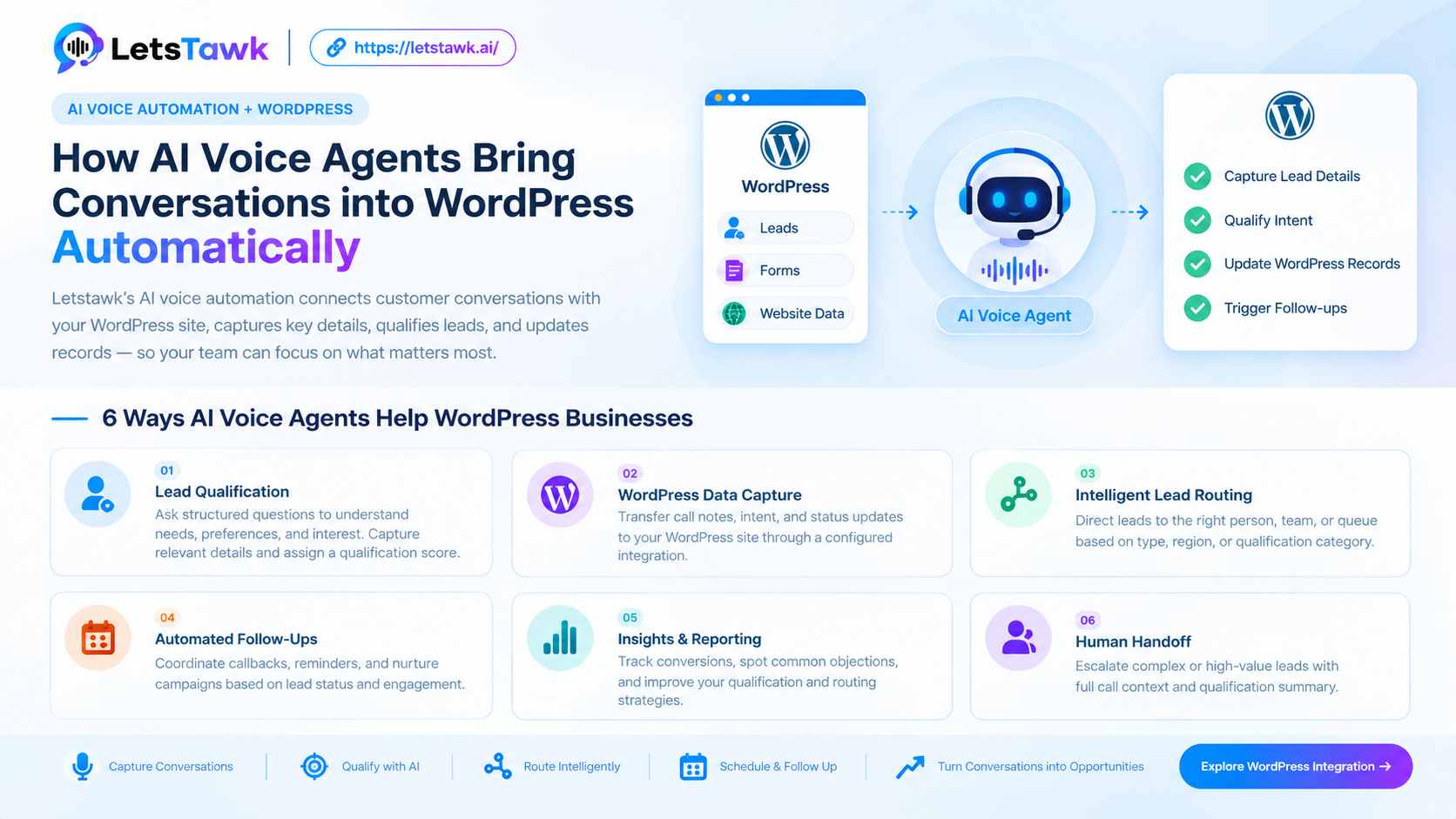
Integrating an AI voice agent with WordPress can help connect customer conversations with the information and workflows teams use to manage leads. Letstawk focuses on capturing relevant details, qualifying intent, and sending conversation outcomes to WordPress through a configured integration.
Why Do Businesses Need AI Voice Automation for WordPress?
WordPress websites can generate enquiries, but collecting a lead is only the beginning. Teams must understand the prospect’s requirements, determine their interest, update records, and coordinate the next step.
Common challenges include:
-
Incomplete call records: Important details remain in notes or are not captured consistently.
-
Inconsistent lead qualification: Team members may ask different questions or assess prospects differently.
-
Poor record quality: Leads may have missing information or unclear status updates.
-
Delayed follow-ups: Sales and support teams may not receive the context they need quickly.
-
Slow manual intake: Repetitive data entry can take time away from customer conversations.
-
Missed high-intent opportunities: Interested prospects may wait while enquiries move through manual queues.
A configured AI voice workflow can help address these challenges by making conversation information easier to organize and act upon.
How Letstawk Can Connect AI Conversations with WordPress
The Letstawk integration overview highlights six areas where voice automation can support lead management and customer engagement.
1. Lead Qualification
An AI voice agent can ask structured questions to understand a prospect’s needs, preferences, and level of interest. Depending on the workflow, qualification criteria might include the service required, budget, project timeline, location, or readiness to proceed.
Consistent questions can help teams collect comparable information. Qualification scores and routing rules should be configured around the business’s actual criteria rather than assumed to be accurate automatically.
2. WordPress Data Capture
Relevant conversation details can be organized into structured responses, notes, intent scores, and status updates for transfer into WordPress.
The exact information that can be stored depends on the integration method, supported fields, permissions, and configuration. Before deployment, confirm which WordPress records or connected data destinations can be created or updated.
3. Intelligent Lead Routing
Not every enquiry belongs with the same team member. Configured rules can help route leads according to criteria such as lead type, region, or qualification category.
For example, a prospect enquiring about enterprise services could be directed to the appropriate sales team, while a routine product question follows a different support process. The routing rules should be tested to ensure that leads reach the intended destination.
4. Automated Follow-Ups
A conversation may reveal that a prospect needs a callback, additional information, or a later appointment. Letstawk’s described workflow includes reminders, nurture flows, and callback campaigns.
These actions may depend on the available campaign features, connected tools, and scheduling configuration. Businesses should verify which follow-up actions are supported before relying on them in a live workflow.
5. Insights and Reporting
Conversation outcomes can help businesses review which objections arise frequently, which enquiries convert, and how lead quality changes over time.
When the relevant data is captured and available for analysis, teams can use these insights to refine qualification questions, routing criteria, and follow-up processes.
6. Human Handoff
Some leads need personal attention, particularly complex enquiries or high-value opportunities. A configured escalation process can pass the available call context and qualification summary to a human representative.
Teams should define when escalation occurs and verify that the required information reaches the representative before the next interaction.
An Illustrative Example: Qualifying a WordPress Website Lead
Imagine a software company receives an enquiry through its WordPress website from a business interested in a customer support solution.
-
The prospect receives a call: A configured AI voice agent contacts the lead or handles an inbound enquiry, depending on the setup.
-
The agent asks qualification questions: It gathers details about the company’s requirements, team size, expected implementation timeline, and main challenges.
-
The conversation is categorized: The configured workflow records relevant answers and assesses the lead against defined qualification criteria.
-
WordPress records are updated: Supported details, notes, and status information are transferred to the designated WordPress destination.
-
The lead is routed: A configured rule directs the enquiry to the appropriate sales representative or queue.
-
The next step is arranged: A supported follow-up workflow initiates a callback, reminder, or other agreed action. If the prospect has a complex requirement, the process can escalate the enquiry to a human.
This is an illustrative scenario, not a guarantee that every step is available by default. The final workflow depends on integration capabilities, permissions, data mapping, and testing.
What Should Businesses Check Before Integration?
Before going live, identify the enquiries the AI agent should handle, confirm the supported WordPress connection method, map the required fields, and test both successful and failed updates. Establish how duplicate leads, incomplete answers, routing errors, and human escalation will be handled.
Before enabling outbound AI calls or call recording, check the requirements that apply to the caller, recipient, and campaign. Obtain any required consent and provide required disclosures. Configure calling permissions, recording settings, opt-out handling, and access to customer data accordingly. Requirements vary by jurisdiction and use case; confirm the setup with your compliance or legal adviser.
Bring Your WordPress Leads into Action with Letstawk
Letstawk helps businesses explore how AI voice automation can connect conversations with lead qualification, record updates, routing, and follow-up workflows. Visit the Letstawk WordPress integration page to review the available capabilities and determine whether they fit your business processes. Start with one defined lead workflow, test it carefully, and expand as your requirements and results become clear.