
Anna Clark of Holloway Farm
A gravestone, a family puzzle, and the world that surrounded a young woman who died in 1838
https://justpaste.it/acoh
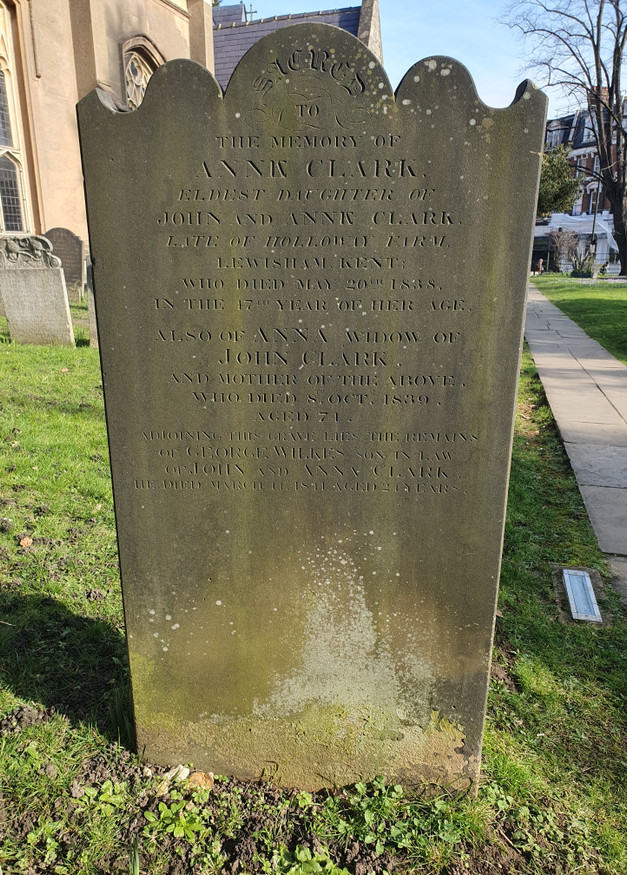
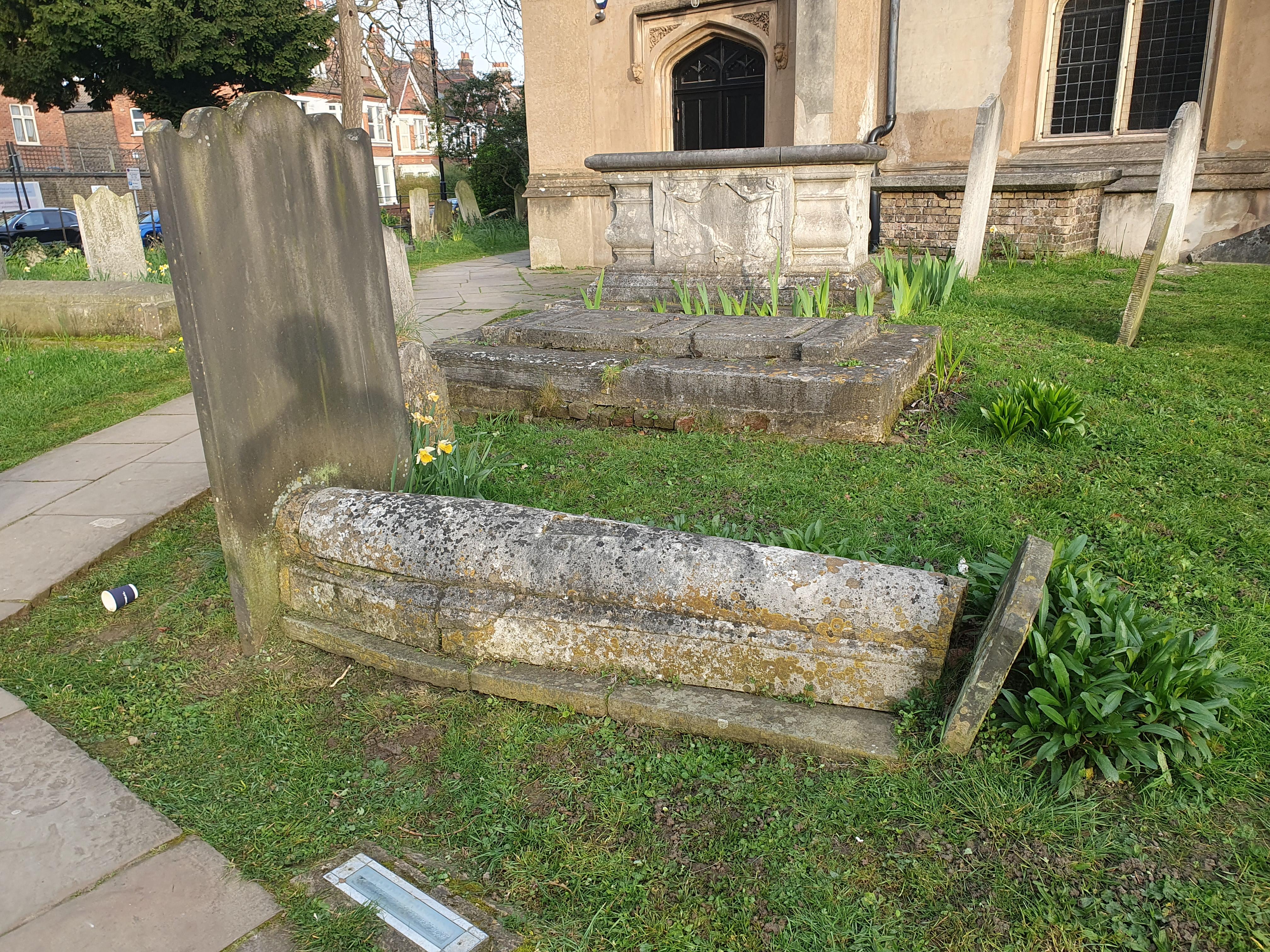
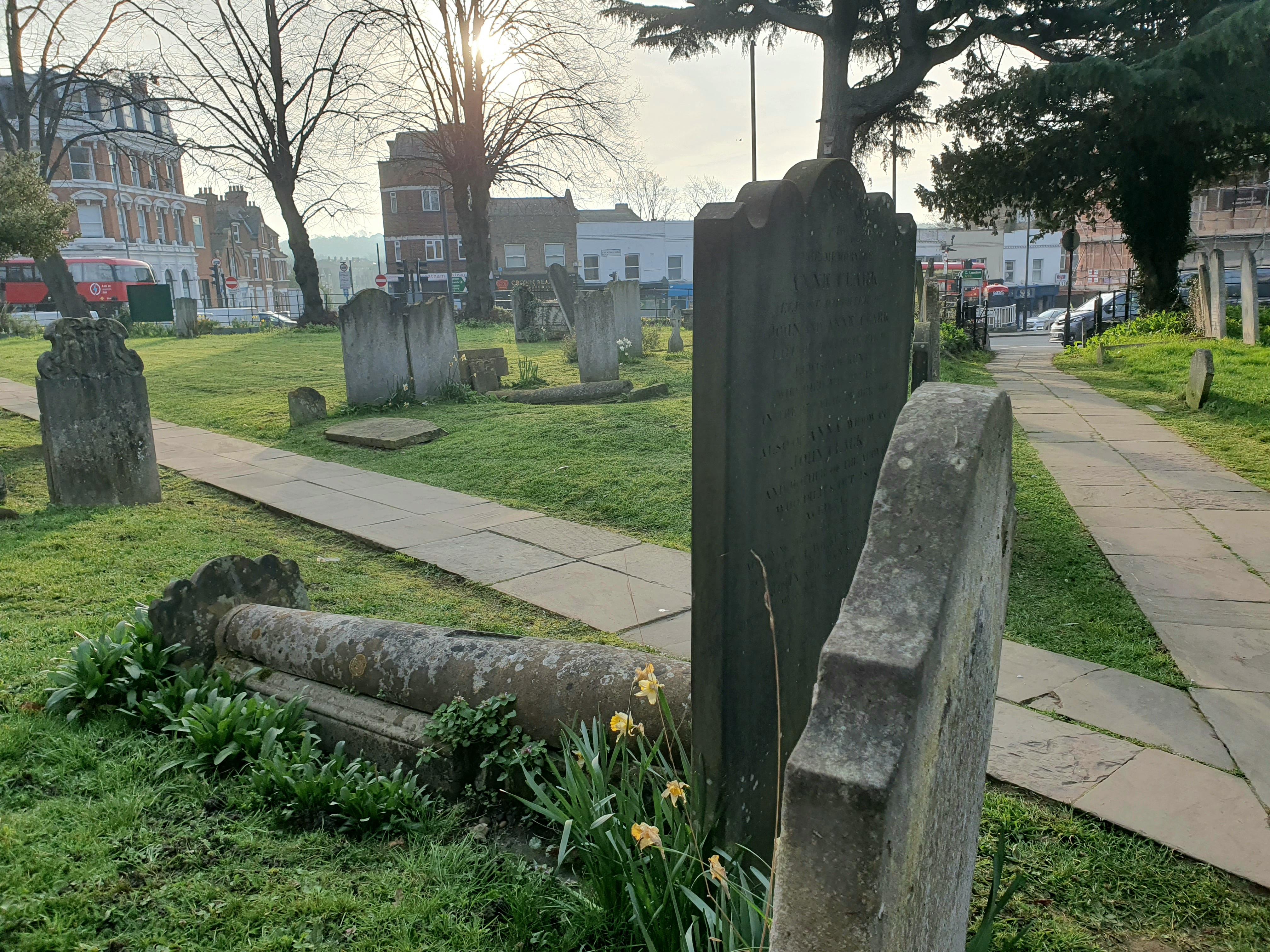
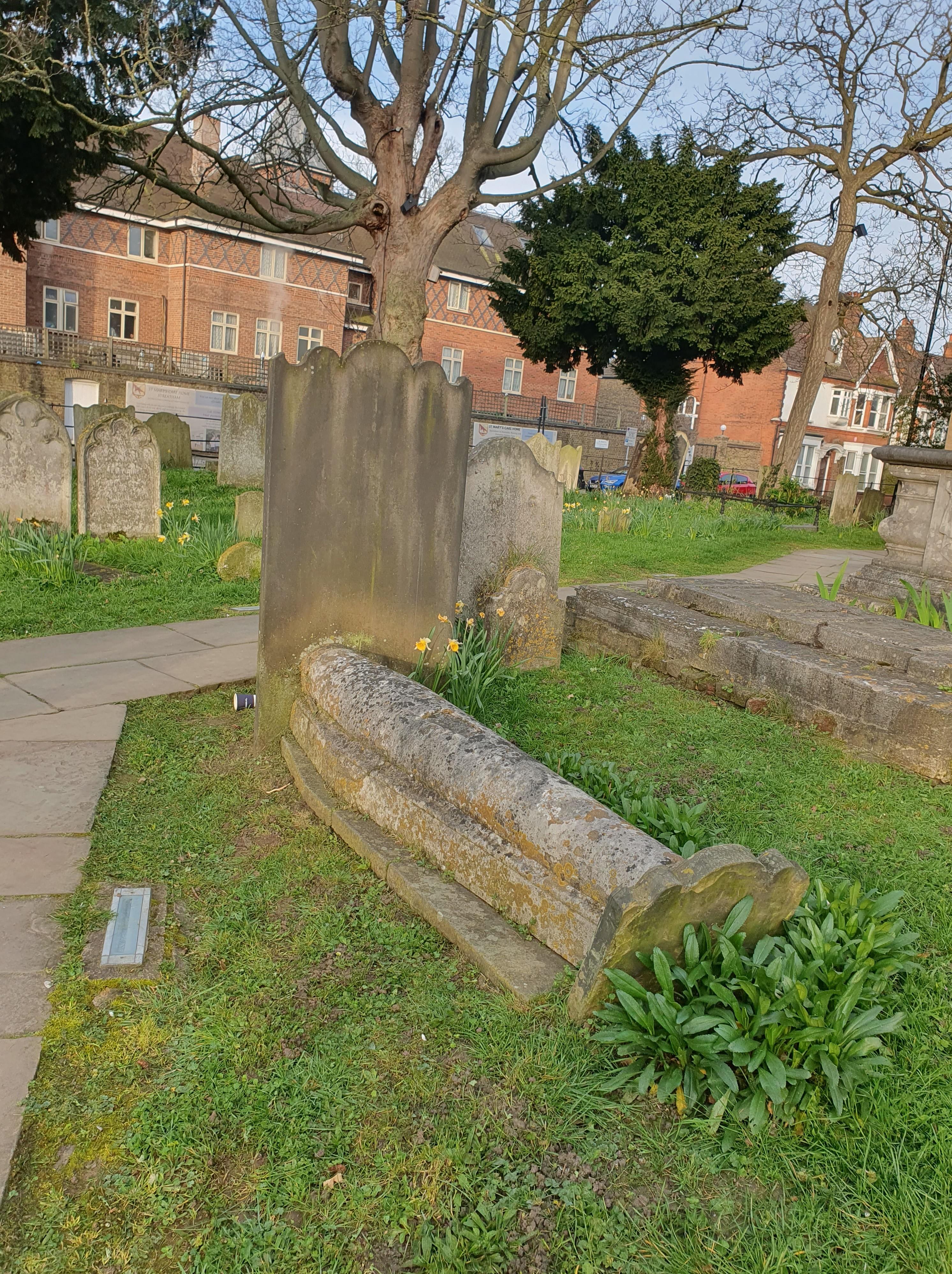
This article grew out of a simple encounter with a gravestone on the churchyard of St Leonard's Church, Streatham, London UK.
At first glance, the memorial seemed straightforward: a daughter, her mother, and a son-in-law mentioned almost as an afterthought. Yet the dates do not sit easily together. The result is a small but absorbing genealogical puzzle, centered here on Anna Clark.
The gravestone commemorates Anna Clark, described as the eldest daughter of John and Anna Clark of Holloway Farm, Lewisham, Kent. She died on 20 May 1838, in the seventeenth year of her age. The same stone also remembers Anna Clark, widow of John Clark, who died on 8 October 1839 aged 71. Then comes the intriguing line: adjoining the grave lie the remains of George Wilkes, son-in-law of John and Anna Clark, who died on 11 March 1811 aged 21.
In other words, the son-in-law appears in the family story decades before the daughter whose memorial dominates the stone was even born. That is what makes the inscription arresting. It preserves grief, but also hints at an absent person -- an earlier daughter whose existence is not directly recorded on the monument.
The gravestone inscription
"Sacred to the memory of Anna Clark, eldest daughter of John and Anna Clark, late of Holloway Farm, Lewisham, Kent, who died May 20, 1838, in the seventeenth year of her age. Also of Anna, widow of John Clark, and mother of the above, who died 8 October 1839, age 71.
Adjoining this grave lies the remains of George Wilkes, son-in-law of John and Anna Clark. He died March 11, 1811, age 21 years."
What can be read directly from the stone
The inscription identifies John Clark and Anna Clark as a married couple connected with Holloway Farm in Lewisham, Kent.
It identifies Anna Clark, who died in 1838, as their eldest daughter. As she died in her seventeenth year, she was about sixteen or seventeen years old and was born around 1820 or 1821.
It identifies Anna Clark, widow of John Clark and mother of the above, as having died in 1839 aged 71. That places her birth around 1767 or 1768.
It identifies George Wilkes as the son-in-law of John and Anna Clark. He died much earlier, in 1811, aged 21.
The phrase 'adjoining this grave' suggests that George Wilkes was buried nearby and was considered important enough to be tied into the family memorial.
Why the dates are puzzling
If Anna Clark, the daughter named most prominently on the stone, was born around 1820 or 1821, she could not have been the wife of George Wilkes, who died in 1811. That much is clear from the dates alone.
This means George Wilkes must have married some other daughter of John and Anna Clark, unless the term 'son-in-law' is being used in an unusual or looser sense. The inscription therefore points toward a missing family member -- or at least toward a family arrangement not explained on the stone.
A further curiosity follows from the mother's age. If Anna Clark the mother was born around 1767 or 1768, she would have been about fifty-two to fifty-four when Anna Clark the younger was born around 1820 or 1821. That is possible, though late. It increases the likelihood that the family history was more complex than the stone spells out.
Another question raised by the stone: place of burial
The inscription also prompts a geographical question. Anna Clark is described as belonging to a household connected with Holloway Farm in Lewisham, then still part of Kent. Yet the gravestone itself stands in the churchyard of St Leonard in Streatham, several miles away to the south-west.
The dates on the stone show that this burial place was already in use long before Anna Clark the younger died. George Wilkes, the son-in-law of John and Anna Clark, was buried there in March 1811. This suggests that the Clark family had an established connection with the parish of Streatham decades before the final losses commemorated on the monument.
In the early nineteenth century it was common for families to be buried in the parish where they lived, worshipped, or maintained social ties, even if they owned or worked land elsewhere. Holloway Farm may therefore represent an economic or familial identity rather than the precise place of residence at the time of death. The continuity of burial at Streatham points toward a lasting attachment to that community.
The stone thus preserves not only a sequence of deaths but also a trace of movement between rural property and suburban parish life, reminding the reader that family histories were often shaped by more than a single fixed place.
Possible ways George Wilkes fits into the family
1. An older full sister. John and Anna Clark may have had an earlier daughter, probably born in the late 1780s or 1790s, who married George Wilkes before his death in 1811. If so, Anna Clark of 1838 would still be called the eldest daughter on the stone only if the earlier daughter had died young, been omitted, or if 'eldest' was being used more loosely than modern readers expect.
2. A daughter from Anna Clark the mother's previous marriage. Anna Clark the elder may have married before she married John Clark. A daughter from that earlier marriage could still have been closely enough bound into the Clark household that her husband, George Wilkes, was remembered as a son-in-law of John and Anna Clark.
3. A daughter from John Clark's previous marriage. John Clark may have had a daughter by an earlier wife. George Wilkes would then still be a son-in-law in ordinary usage, and Anna Clark of 1838 would be a younger half-sister.
4. A daughter born outside marriage. It is also possible, though less likely, that an earlier daughter was born before a formal marriage yet was raised within the household and recognized as part of the family.
5. A broader use of the term 'son-in-law'. Less likely, but worth noting, is that the phrase may have been used somewhat more loosely than strict modern legal terminology would suggest. Even so, the most natural reading remains that George Wilkes was the husband of a daughter.
How the family timeline may look
Working only from the inscription, a tentative timeline can be reconstructed. Anna Clark the elder was born around 1767 or 1768. If she had children in the late 1780s or 1790s, an older daughter could have been old enough to marry by the first decade of the nineteenth century. George Wilkes, who died in 1811 aged 21, may then have been her husband.
Roughly a decade later, around 1820 or 1821, Anna Clark the younger was born. She died in 1838. Her mother died the following year. The memorial stone, therefore, seems to gather together losses across at least three decades, while leaving one crucial figure unnamed.
Burial, distance, and patterns of residence
The reference to Holloway Farm also raises practical questions about distance and burial custom. The farm lay in the Lewisham area, then on the Kent side of London’s expanding boundary. Streatham, where the grave stands, was roughly six to eight miles away in a straight line, and perhaps ten miles by the roads of the time. This was a journey of only a few hours by horse-drawn carriage or farm wagon.
There was no religious prohibition in Anglican practice against transporting the dead over such distances. Families with the means to do so often chose burial places based on long-standing parish connections, family vaults, or social preference rather than on the exact location of death. A burial site might therefore reflect where a family felt it belonged, rather than where a particular event occurred.
It is also important to remember that early nineteenth-century Streatham was not yet the densely urban district it would later become. It retained a semi-rural character and attracted residents who combined agricultural interests with proximity to London. Ownership or management of land in Kent did not necessarily imply continuous residence there. The Clarks may well have maintained a household identity tied to Holloway Farm while living, worshipping, or sustaining social ties in Streatham.
Seen in this light, the gravestone becomes evidence of a family whose life was spread across more than one landscape. The rural reference and the suburban burial together suggest patterns of movement, property, and belonging typical of the period.
The larger world during Anna Clark's life
Anna Clark the younger lived from about 1820 or 1821 until May 1838. Her life fell into a period of rapid change. Britain was being reshaped by the Industrial Revolution. Railways, factories, and urban growth were transforming everyday life. Scientific discovery was accelerating, and the political order established after Napoleon was still settling into place.
During her short lifetime, Europe was living in the aftermath of the Napoleonic Wars and the Congress of Vienna. The Greek War of Independence unfolded from 1821 to 1830. France experienced the July Revolution of 1830, and Belgium gained independence that same year. In Britain, the Reform Act of 1832 altered parliamentary representation, while the Slavery Abolition Act of 1833 ended slavery across most of the British Empire, though not without delay and compromise.
Public health was fragile. The cholera pandemics of the early nineteenth century reached Europe and Britain, exposing the terrible sanitary conditions of growing towns and cities. Smallpox vaccination had already been introduced through Edward Jenner's work, yet skepticism and uneven uptake remained familiar features of public life.
The period also saw striking technological and scientific advances. Michael Faraday's work on electromagnetism opened the way to later electrical technologies. Charles Babbage was formulating ideas that would become foundational in the history of computing. Charles Darwin sailed on HMS Beagle between 1831 and 1836, gathering material that would later reshape biology. Rail travel was becoming a reality, especially after the Stockton and Darlington Railway of 1825 and the Liverpool and Manchester Railway of 1830. Photography, too, was emerging in the 1830s.
Exploration was very much part of the age. Antarctica was first sighted in 1820. Arctic expeditions continued under figures such as John Franklin. British exploration and mapping in parts of Africa also expanded during these decades, often bound up with trade, empire, and missionary ambition.
In literature and culture, Mary Shelley's Frankenstein was already in circulation, Walter Scott's historical novels were widely read, and Charles Dickens was beginning to publish. The old Romantic generation was passing: Byron died in 1824 and Percy Bysshe Shelley in 1822. Beethoven died in 1827. Queen Victoria came to the throne in 1837, only a year before Anna Clark's death, marking the beginning of a new symbolic age in Britain.
Why Anna Clark stands at the center of the story
Anna Clark is the central figure because the monument is primarily hers. Her name occupies the most visible place on the stone. She is the person through whom the viewer first enters the family story.
The description of Anna Clark as belonging to a household “late of Holloway Farm” also carries social meaning. In early nineteenth-century memorial language, reference to a named property could signal respectability, stability, and a recognised place within the local landscape. Even when residence was divided between different locations, such wording affirmed family identity and status. For a young unmarried woman, being linked to a specific farm or estate in this way suggests that she was understood not as a labouring servant but as a daughter of a household with standing. The epitaph thus preserves not only grief but a quiet assertion of social position.
Yet her memorial also opens a door to people no longer fully visible: her widowed mother, her absent father, and George Wilkes, the son-in-law whose presence points to another daughter or another marriage. In this way, Anna's stone becomes more than a record of one death. It becomes a compressed family archive.
There is also something moving in the brevity of her life. She lived just long enough to belong to a world on the threshold of modernity, but not long enough to see what that world would become. Railways, photography, public health reform, the Victorian age, and later scientific revolutions were all beginning to gather around the edges of her lifetime.
A brief reflection
The gravestone does not answer every question. It leaves gaps, and those gaps are part of its power. Many family histories survive in precisely this form: a few names, a few dates, and one unexpected relationship that disturbs the neatness of the record.
Rather than forcing a certainty the stone cannot provide, it may be enough to say this: George Wilkes almost certainly entered the Clark family through a daughter older than Anna Clark of 1838, whether as a full sister, half-sister, step-sister, or a daughter whose precise status has disappeared from the memorial record. The monument preserves the outline of that lost connection.
It also preserves the outline of a life lived between places. The reference to Holloway Farm and the enduring use of a burial site in Streatham suggest a family whose identity was shaped by movement as well as continuity. Rural property, suburban parish ties, and changing patterns of residence all leave their faint mark on the stone. In this way, the monument does not simply commemorate individuals. It hints at the wider geography of belonging that framed their lives.
Reference index
|
Field |
Information |
|
Article title |
Anna Clark of Holloway Farm |
|
Central figure |
Anna Clark, eldest daughter of John and Anna Clark |
|
Other names on the stone |
Anna Clark, widow of John Clark; George Wilkes, son-in-law of John and Anna Clark; John Clark |
|
Place named on the stone |
Holloway Farm, Lewisham, Kent |
|
Current photographed location |
|
|
GPS coordinates |
Latitude: 51.42937703179858 |
|
Dates mentioned |
George Wilkes died 11 March 1811; Anna Clark died 20 May 1838; Anna Clark the elder died 8 October 1839 |
|
Core puzzle |
How George Wilkes, who died in 1811, could be the son-in-law of John and Anna Clark when Anna Clark, the daughter most prominently named on the stone, was born around 1820 or 1821 |
|
Most likely explanation |
George Wilkes married an older daughter of the Clark household whose identity is not stated on the monument |
|
Find A Grave |
|
|
ChatGPT conversation copy |
https://chatgpt.com/share/67b4acf2-f690-800f-9d65-02618c32a9c2 |
|
Short link used in uploaded note |
Source note:
This document was created from the uploaded gravestone photograph, the uploaded text note, and the uploaded PDF copy of the original ChatGPT conversation.
Churchyard of St Leonard's Church. Streatham, London, UK
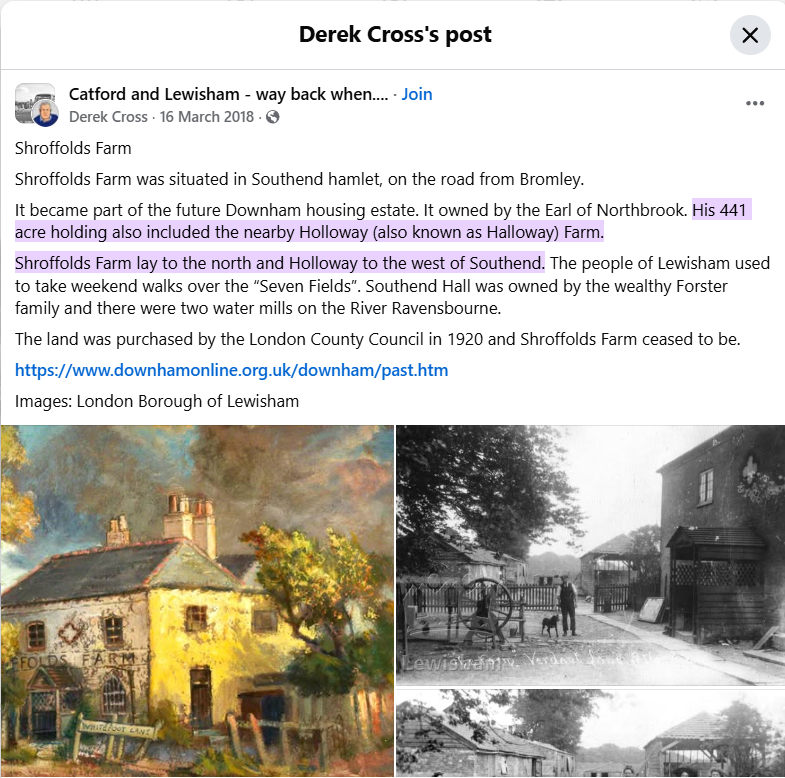 https://www.facebook.com/groups/435277893269381/posts/1236697809794048/
---