
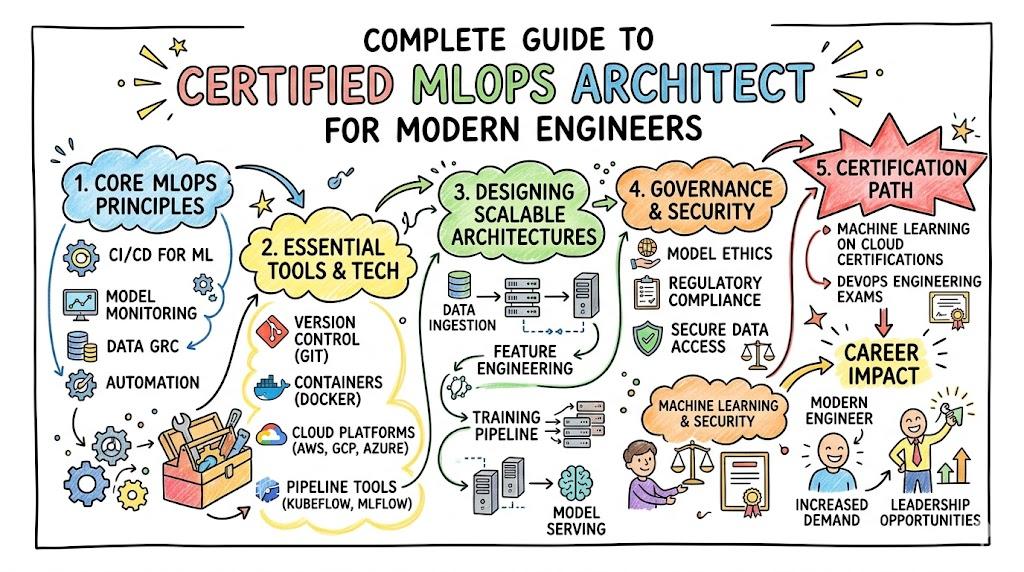
Introduction
Machine learning is no longer only a data science experiment. Today, companies want ML models to run safely, reliably, and continuously in real business environments. This is where MLOps becomes important.
A Certified MLOps Architect is a professional who understands how to design, scale, secure, and govern machine learning platforms for teams, products, and enterprises. This certification is useful for working engineers, managers, software engineers, platform teams, DevOps professionals, SREs, DataOps engineers, and technical leaders who want to move toward advanced ML platform architecture.
For India and global professionals, this certification can help build clarity around production ML systems, ML pipelines, feature platforms, multi-cloud ML design, model governance, and enterprise ML operations.
This guide explains what the Certified MLOps Architect certification is, who should take it, what skills it covers, how to prepare, what mistakes to avoid, and which learning path to choose based on your current role.
Certification Overview
| Field | Details |
|---|---|
| Certification Name | Certified MLOps Architect |
| Provider | AIOps School |
| Track | MLOps |
| Level | Expert-Level / Architect-Level |
| Who It’s For | Working engineers, software engineers, managers, ML engineers, DevOps engineers, platform engineers, SREs, and technical leaders |
| Prerequisites | Certified MLOps Professional or strong ML platform/infrastructure experience |
| Skills Covered | ML platform architecture, scalable ML pipelines, feature platform design, multi-cloud ML, security, compliance, governance, and organization-wide ML enablement |
| Recommended Order | MLOps Foundation → MLOps Engineer → MLOps Professional → Certified MLOps Architect |
What Is Certified MLOps Architect?
Certified MLOps Architect is an advanced certification for professionals who want to design and lead enterprise-grade machine learning platforms.
It focuses on how ML systems are planned, built, deployed, monitored, secured, scaled, and governed across an organization.
This certification is not only about tools. It is about architecture, strategy, platform thinking, reliability, security, governance, cost, and long-term ML maturity.
Why Certified MLOps Architect Matters
Many companies start machine learning projects, but only a few successfully run ML at scale. The main reason is not always model accuracy. The real challenge is production readiness.
A model needs clean data, repeatable pipelines, version control, monitoring, deployment automation, rollback strategy, governance, access control, and cost management.
A Certified MLOps Architect learns how to connect all these parts into one strong ML platform. This helps organizations reduce manual work, improve model reliability, avoid compliance risks, and make ML useful for real business outcomes.
For managers, this certification helps in making better technical decisions. For engineers, it helps in moving from task execution to architecture-level thinking.
Who Should Take This Certification?
This certification is best for professionals who already understand software delivery, cloud, automation, infrastructure, or machine learning operations.
It is useful for:
- Software Engineers moving into AI/ML platform roles
- DevOps Engineers working with ML deployment pipelines
- SREs responsible for ML system reliability
- ML Engineers who want to design production-grade ML platforms
- Data Engineers working with feature stores and ML data pipelines
- Platform Engineers building self-service ML environments
- Engineering Managers leading AI or ML teams
- Cloud Architects designing scalable ML infrastructure
- Technical Leads responsible for enterprise ML strategy
- Consultants helping companies adopt MLOps
This certification is especially useful for professionals who want to move from implementation-level work to architecture-level decision-making.
Skills You’ll Gain
After preparing for Certified MLOps Architect, you should gain practical knowledge in several important areas:
- Designing end-to-end ML platforms
- Building scalable ML pipeline architecture
- Creating reusable pipeline templates
- Designing feature stores and feature platforms
- Supporting batch and real-time ML use cases
- Managing model lifecycle from training to deployment
- Understanding model monitoring and drift detection
- Planning multi-cloud ML infrastructure
- Designing secure ML environments
- Applying governance and compliance controls
- Supporting data lineage and model auditability
- Improving developer experience for ML teams
- Planning cost-effective ML infrastructure
- Creating self-service platforms for data scientists
- Building operating models for enterprise ML adoption
These skills are valuable because modern ML success depends on both engineering quality and architectural clarity.
Real-World Projects You Should Be Able to Do After It
After completing this certification, you should be able to work on practical enterprise-level MLOps projects such as:
- Design a complete ML platform for a mid-size or large organization
- Build an architecture for model training, testing, deployment, and monitoring
- Create a scalable ML pipeline system for multiple teams
- Design a feature store for shared and governed ML features
- Build a multi-cloud ML architecture across AWS, Azure, or Google Cloud
- Plan model governance, approval workflows, and audit logs
- Design access control for models, datasets, and pipelines
- Create a monitoring strategy for model performance and data drift
- Build a self-service ML platform for data scientists
- Create cost-control practices for ML training and inference workloads
- Define architecture standards for production ML systems
- Help engineering teams move from manual ML deployment to automated MLOps
These projects show that the certification is not limited to theory. It prepares professionals for real architecture challenges.
Core Areas Covered in Certified MLOps Architect
1. ML Platform Architecture
This area teaches how to design a complete ML platform. A strong ML platform should support data scientists, ML engineers, software engineers, DevOps teams, security teams, and business teams.
The architect must think about user experience, platform components, APIs, compute layers, storage, pipeline orchestration, experiment tracking, model registry, deployment systems, and monitoring.
The goal is to create a platform that is scalable, reusable, secure, and easy for teams to adopt.
2. Scalable ML Pipelines
ML pipelines are the backbone of production machine learning. They connect data preparation, feature engineering, training, validation, deployment, and monitoring.
An MLOps Architect must know how to design pipelines that can run repeatedly, handle large data, support multiple teams, and remain traceable.
Good pipeline architecture reduces manual errors and helps teams release models faster with better control.
3. Data Lake and Feature Platform Design
Machine learning depends heavily on data quality. Without reliable data, even the best model can fail.
This certification covers how to design data foundations for ML workloads. It includes feature platforms, data lakes, real-time features, batch features, feature discovery, governance, and data lineage.
A feature platform helps teams reuse trusted features instead of creating the same logic again and again.
4. Multi-Cloud ML Strategy
Many organizations use more than one cloud provider. Some also run workloads on-premises due to compliance, cost, or data location needs.
An MLOps Architect should understand how to design ML systems across cloud and hybrid environments. This includes workload placement, vendor lock-in reduction, data movement, cost optimization, and cloud-agnostic design.
This is important for global companies and Indian enterprises that work with multiple regions, teams, and compliance requirements.
5. Security and Compliance
ML platforms handle sensitive data, business logic, and sometimes customer information. Security cannot be added at the end. It must be part of the architecture.
Important security areas include encryption, access control, network security, secrets management, model access control, audit logs, data privacy, and compliance readiness.
A Certified MLOps Architect should be able to design safe ML systems that satisfy both engineering and business risk requirements.
6. Organization-Wide ML Enablement
Architecture is not only about technology. It is also about helping teams use the platform correctly.
This includes documentation, internal training, platform onboarding, developer experience, reusable templates, best practices, governance processes, and center-of-excellence models.
A good MLOps Architect does not only build systems. They help teams adopt ML responsibly at scale.
Preparation Plan
7–14 Days Plan
This short plan is suitable for experienced professionals who already work with ML platforms, DevOps, cloud, or production ML systems.
Focus areas:
- Read the official certification page carefully
- Revise MLOps architecture basics
- Study ML pipeline design patterns
- Review feature store concepts
- Practice architecture diagrams
- Revise security and compliance basics
- Study multi-cloud ML architecture
- Practice one enterprise ML platform case study
- Prepare for design-based questions
This plan works best if you already have strong hands-on experience.
30 Days Plan
This plan is suitable for working engineers who have DevOps, cloud, software, or data experience but need structured preparation.
Weekly approach:
Week 1: MLOps Foundations and Platform Thinking
Understand ML lifecycle, model registry, experiment tracking, pipeline orchestration, deployment patterns, and monitoring.
Week 2: Scalable Pipelines and Feature Platforms
Study batch pipelines, real-time pipelines, feature engineering, feature stores, data quality, and lineage.
Week 3: Cloud, Security, and Governance
Focus on multi-cloud strategy, access control, encryption, compliance, auditability, and production governance.
Week 4: Architecture Practice and Review
Create diagrams, solve design scenarios, compare architecture options, and revise weak areas.
This is a balanced plan for most professionals.
60 Days Plan
This plan is best for software engineers, managers, or DevOps professionals who are new to MLOps architecture.
Month 1 should focus on fundamentals:
- ML lifecycle
- DevOps basics for ML
- Cloud infrastructure
- CI/CD for ML
- Data pipelines
- Model deployment
- Monitoring basics
- Containerization and orchestration concepts
Month 2 should focus on architecture:
- ML platform design
- Feature platform design
- Multi-cloud strategy
- Security and compliance
- Governance model
- Cost optimization
- Architecture case studies
- Practice exams and design challenges
This plan gives enough time to understand concepts deeply and apply them in real-world scenarios.
Common Mistakes to Avoid
Many professionals prepare for architecture-level certifications in the wrong way. Avoid these mistakes:
- Studying only tools instead of architecture concepts
- Ignoring data governance and compliance
- Thinking MLOps is only CI/CD for models
- Not practicing architecture diagrams
- Ignoring cost planning for ML workloads
- Not understanding feature store design
- Overlooking monitoring and model drift
- Ignoring security in ML pipelines
- Not preparing for design-based scenarios
- Assuming cloud knowledge alone is enough
- Not connecting ML needs with business goals
- Building complex architectures without clear use cases
The best way to prepare is to think like an architect, not only like an implementer.
Choose Your Path
Different professionals can approach Certified MLOps Architect from different backgrounds. Choose the path that matches your current role.
1. DevOps Path
If you are from a DevOps background, focus on CI/CD, automation, infrastructure as code, containerization, Kubernetes, monitoring, and release management.
Your next step is to understand how ML pipelines are different from normal software pipelines. Learn model versioning, experiment tracking, data validation, model registry, and model deployment.
This path is strong for DevOps engineers who want to move into AI/ML platform engineering.
2. DevSecOps Path
If you are from DevSecOps, focus on secure ML pipelines, data privacy, model access control, secret management, compliance checks, vulnerability scanning, and audit logs.
ML systems introduce new risks such as sensitive training data, model misuse, poisoned datasets, and unapproved model deployment.
This path is useful for security engineers who want to secure AI and ML platforms.
3. SRE Path
If you are from SRE, focus on reliability, observability, incident response, service-level objectives, error budgets, capacity planning, and production monitoring.
For MLOps, you also need to learn model drift, data drift, model performance monitoring, inference latency, and rollback strategies.
This path is excellent for SREs who want to support reliable ML systems in production.
4. AIOps/MLOps Path
If you are already working in AIOps or MLOps, this is the most direct path.
You should focus on platform design, pipeline scalability, enterprise governance, multi-cloud ML, feature platforms, and architecture design challenges.
This path is best for professionals who want to move into senior MLOps architect, ML platform architect, or AI infrastructure leadership roles.
5. DataOps Path
If you are from DataOps, focus on data pipelines, data quality, lineage, metadata, feature engineering, data governance, and data platform reliability.
MLOps depends heavily on trusted and repeatable data workflows. A DataOps professional can become strong in MLOps architecture by learning model lifecycle, model deployment, and ML monitoring.
This path is ideal for data engineers and analytics platform professionals.
6. FinOps Path
If you are from FinOps, focus on ML cost visibility, cloud workload optimization, GPU cost management, storage cost, training cost, inference cost, and multi-cloud pricing decisions.
ML workloads can become expensive very quickly. An MLOps Architect must know how to design cost-aware ML platforms.
This path is helpful for cloud cost professionals who want to support AI and ML transformation programs.
Best Next Certification After This
After Certified MLOps Architect, the best next certification depends on your career goal.
If you want to grow in AI operations, choose an advanced AIOps certification. If you want to specialize in reliability, choose an SRE certification. If your role involves security, choose DevSecOps. If you manage cloud cost, choose FinOps. If you work deeply with data platforms, choose DataOps.
A practical next path can be:
- Certified AIOps Architect for AI-driven operations leadership
- Advanced DevSecOps certification for secure ML and AI systems
- SRE certification for reliability engineering leadership
- DataOps certification for data pipeline and governance specialization
- FinOps certification for ML infrastructure cost optimization
For most ML platform professionals, moving toward AIOps Architect or SRE leadership is a strong next step.
Top Institutions for Training cum Certification Help
DevOpsSchool
DevOpsSchool can help professionals who are coming from DevOps, CI/CD, automation, cloud, and platform engineering backgrounds.
It is useful for learners who want structured guidance before moving into advanced MLOps architecture.
The learning support can help engineers understand how DevOps practices connect with ML pipelines and production ML systems.
This is a good option for software and DevOps engineers who want career-oriented preparation.
Cotocus
Cotocus is useful for professionals and organizations looking for practical technology consulting, platform engineering, and digital transformation support.
For Certified MLOps Architect preparation, Cotocus can help learners understand enterprise implementation needs.
It is especially helpful for managers and engineering teams who want to connect certification learning with real business use cases.
The focus can be practical, project-based, and industry-aligned.
Scmgalaxy
Scmgalaxy is suitable for learners who want to strengthen software configuration management, DevOps, release management, and automation fundamentals.
These fundamentals are useful before learning MLOps architecture because ML systems also need versioning, traceability, and controlled releases.
It can help working engineers build a strong base in software delivery practices.
This is helpful for professionals transitioning from traditional software engineering to MLOps.
BestDevOps
BestDevOps can support learners who want a broader understanding of DevOps certifications, career paths, and technical growth.
For Certified MLOps Architect aspirants, it can help connect DevOps skills with advanced platform architecture.
It is useful for professionals comparing different certification paths before choosing a specialization.
The platform can be helpful for career planning and certification awareness.
devsecopsschool
devsecopsschool is useful for professionals who want to understand security in software, cloud, DevOps, and ML environments.
Security is a major part of MLOps architecture because ML platforms deal with sensitive data, access control, and compliance.
This institution can help learners strengthen secure pipeline design and governance thinking.
It is a good choice for DevSecOps engineers moving toward secure MLOps architecture.
sreschool
sreschool is helpful for professionals who want to build strong reliability engineering skills.
MLOps platforms need monitoring, incident response, service reliability, capacity planning, and production readiness.
SRE knowledge is very useful for Certified MLOps Architect preparation because ML systems must run reliably after deployment.
This is a strong path for SREs and operations engineers entering ML platform roles.
aiopsschool
AIOps School is the official provider mentioned for Certified MLOps Architect.
It is the most relevant institution for this certification because the official certification page belongs to AIOps School.
Learners can use the official certification URL to understand exam details, skills covered, prerequisites, and preparation direction.
This is the primary source for candidates planning to pursue Certified MLOps Architect.
dataopsschool
dataopsschool can help learners strengthen data pipeline, data governance, data quality, and data operations concepts.
These skills are important because MLOps architecture depends heavily on reliable data systems.
A DataOps background helps professionals understand feature platforms, lineage, and data reliability.
This is useful for data engineers and analytics professionals moving into MLOps architecture.
finopsschool
finopsschool is useful for professionals who want to understand cloud cost management and financial operations.
MLOps platforms often involve expensive compute, storage, GPUs, and multi-cloud workloads.
FinOps knowledge helps architects design cost-aware ML systems without reducing performance or reliability.
This is a good learning support option for managers, cloud architects, and platform leaders.
Career Benefits of Certified MLOps Architect
Certified MLOps Architect can help professionals grow from execution roles to design and leadership roles.
For engineers, it builds confidence in platform design, automation, and scalable ML systems. For managers, it improves decision-making around AI infrastructure, team structure, cost, governance, and long-term strategy.
This certification is also useful for professionals in India who want to work with global companies, remote teams, AI startups, product companies, service companies, and consulting organizations.
It helps show that you understand not only machine learning concepts but also the engineering systems required to run ML successfully in production.
Final Conclusion
Certified MLOps Architect is a valuable certification for professionals who want to lead the future of enterprise machine learning platforms.It is best suited for working engineers, software engineers, DevOps engineers, SREs, DataOps professionals, cloud architects, managers, and technical leaders who want to move into advanced MLOps architecture.The certification focuses on real-world skills such as ML platform design, scalable pipelines, feature platforms, multi-cloud ML, security, compliance, governance, and organization-wide ML enablement.
If your goal is to become a strong ML platform architect or lead production ML transformation in an organization, this certification can be a strong step in your career journey.