
Exothermic welding is used in earthing and grounding systems to create permanent, low-resistance electrical connections between copper conductors, earth rods, grounding grids, steel structures, and lightning protection systems. An Exothermic Welding Product uses exothermic welding powder to produce a molecular bond that resists corrosion, carries high fault current, and lasts for decades without loosening.
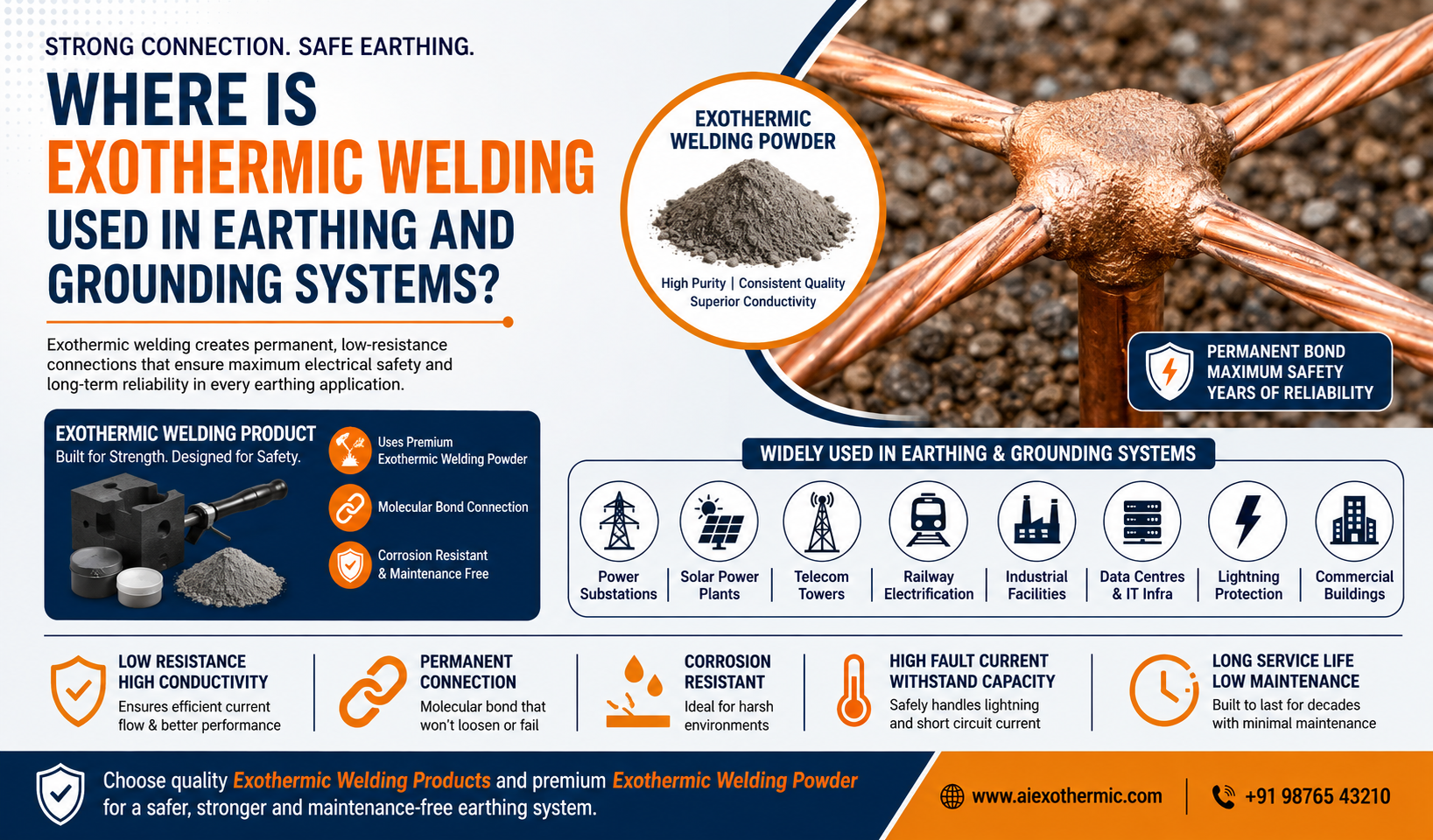
Where Is Exothermic Welding Used in Earthing and Grounding Systems?
Exothermic welding is widely used wherever electrical grounding requires a permanent and highly conductive connection. In India, it is commonly installed in power substations, solar power plants, telecom towers, railway electrification projects, industrial manufacturing facilities, data centres, oil and gas installations, commercial buildings, hospitals, airports, and lightning protection networks. The process joins copper-to-copper, copper-to-steel, and copper-to-galvanized steel conductors without bolts or mechanical clamps, ensuring reliable performance even in harsh environmental conditions.
Introduction
A dependable earthing system is one of the most important safety components in any electrical installation. Whether it is a residential building, a 400 kV transmission substation, a solar photovoltaic project, or a telecom tower, the grounding network must safely dissipate fault current into the earth while maintaining minimal electrical resistance. The quality of every grounding connection directly affects the performance of the entire system.
Traditional mechanical connectors can loosen because of vibration, corrosion, temperature changes, and moisture. This is why engineers increasingly prefer Exothermic Welding Product solutions for permanent grounding installations. By using specially formulated exothermic welding powder, the welding process creates a molecular bond rather than a simple mechanical connection. The resulting joint becomes electrically superior, corrosion resistant, and capable of carrying repeated fault currents throughout the service life of the installation.
Across India, industries follow earthing practices based on standards such as IS 3043 and international grounding guidelines. Exothermic welding has become a trusted method because it delivers long-term reliability with minimal maintenance, making it suitable for critical infrastructure where safety cannot be compromised.
Understanding Exothermic Welding in Grounding Systems
Exothermic welding is a chemical welding process that joins metallic conductors through an extremely high-temperature reaction. The reaction occurs when exothermic welding powder is ignited inside a graphite mould. The molten copper produced by the reaction flows around the conductors and solidifies into a single continuous metal connection.
Unlike soldering or brazing, exothermic welding does not rely on filler metals with lower conductivity. Instead, the connection becomes nearly identical to the parent conductor in electrical characteristics. This molecular bond provides exceptional current-carrying capacity, making it ideal for earthing systems exposed to lightning strikes and electrical faults.
An Exothermic Welding Product typically includes the welding powder, graphite mould, handle clamp, ignition source, and cleaning accessories. Together, these components ensure consistent and repeatable weld quality across different conductor sizes and configurations.
Why Earthing Systems Require Permanent Connections
An earthing network is only as strong as its weakest joint. During a short circuit or lightning event, enormous current flows through grounding conductors within milliseconds. If a connection has high resistance, corrosion, or loose contact pressure, excessive heating may occur, leading to equipment damage or complete grounding failure.
Permanent welded connections eliminate these risks because there are no bolts to tighten and no contact surfaces that deteriorate over time. The welded joint remains mechanically strong even when buried underground, exposed to chemicals, or subjected to moisture for decades.
This reliability explains why exothermic welding has become a preferred solution for mission-critical electrical infrastructure across India.
Applications in Electrical Power Substations
Electrical substations represent one of the largest applications of Exothermic Welding Product technology. Every transformer, circuit breaker, switchgear panel, steel structure, and grounding grid must be interconnected with extremely low resistance.
In substations, exothermic welding powder is used to connect bare copper conductors forming the underground earth mat. It is also used for joining copper cables to earth electrodes, connecting steel structures to grounding grids, and bonding equipment foundations with the main earthing network.
Since substations experience very high fault currents, welded joints provide superior thermal stability compared to mechanical connectors. The absence of moving parts also reduces maintenance requirements throughout the operational life of the facility.
Solar Power Plants and Renewable Energy Projects
India's rapidly expanding solar industry has significantly increased the demand for permanent grounding systems. Utility-scale solar parks contain thousands of module mounting structures, inverter stations, transformers, and lightning protection devices that require interconnected grounding.
Exothermic welding ensures reliable bonding between copper grounding conductors and galvanized steel mounting structures. Because solar installations operate outdoors for more than 25 years, corrosion resistance becomes essential. Welded joints maintain consistent electrical performance despite rain, humidity, and seasonal temperature variations.
For renewable energy developers, selecting the correct Exothermic Welding Product contributes to improved system reliability and lower lifetime maintenance costs.
Telecom Towers and Communication Infrastructure
Telecommunication towers require robust grounding to protect sensitive electronic equipment from lightning and power surges. Even a brief voltage spike can damage communication hardware and interrupt network services.
Exothermic welding is commonly used to connect tower legs, copper down conductors, earth rods, and equipment grounding bars. The molecular bond minimizes impedance, allowing lightning energy to dissipate safely into the earth.
As India's telecom infrastructure continues expanding with 4G and 5G networks, dependable grounding remains a critical engineering requirement.
Railway Electrification Projects
Modern railway systems rely on extensive earthing networks for signalling equipment, overhead electrification, substations, and station infrastructure. Railway environments involve continuous vibration, weather exposure, and high electrical loads.
Mechanical connectors may loosen over time under these conditions. Exothermic welding provides a vibration-resistant connection that maintains electrical continuity throughout years of operation. This makes it particularly valuable in railway signalling and traction power grounding applications.
Industrial Manufacturing Facilities
Factories contain heavy machinery, motor control centres, generators, transformers, and automated production equipment that require comprehensive grounding. Fault currents generated by industrial equipment can be substantial, making permanent electrical connections essential for personnel safety and equipment protection.
Exothermic welding connects copper strips, grounding grids, equipment frames, and structural steel into a unified earthing network. Industries including steel, cement, pharmaceuticals, automotive manufacturing, and chemical processing widely use welded grounding connections because they withstand demanding operating environments.
Data Centres and IT Infrastructure
Data centres demand extremely stable electrical grounding to protect servers, networking equipment, and uninterrupted power systems. Even small grounding inconsistencies may contribute to electrical noise and equipment malfunction.
An Exothermic Welding Product helps establish low-impedance grounding between copper busbars, grounding electrodes, UPS systems, generator earthing, and lightning protection networks. Because data centres operate continuously, maintenance-free welded joints offer significant operational advantages.
Oil, Gas, and Petrochemical Installations
Hazardous industrial environments require grounding systems that remain reliable despite corrosive chemicals and extreme weather. Oil refineries, LNG terminals, gas processing plants, and petrochemical facilities often use buried copper grounding grids connected through exothermic welding.
The welded connection eliminates sparking risks associated with loose mechanical joints while providing excellent resistance against underground corrosion. This contributes to improved electrical safety in potentially explosive environments.
Commercial Buildings, Hospitals, and Airports
Large commercial infrastructure contains sophisticated electrical distribution systems, HVAC equipment, elevators, fire protection systems, and lightning protection installations. Hospitals additionally require highly dependable grounding for medical equipment, imaging systems, and emergency power supplies.
Airports rely on extensive grounding networks protecting navigation equipment, runway lighting, communication systems, and terminal electrical infrastructure. Exothermic welding delivers permanent electrical continuity across these complex installations while reducing long-term maintenance requirements.
Lightning Protection Systems
One of the most important applications of exothermic welding powder is lightning protection. During a lightning strike, currents exceeding hundreds of kiloamperes may travel through down conductors into the grounding system. Every connection must safely withstand this enormous electrical energy.
Exothermic welding permanently bonds copper tapes, grounding electrodes, earth pits, and lightning down conductors. The resulting connection exhibits excellent conductivity and mechanical strength, making it suitable for repeated lightning discharge events.
Buildings, industrial plants, telecom towers, wind turbines, and educational institutions frequently use exothermic welded grounding within their lightning protection systems.
Common Conductor Combinations
Grounding installations involve different conductor materials depending on project design and environmental conditions. Exothermic welding supports copper-to-copper joints for grounding cables, copper-to-earth rod connections for earthing electrodes, copper-to-galvanized steel bonding for structural applications, and copper-to-steel welds for reinforcement bars and equipment foundations.
Each connection type requires an appropriate graphite mould and the correct quantity of exothermic welding powder to ensure complete fusion and consistent weld quality.
Why Exothermic Welding Is Better Than Mechanical Clamps
The primary advantage of an Exothermic Welding Product is permanence. Mechanical clamps depend on contact pressure between metal surfaces, while welded joints create a continuous molecular connection. This difference significantly improves electrical conductivity and long-term reliability.
Welded connections resist corrosion because there are no exposed interfaces where oxidation can increase resistance. They also tolerate vibration, thermal expansion, underground moisture, and chemical exposure better than bolted connectors.
For critical grounding systems designed to operate for 30 to 50 years, exothermic welding often becomes the preferred engineering solution.
Selecting the Right Exothermic Welding Product
Choosing the correct product depends on conductor size, conductor material, joint configuration, and application environment. Engineers typically determine the appropriate graphite mould based on cable diameter, strip dimensions, or earth rod size. The quantity of exothermic welding powder must match the mould specification to achieve complete metal fusion without defects.
Quality-certified materials and accurate installation procedures are equally important. Clean conductor surfaces, dry graphite moulds, and proper ignition techniques contribute to strong and consistent welded joints.
For Indian infrastructure projects, selecting a reliable Exothermic Welding Product ensures compliance with engineering specifications while improving overall grounding performance.
Maintenance and Service Life
One of the strongest benefits of exothermic welding is its exceptionally long service life. Since the welded joint becomes part of the conductor itself, it requires virtually no routine tightening or adjustment. Underground installations remain protected from moisture penetration and corrosion far better than conventional connectors.
Although periodic earthing resistance testing remains necessary for the complete grounding system, the welded joints themselves generally require minimal maintenance throughout decades of operation.
Conclusion
Exothermic welding has become an essential technology for modern earthing and grounding systems across India. From electrical substations and solar power plants to telecom towers, railways, industrial factories, hospitals, airports, and lightning protection systems, permanent welded connections provide the reliability required for critical electrical safety.
By using high-quality exothermic welding powder within a certified Exothermic Welding Product system, engineers create molecular bonds that deliver excellent conductivity, corrosion resistance, mechanical strength, and long operational life. As India's infrastructure continues expanding, exothermic welding will remain one of the most trusted methods for building durable and maintenance-free grounding networks.
Frequently Asked Questions (FAQs)
1. Where is exothermic welding mainly used?
Exothermic welding is mainly used in earthing and grounding systems for substations, solar plants, telecom towers, industrial facilities, railways, data centres, and lightning protection installations.
2. What is exothermic welding powder?
Exothermic welding powder is a specially formulated chemical mixture that generates molten copper through a controlled reaction, creating a permanent electrical connection between conductors.
3. Why is exothermic welding preferred for earthing?
It creates a molecular bond with very low electrical resistance, excellent corrosion resistance, and high fault current carrying capacity, making it more reliable than mechanical connectors.
4. Can exothermic welding join copper and steel?
Yes. An appropriate Exothermic Welding Product can join copper to steel, galvanized steel, earth rods, and reinforcing bars using dedicated graphite moulds.
5. Is exothermic welding suitable for underground installations?
Yes. It is especially suitable for buried grounding grids because the welded joint resists moisture, corrosion, and soil chemicals over long periods.
6. How long does an exothermic welded joint last?
A properly executed exothermic weld can last for several decades and is often designed to match or exceed the service life of the grounding conductor itself.
7. Is exothermic welding used in solar power projects?
Yes. Solar power plants use exothermic welding to bond module structures, grounding conductors, transformers, inverter stations, and lightning protection systems.
8. Does exothermic welding require electricity?
No. The welding process uses a chemical reaction initiated by an ignition source and does not require an external electrical power supply.
9. What materials can be welded using exothermic welding?
Common materials include copper cables, copper strips, copper earth rods, galvanized steel, structural steel, and grounding electrodes.
10. How do I choose the correct Exothermic Welding Product?
Selection depends on conductor type, cable size, joint configuration, graphite mould compatibility, and the specified quantity of exothermic welding powder required for the application.