
Introduction
The Toyota Camry has been one of the world's best-selling sedans for decades, and the four-cylinder engines powering it have earned a legendary reputation for engineering quality and longevity. When the time comes to source a Toyota Camry 4-cylinder engine for sale whether due to high mileage failure, thermal damage, or oil starvation understanding the specific technical characteristics of each engine generation is essential. This in-depth technical guide examines every major four-cylinder engine used in the Camry, covering specifications, known issues, sourcing considerations, and what to look for before you buy.
Engine Generations and Technical Specifications
1. 5S-FE — 2001 (2.2L DOHC 4-Cylinder)
Displacement: 2,164 cc
Power Output: 133 hp @ 5,400 RPM
Torque: 145 lb-ft @ 4,400 RPM
Compression Ratio: 9.5:1
Valvetrain: DOHC, 16-valve, non-interference
Fuel System: Sequential multi-port fuel injection
The 5S-FE is a robust, non-interference design, meaning that a timing belt failure does not result in valve-to-piston contact and catastrophic engine damage. This makes it significantly more forgiving of timing belt neglect than interference designs. Common issues include oil consumption from worn valve stem seals (particularly above 150,000 miles) and coolant leaks from the water pump and thermostat housing. When sourcing a used 5S-FE, check for valve seal smoke on cold start-up and verify the timing belt replacement history.
2. 2AZ-FE — 2002 to 2011 (2.4L DOHC 4-Cylinder)
Displacement: 2,362 cc
Power Output: 157–166 hp @ 5,700–6,000 RPM
Torque: 162 lb-ft @ 4,000 RPM
Compression Ratio: 9.8:1
Valvetrain: DOHC, 16-valve, VVT-i on intake camshaft
Fuel System: Sequential EFI with VVT-i
The 2AZ-FE is one of the most widely sold Toyota engines in history and is found not only in the Camry but also the RAV4, Solara, and Highlander. It introduced VVT-i variable valve timing to the Camry's four-cylinder lineup, producing meaningfully more power and efficiency than its predecessor. However, the 2AZ-FE has a well-documented problem with stripped head bolt threads in the engine block. This issue, known to occur in engines produced before 2007 in particular, can lead to head gasket failures and coolant intrusion. Toyota issued an extended warranty for affected vehicles and a repair kit is available. When sourcing a used 2AZ-FE, specifically ask whether the head bolt issue has been addressed.
⚠️ Important: Always check for white smoke from the exhaust and signs of coolant contamination in the oil (milky deposits on the dipstick) when inspecting a 2AZ-FE — these are direct indicators of the head gasket or head bolt issue.
3. 2AR-FE — 2012 to 2017 (2.5L DOHC 4-Cylinder)
Displacement: 2,494 cc
Power Output: 178 hp @ 6,000 RPM
Torque: 170 lb-ft @ 4,100 RPM
Compression Ratio: 10.4:1
Valvetrain: DOHC, 16-valve, Dual VVT-i
Fuel System: Port fuel injection with Dual VVT-i
The 2AR-FE represents a significant step forward in efficiency and refinement. Dual VVT-i — variable timing on both intake and exhaust camshafts — improves combustion efficiency across the entire RPM range, contributing to the Camry's best-in-class fuel economy figures at the time. The 2AR-FE is a highly reliable engine with no systemic design flaws comparable to the 2AZ-FE head bolt issue. Common wear items include the VVT-i gear actuators, which can produce a rattling noise at cold start if oil change intervals are not respected.
4. A25A-FKS — 2018 to Present (2.5L DOHC 4-Cylinder)
Displacement: 2,487 cc
Power Output: 203 hp @ 6,600 RPM
Torque: 184 lb-ft @ 5,000 RPM
Compression Ratio: 13.0:1 (Dynamic Force Engine)
Valvetrain: DOHC, 16-valve, Dual VVT-iW + VVT-iE
Fuel System: Combined port and direct injection
Toyota's Dynamic Force Engine represents a fundamental rethinking of four-cylinder engine design. At a 13.0:1 compression ratio — extremely high for a naturally aspirated engine — it achieves near-diesel levels of thermal efficiency. The combination of port and direct injection addresses the carbon deposit concerns common to direct-injection-only designs, while the dual VVT system with both mechanically and electrically driven variable timing provides unprecedented flexibility in valve control. On the used market, early examples are now becoming available as higher-mileage fleet and rental vehicles enter the secondary market.
What to Verify Before Purchasing Any Used Camry 4-Cylinder
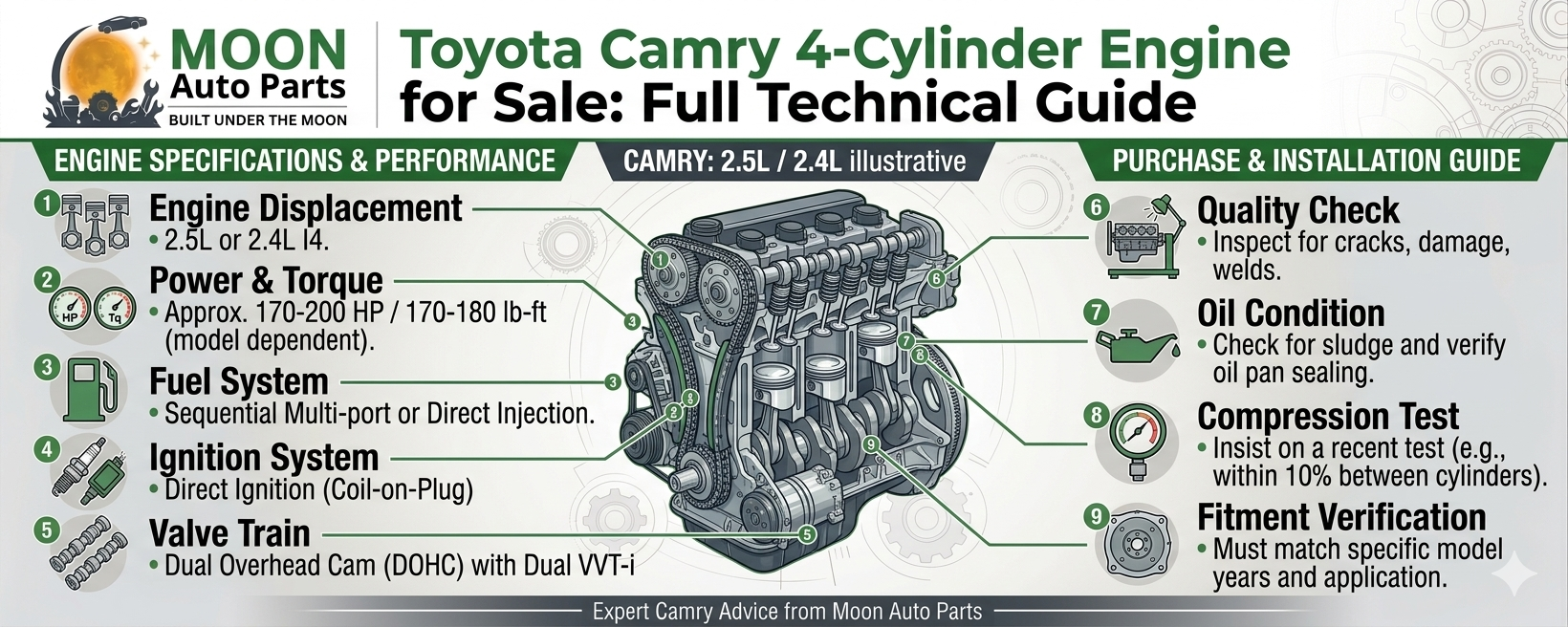
Regardless of which engine generation you are sourcing, the following technical verification steps should be completed before finalising any purchase:
1. Request or conduct a compression test. All cylinders should read above 150 PSI with less than 15% variation between cylinders.
2. Perform a cooling system pressure test to identify any external coolant leaks from hoses, the water pump, or the head gasket area.
3. Inspect the oil filler cap interior for a creamy or foamy residue, which indicates coolant contamination of the oil — a head gasket indicator.
4. Check the exhaust under cold-start conditions for blue smoke (oil consumption) or white smoke (coolant combustion).
5. Verify the VIN-matched engine code to confirm the unit is the correct variant for your specific Camry model year, market, and transmission type.
6. Confirm whether the timing belt (5S-FE) or timing chain (2AZ-FE, 2AR-FE, A25A-FKS) has been inspected or replaced, and ask about service history.
Pricing by Engine Generation
5S-FE (2.2L, 2001): $350 to $750. Widely available, simple design, low labour complexity.
2AZ-FE (2.4L, 2002–2011): $600 to $1,400. Higher demand due to wide application. Price reflects head bolt repair status.
2AR-FE (2.5L, 2012–2017): $900 to $1,800. Strong reliability reputation commands a modest premium.
A25A-FKS (2.5L, 2018–Present): $1,500 to $3,200. Limited used availability, high performance specifications.
Conclusion
Sourcing a Toyota Camry 4-cylinder engine for sale is a decision that rewards technical knowledge. Understanding the specific characteristics, strengths, and known issues of each engine generation — from the simple and forgiving 5S-FE to the sophisticated Dynamic Force A25A-FKS — allows you to evaluate any used unit with real confidence. Match the engine generation to your budget, verify its condition with the technical checks outlined above, and your Camry will return to the road running with the precision and reliability that has defined this nameplate for four decades.
Read more - Used Toyota Engines: New vs Used Which Is Worth Buying?