
The Transformative Potential of Artificial Intelligence in Structural BIM
As per Markets & Markets, the global Artificial Intelligence Market size is anticipated to grow at a CAGR of 36.2% during 2022-2027, reaching at $407.0 billion by the end of 2027. There's no denying that artificial intelligence (AI) is on the rise in every industry, and the world of structural building information modeling (BIM) is no exception. From improving design efficiency to detecting potential flaws before construction begins, AI has the potential to revolutionize the way we approach building projects. But let's not forget that BIM already takes a considerable amount of data to make decisions. So why not delegate some of that decision-making power to automated techniques? With AI taking on more complex tasks such as predicting construction timelines or assessing material compatibility, we can free up human experts to focus on creative solutions and decision making. The role of AI in structural BIM engineering may be new, but it's already showing great promise. We can't wait to see what other breakthroughs lay ahead! Before that, let’s take a quick look at the overview of structural BIM and significance of AI.
Overview of Structural BIM:
Structural BIM is an essential tool for the design and analysis of building structures. Building Information Modeling enables architects, engineers and construction professionals to create intelligent 3D models of buildings that include detailed information about structure. This provides a more collaborative approach to building design, with stakeholders sharing data in real-time and making necessary adjustments efficiently.
How Artificial Intelligence can be integrated with structural BIM?
The integration of artificial intelligence in structural BIM services has further enhanced its capabilities by automating repetitive tasks such as clash detection and quantity takeoff. This accelerates the design process and improves accuracy, thereby reducing errors on-site during construction. Therefore, utilizing AI-powered structural BIM can significantly improve efficiencies in the project delivery process allowing teams to optimize resources and achieve better outcomes for clients.
Objectives of the Study:
The objective of exploring the role of artificial intelligence in structural BIM services is to determine how AI can be utilized to enhance the accuracy and effectiveness of Building Information Modeling in structural engineering design.
- Complex design management:
The study examines the various ways in which AI algorithms and techniques can be integrated into BIM workflows to better manage complex design and construction processes.
- Identifying potential benefits:
It also seeks to identify potential benefits of integrating AI with structural BIM services including improved decision-making, reduced errors, cost savings, and increased productivity.
- Insight into challenges:
Further, it aims at providing insights into the challenges associated with implementing AI in structural BIM modeling such as data integration issues and the need for skilled professionals with technical expertise.
- Sustainable building design:
The study intends to contribute further on how AI-driven technologies can transform traditional industry practices by unlocking new possibilities for efficient and sustainable building design.
How Artificial Intelligence can be integrated with structural BIM?
Integrating AI with structural Building Information Modeling can greatly benefit the construction industry by saving time, enhancing accuracy, and improving collaboration among project teams.
- Time-saving:
AI algorithms can analyze large volumes of data, detect patterns and anomalies, and provide insights that can optimize workflow efficiency. Structural BIM allows for a 3D model of the building to be created, which is helpful for architects, engineers, and contractors to visualize the project before it is constructed. When combined with AI, machine learning models can identify potential errors, clashes or design flaws before construction, thus saving significant amounts of time by avoiding rework or delays during the construction phase. Additionally, AI-powered robots could automate certain tasks like bricklaying or welding based on input from BIM models. The use of AI in conjunction with structural BIM provides exciting possibilities to streamline construction processes and boost productivity within the industry.
- Enhanced Accuracy:
AI integrated with structural BIM speeds up the process and improves the accuracy of design predictions by eliminating human-error. BIM systems are already have detailed 3D schematics to visualize projects before building begins. However, AI integration can add impressive new layers of insight into these models. By applying machine learning algorithms to BIM data, engineers can optimize structural designs based on real-world performance data gathered from similar buildings or simulations. This enhances the accuracy of the final design and speeds up the process. This is because AI-enabled tools automatically identify potential issues that would otherwise require expert human input.
- Improved Collaboration:
AI algorithms can swiftly analyze vast amounts of data collected through BIM systems, enhance decision-making capabilities, and identify possible problems or errors early on in the process, saving time and costs. For instance, AI can be used to study the relationship between various components of a structure more accurately. It also allows designers to consider sustainability factors like energy efficiency and carbon footprint during early-stage designs when standard changes have significant cost-implications. Moreover, an AI-enabled BIM system can provide meaningful insights into site conditions and structural performance. It can predict how materials will behave under specific environmental stimuli leading to efficient material-management systems. By leveraging these technologies together, stakeholders achieve better communication through the provision of concise real-time updates that enable informed decision-making.
- Optimized Performance:
There could be automated design optimization, including load calculations and distribution, material selection, and structural analysis. This integration also assists in generating precise construction schedules through real-time site conditions such as weather forecast and site availability of materials using predictive analytics. By analyzing data, AI technology promotes efficient decision-making for architects, engineers, contractors or project managers. Ultimately this reduces potential errors during construction, resulting in faster delivery and high-quality projects at a lower cost.
Integration of Artificial Intelligence in BIM:
- Applications of AI in Structural BIM:
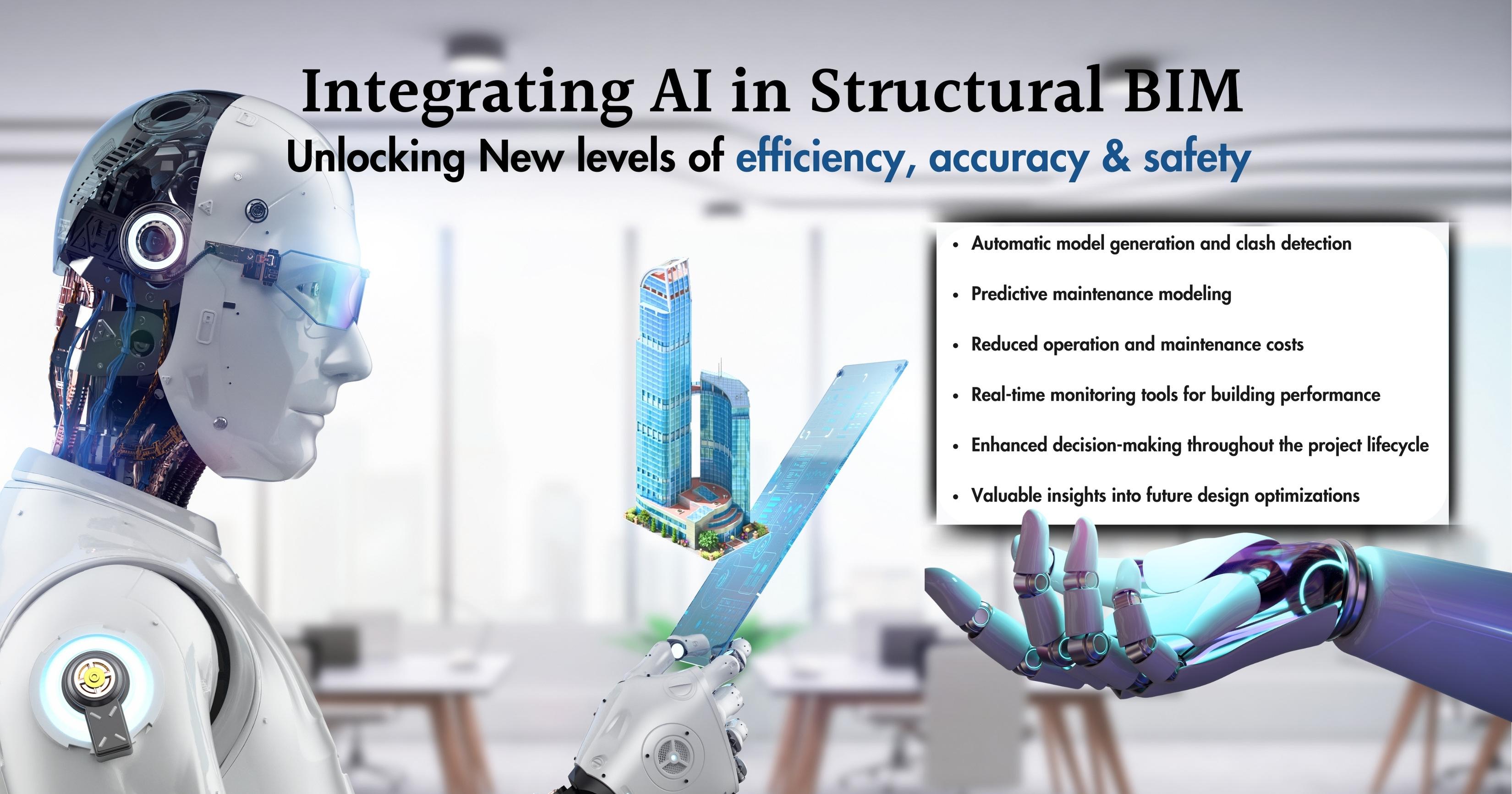
The integration of artificial intelligence in structural Building Information Modeling is unlocking new levels of efficiency, accuracy, and safety in construction projects. AI applications are being employed for tasks such as automatic model generation and clash detection to enhance the design phase, predictive maintenance modeling, reduce operation and maintenance costs, and real-time monitoring tools for building performance optimization. Advanced AI-powered simulations can assist stakeholders in enhancing decision-making capabilities throughout the project lifecycle. By training AI algorithms on vast datasets of past construction projects, smart BIM systems anticipate potential pitfalls before they occur while providing valuable insights into future design optimizations.
- AI-based Clash Detection and Coordination – plug-ins and add-ons in Navisworks:
With the rising adoption of BIM in construction projects, AI-based clash detection and coordination have gained significant importance. Navisworks plug-ins and add-ons provide an intelligent solution to address this challenge. It works by selecting building components from different disciplines, comparing their location and spatial relationships for clashes, and generating a report with suggestions for resolution. AI-based algorithms identify complex clashes that may not be visible through traditional methods. Moreover, certain Navisworks plug-ins offer multidisciplinary coordination to minimize interference amongst MEP systems or between structural elements and architectural features. This feature transforms BIM models into actionable intelligence that can enhance collaboration amongst teams. It enables them to identify issues before they occur during construction, increase quality assurance, reduce rework costs, save time and ensure safe working conditions on site.
- AI-powered Generative Design in BIM – Dynamo scripting and using Chatgpt for code generation:
Using dynamo scripting and Chatgpt, designers automate the generation of complex shapes and structures based on a set of predefined parameters. This technology uses machine learning algorithms to analyze vast amounts of data and generate innovative designs within just a few hours, ensuring precision. BIM models with AI-generated designs can be optimized for manufacturing, assembly, and construction by eliminating errors and minimizing waste materials. It also offers flexibility in modeling with real-time 3D visualization for better decision-making ability. This tool holds great potential in creating sustainable designs that are both functional and aesthetically pleasing. It reduces time costs for contractors as they can work with more accurate data sets from insightful generative designs created by AI-powered processes like dynamo scripting or Chatgpt code generation.
- Cloud-based AI tools for AEC - Verse, etc:
Cloud-based AI tools have revolutionized the way AEC industries operate. Verse is one such tool that utilizes artificial intelligence to provide sophisticated design algorithms, enable faster decision-making, and generate valuable insights during construction projects. With its intuitive interface and access to vast amounts of data through cloud integration, architects and engineers can undertake complex design tasks with ease. Similarly, Autodesk's cloud-based BIM 360 platform enables teams to collaborate from anywhere in real-time while monitoring project progress continually. These tools leverage machine learning algorithms and predictive analytics, cutting down on time wastage which enables them to complete projects more efficiently. The resulting impact is on productivity levels in the AEC industry as these firms can tackle challenges like workload planning with greater accuracy, ultimately driving down costs while delivering better results.
Final Thought: Whether to adopt or recoil from it?
As the construction industry increasingly embraces BIM for its collaborative and data-centric approach, it is natural to explore how Artificial Intelligence can further augment this process. Major advantage of AI in Structural BIM modeling is to analyze large amounts of data quickly and efficiently, enabling stakeholders to make informed decisions faster. AI technologies like machine learning can learn from real-world scenarios and improve over time, streamlining processes such as design optimization or risk analysis. However, there are concerns about AI replacing human expertise in some areas of BIM, particularly in creative and problem-solving aspects. Additionally, the cost of implementing AI systems may be a deterrent for smaller firms or projects. So, while the benefits of incorporating AI into Structural BIM services are significant, careful consideration should be given to how it complements human skills while avoiding displacement and ensuring economic viability.