
Children who are deaf or hard of hearing and lack proficiency in sign language may encounter various challenges upon entering school. Therefore, numerous parents are currently advocating for increased American Sign Language (ASL) education within schools across the United States. Studies have demonstrated that children who learn sign language at an early age perform better in various areas, including academic achievement and social interaction, as compared to those who do not possess sign language skills.
Children clinically diagnosed as deaf or hard-of-hearing are often equipped with hearing aids, cochlear implants, or both. Hearing aids aim to enhance residual hearing by amplifying sounds, while cochlear implants bypass the ear entirely and transmit electronic signals directly to the brain.
An article featured in the Social Service Review titled “Avoiding Linguistic Neglect of Deaf Children”. The authors of the article, who are predominantly deaf or hard-of-hearing individuals themselves, assert that the exclusive reliance on oral communication, facilitated through electronic devices, adversely impacts a significant number of deaf children. This prevents them from mastering the language during their formative years, which is a crucial time for learning. This, consequently, results in insufficient brain development and and will result in lasting harm to their mental and social functioning. The optimal approach would be for parents to commence teaching sign language to their deaf children at the earliest possible stage.
Challenges to Expanding Entry to ASL Education
A lot of parents of Deaf/HoH kids discover that their communities do not have the resources necessary to carry out ASL instruction. When these parents seek guidance from educators on how to assist their Deaf or Hard-of-hearing child, they become exasperated. Parents with Deaf or Hard-of-Hearing children should be allowed to engage in conversations about communication, access, language learning, and their options
In most cases, school districts in the area do not provide any assistance to students who are Deaf/Hard of Hearing. Thus, the options for these children as well as their capability to access language learning immediately need expansion.
Social workers can take the following measures to tackle the problem of insufficient ASL education in their communities:
- make a concerted effort to educate themselves about the issue
- encourage the public to become educated about American Sign Language (ASL), and
- promote and uphold rigorous standards for the acquisition of ASL among children who are Deaf/Hard of Hearing.
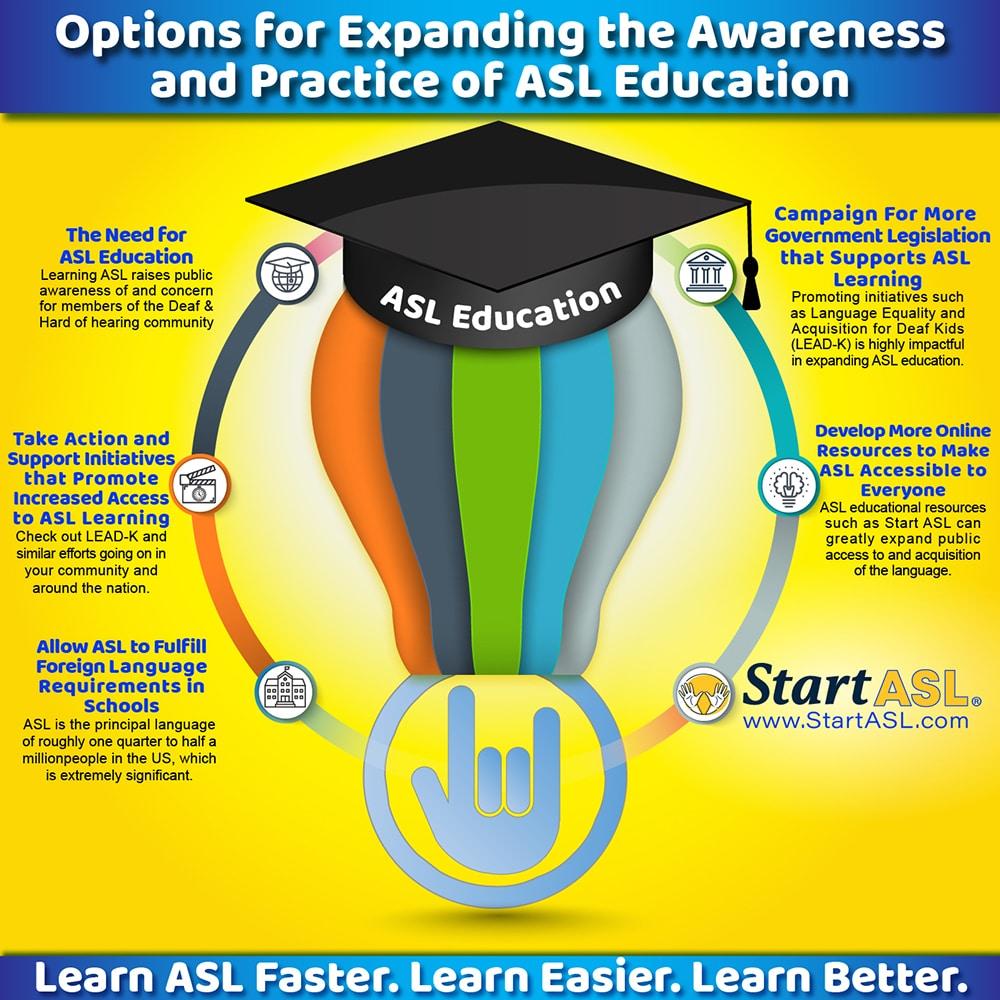
Other Options for Expanding the Awareness and Application of ASL Education
Below are extra approaches to expanding ASL learning via the government, communications media, and educational systems.
Enable ASL to meet foreign language requirements in schools
Supplying ASL to fulfill a foreign language requirement is a practical alternative for a lot of students. That is because ASL is the main language of approximately one-quarter to half a million people in the United States. Providing ASL as a foreign language option can also result in better child care for Deaf and Hard-of-hearing kids. It can tremendously facilitate communications amongst the D/HoH and hearing communities when ASL is known and used by many individuals.
Develop more online learning resources to make ASL available to everyone
At the start of 2023, as many as 5.16 billion individuals around the world were using the internet. This number comes to 64.4% within the worldwide population. Thus, increasing the number and accessibility to online ASL educational resources which include Start ASL can tremendously expand public entry to and acquisition of the language.
Campaign to get more government legal guidelines that facilitates ASL learning
Advertising projects such as Language Equality and Acquisition for Deaf Kids (LEAD-K) are remarkably impactful in broadening ASL education. LEAD-K is a nationwide legislative campaign. It calls for states to put ASL learning to be equal with English learning so that D/HoH kids have a strong language foundation when they start school. What's more, it calls for states to make sure that D/HoH children are at age-appropriate learning levels once they reach kindergarten.
The particular methods described above could go a long way toward delivering more significant access to ASL education. If you would like to take some action and support initiatives promoting increased entry to ASL learning, check out LEAD-K as well as other similar efforts in your community and around the nation. You can also get started in learning ASL online to become part of the growing American Sign Language family.