
A Divine Mystery That Begins with Five Personalities
Imagine walking into a Gaudiya Vaishnava temple for the first time. You expect to see the familiar forms of Sri Sri Radha and Krishna. Instead, your attention is drawn to five radiant personalities standing together with graceful, uplifted arms, as though inviting everyone into an embrace. Their appearance is joyful, welcoming, and unlike any other form of the Lord commonly worshipped in Hindu temples.
Many devotees first encounter these sacred deities while exploring www.mayapur.store, where devotional books, deity worship items, and spiritual resources introduce the rich heritage of Gaudiya Vaishnavism. Yet understanding who the Panca Tattva are requires looking beyond
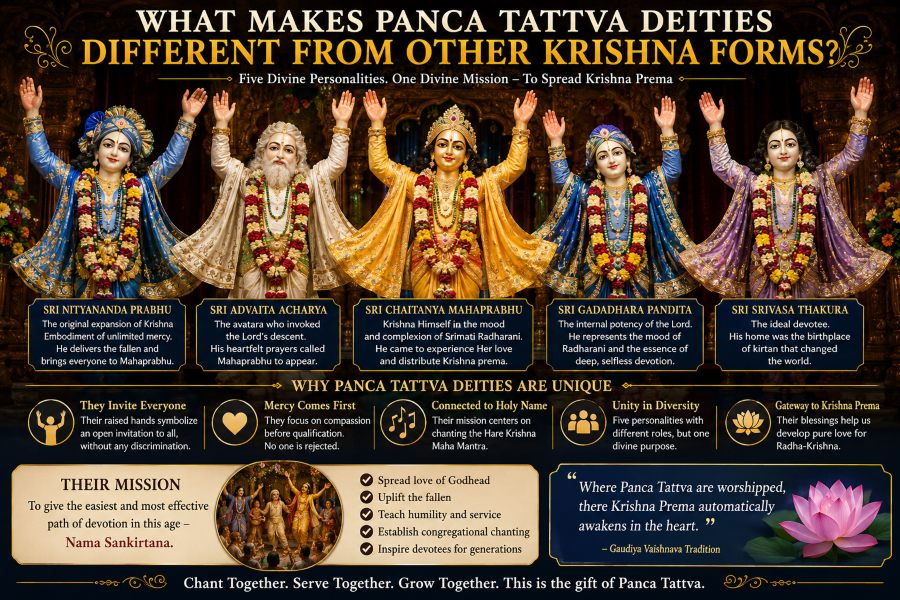
their beautiful forms. Their presence represents one of the most profound theological revelations in the Bhakti tradition.
Unlike other manifestations of Krishna that emphasize divine majesty, heroic pastimes, or intimate exchanges with devotees, the Panca Tattva reveal something extraordinary. They show the Supreme Lord choosing to experience the heart of His own devotee while inviting every soul—regardless of background, learning, or past mistakes—to participate in pure devotional service.
Their appearance marked the beginning of a spiritual movement built not upon social status or ritual complexity, but upon humility, compassion, and the congregational chanting of the holy names of the Lord.
Understanding the Panca Tattva is not simply about recognizing five sacred personalities.
It is about discovering why divine love became freely available to the entire world.
Who Are the Panca Tattva?
The Sanskrit phrase "Panca Tattva" literally means "Five Divine Truths" or "Five Absolute Realities."
Rather than representing five separate gods, the Panca Tattva reveal five distinct aspects of the same Absolute Truth working together to spread Krishna-prema, pure love for Krishna.
Each personality performs a unique role while remaining completely united in purpose.
Sri Chaitanya Mahaprabhu — Krishna in the Mood of His Greatest Devotee
At the center of the Panca Tattva stands Sri Chaitanya Mahaprabhu.
Gaudiya Vaishnava theology explains that He is Sri Krishna Himself, yet He appears in a unique way unlike any previous incarnation.
Instead of displaying royal authority or supernatural power, He accepts the mood and devotion of Srimati Radharani.
This appearance answers a deeply spiritual question.
What does Krishna experience when He becomes the object of pure love?
By appearing as Sri Chaitanya, Krishna tastes the love that His greatest devotee feels for Him while simultaneously teaching humanity how to cultivate that same devotion.
This makes His incarnation unique among all manifestations of the Lord.
Sri Nityananda Prabhu — Unlimited Compassion in Human Form
Standing beside Mahaprabhu is Sri Nityananda Prabhu.
He is understood to be the original expansion of Krishna known as Balarama.
If Mahaprabhu embodies divine love, Nityananda embodies limitless mercy.
His life demonstrates extraordinary compassion.
He approached those whom society rejected.
He forgave people others considered beyond redemption.
He welcomed individuals who believed they were too fallen to approach God.
His message remains simple.
No one is disqualified from receiving Krishna's mercy.
This welcoming spirit explains why devotees often pray first to Lord Nityananda before seeking deeper spiritual realization.
Sri Advaita Acharya — The Devotee Who Called the Lord to Earth
Sri Advaita Acharya occupies another remarkable place within the Panca Tattva.
Before Mahaprabhu's appearance, Advaita Acharya witnessed widespread spiritual decline.
Rather than accepting the situation with despair, he offered heartfelt prayers to Krishna.
He worshipped with sacred Ganges water and tulasi leaves, pleading for the Lord to descend and restore devotion.
Gaudiya scriptures describe these prayers as one of the principal reasons for Mahaprabhu's appearance.
His life teaches an inspiring lesson.
One sincere devotee, praying with complete faith, can influence the spiritual destiny of countless people.
Sri Gadadhara Pandita — The Quiet Depth of Divine Love
Among the five personalities, Gadadhara Pandita often appears the most gentle and reserved.
Gaudiya teachers explain that He represents the internal pleasure potency of Krishna and is closely identified with Srimati Radharani.
While others preached energetically across towns and villages, Gadadhara revealed another side of devotion.
Steady affection.
Deep scriptural wisdom.
Peaceful surrender.
His example reminds devotees that spiritual greatness is not measured only by visible achievements.
Sometimes the deepest devotion grows silently within the heart.
Sri Srivasa Thakura — The Perfect Devotee
The fifth member of the Panca Tattva is Sri Srivasa Thakura.
Unlike the others, he represents the ideal devotee rather than an expansion of the Lord Himself.
His home became the birthplace of the famous nocturnal kirtans led by Mahaprabhu.
Those gatherings transformed the spiritual atmosphere of Navadvipa.
Srivasa demonstrates unwavering faith.
Even during severe personal hardship, his devotion remained fixed.
His life teaches that genuine bhakti does not depend upon favorable circumstances.
It depends upon unwavering trust in Krishna.
Why Did Krishna Appear as Sri Chaitanya Mahaprabhu?
One of the deepest questions in Gaudiya philosophy is remarkably personal.
Why would the Supreme Lord appear not to receive worship, but to become a devotee Himself?
The answer reveals the unique heart of Chaitanya Mahaprabhu's mission.
Three Inner Desires
Gaudiya Vaishnava acharyas explain that Krishna desired to understand three profound mysteries.
What is the nature of Radharani's love?
Krishna is the object of Her devotion.
Yet only She fully experiences the depth of that love.
Krishna wished to understand it from Her perspective.
What qualities does Radharani perceive in Krishna that fill Her heart with unlimited joy?
Although Krishna is all-attractive, He desired to experience His own sweetness through the eyes of His greatest devotee.
What happiness does Radharani experience while loving Krishna?
This bliss could not be understood merely by observation.
It had to be experienced directly.
Sri Chaitanya Mahaprabhu fulfills these desires by appearing in the mood and golden complexion of Srimati Radharani.
No previous incarnation reveals this intimate purpose.
The Hidden Meaning Behind the Five Truths
The Panca Tattva are often described individually.
Yet their greatest significance appears when they are understood together.
Imagine an orchestra.
Each musician performs a different part.
One plays melody.
Another provides rhythm.
Others create harmony.
Separately, each contribution is meaningful.
Together, they produce something extraordinary.
The Panca Tattva work in a similar way.
Each personality reveals one aspect of divine reality.
Together they demonstrate how Krishna distributes divine love throughout the world.
Five Expressions of One Supreme Truth
Each member reflects a unique relationship with the Absolute:
- Sri Chaitanya Mahaprabhu reveals the Supreme Lord acting as His own devotee.
- Sri Nityananda Prabhu expresses boundless mercy.
- Sri Advaita Acharya represents the Lord responding to sincere devotion.
- Sri Gadadhara Pandita embodies pure devotional love and internal spiritual energy.
- Sri Srivasa Thakura represents the perfect devotee who inspires others through unwavering faith.
These are not competing identities.
They are complementary expressions of one divine purpose.
Unity Without Losing Individual Beauty
One remarkable feature of the Panca Tattva is that each personality retains a distinct identity while remaining perfectly united.
This balance teaches an important lesson for spiritual communities.
Real unity does not require everyone to become identical.
Instead, individual qualities become harmonious when centered on serving Krishna.
That principle continues to inspire Gaudiya Vaishnava communities around the world, where different talents, personalities, and services come together in the shared mission of spreading devotion through humility, compassion, and the chanting of the holy names.
Why Panca Tattva Worship Feels Different
Many people notice something unique the moment they stand before the Panca Tattva deities.
The atmosphere feels joyful rather than formal.
Instead of majestic expressions that inspire respectful distance, the Panca Tattva radiate warmth, invitation, and compassion. Their raised arms seem to welcome every visitor, whether they are lifelong devotees or someone entering a temple for the very first time.
This welcoming mood is one of the defining characteristics of their worship.
Rather than asking, "Are you qualified to approach the Lord?" the Panca Tattva seem to ask, "Why not begin today?"
That simple difference has changed countless lives.
Mercy Before Qualification
Many spiritual traditions place strong emphasis on personal qualification.
People often wonder:
- Have I studied enough?
- Am I pure enough?
- Have I made too many mistakes?
- Does God even want me?
The appearance of Sri Chaitanya Mahaprabhu answered these fears with extraordinary compassion.
His movement was built on mercy first.
Transformation followed afterward.
Instead of waiting for people to become spiritually perfect, Mahaprabhu encouraged everyone to begin chanting the holy names immediately.
The chanting itself would gradually purify the heart.
This approach removed barriers that had discouraged many sincere seekers.
Love Instead of Fear
Throughout history, religion has sometimes been approached primarily through fear of punishment.
The Panca Tattva present another vision.
Their mission centers on love.
A devotee does not serve Krishna simply to avoid suffering.
He serves because love naturally seeks to please the beloved.
This subtle change transforms spiritual practice.
Rules become opportunities rather than burdens.
Service becomes joyful instead of obligatory.
Devotion becomes a relationship rather than a duty.
The Raised Arms That Changed the World
One of the most recognizable features of Panca Tattva deities is their uplifted arms.
This posture is not merely artistic.
It carries deep theological meaning.
An Invitation to Chant
Gaudiya teachers explain that Mahaprabhu raised His arms while leading ecstatic kirtan.
His gesture called everyone to join the chanting of the Hare Krishna Mahamantra.
No invitation was restricted by birth, education, wealth, nationality, or previous religious identity.
The call was universal.
Anyone could participate.
That openness remains one of the defining features of the Gaudiya tradition.
Victory Through Compassion
Raised arms also symbolize triumph.
Yet this victory differs from military conquest.
Mahaprabhu conquered hearts.
He transformed lives through kindness, humility, and divine love.
Instead of defeating enemies, He transformed them into devotees.
History remembers many leaders who ruled through power.
Sri Chaitanya became beloved because He ruled through compassion.
Joy That Cannot Be Hidden
When people experience overwhelming happiness, they naturally lift their hands.
Children do it.
Devotees singing kirtan often do the same.
The posture reflects inner joy overflowing into outward expression.
The Panca Tattva remind devotees that bhakti is not dry philosophy.
It is living, joyful experience.
The Connection Between Panca Tattva and the Holy Name
It is almost impossible to discuss the Panca Tattva without speaking about the Hare Krishna Mahamantra.
The two are inseparable.
Mahaprabhu did not establish a complicated spiritual system accessible only to scholars.
Instead, He placed the holy name at the center of devotional life.
Why Devotees First Chant the Panca Tattva Mantra
Before chanting the Hare Krishna Mahamantra, Gaudiya Vaishnavas traditionally recite:
Sri Krishna Chaitanya
Prabhu Nityananda
Sri Advaita Gadadhara
Srivasadi Gaura Bhakta Vrinda
This prayer is not a ritual formality.
It expresses humility.
Devotees ask the mercy of the Panca Tattva before approaching Krishna directly.
Gaudiya acharyas explain that Mahaprabhu and His associates are exceptionally merciful.
They overlook countless shortcomings and help sincere souls develop genuine devotion.
For this reason, many devotees describe the Panca Tattva as the compassionate gateway to Krishna-bhakti.
The Holy Name Is the Center of Their Mission
Every activity of the Panca Tattva points toward one purpose:
Spreading the chanting of Krishna's holy names.
Temples.
Scriptures.
Festivals.
Kirtans.
Pilgrimages.
Preaching.
Everything ultimately encourages remembrance of Krishna through His names.
This focus explains why Gaudiya Vaishnava communities around the world place such strong emphasis on congregational chanting.
It reflects the original mission established by Sri Chaitanya Mahaprabhu.
Why Every Gaudiya Vaishnava Temple Honors the Panca Tattva
Visitors sometimes notice that many Gaudiya temples feature Panca Tattva deities alongside Radha-Krishna or Jagannatha, Baladeva, and Subhadra.
This arrangement is deeply meaningful.
The Panca Tattva represent the mood through which devotees approach Krishna.
Their mercy prepares the heart for deeper realization.
Rather than replacing Krishna worship, they make sincere Krishna worship accessible.
They Represent the Age of Mercy
Scriptures describe different spiritual practices for different ages.
Gaudiya philosophy teaches that the current age, Kali-yuga, is marked by distraction, conflict, and spiritual forgetfulness.
Recognizing these challenges, Mahaprabhu offered a process suitable for everyone.
Instead of demanding severe austerities, He emphasized:
- Chanting the holy names.
- Association with devotees.
- Hearing Krishna's pastimes.
- Honoring prasadam.
- Serving with humility.
These practices remain practical even in modern life.
Their Example Is as Important as Their Teachings
The Panca Tattva did not merely preach devotion.
They lived it.
Mahaprabhu demonstrated humility.
Nityananda demonstrated forgiveness.
Advaita demonstrated determined prayer.
Gadadhara demonstrated quiet surrender.
Srivasa demonstrated unwavering faith.
Together they show that philosophy becomes meaningful only when expressed through character.
This combination of teaching and personal example explains why their influence continues centuries after their earthly pastimes.
Common Misunderstandings About Panca Tattva Worship
As interest in Gaudiya Vaishnavism grows around the world, newcomers often develop understandable misconceptions.
Clarifying these ideas helps deepen appreciation for the Panca Tattva.
Misunderstanding 1: They Are Five Separate Gods
The Panca Tattva do not represent competing divine beings.
They reveal different manifestations and energies of one Absolute Truth working together in perfect harmony.
Their unity is one of the most beautiful features of Gaudiya theology.
Misunderstanding 2: Their Worship Is Only for Monks
Nothing could be further from reality.
Mahaprabhu's movement spread primarily through householders, families, teachers, artisans, merchants, and ordinary members of society.
Bhakti is meant for everyone.
Occupation does not determine spiritual eligibility.
Sincerity does.
Misunderstanding 3: Their Mission Ended Centuries Ago
Although the historical pastimes occurred in sixteenth-century Bengal, their mission continues wherever devotees chant the holy names, distribute spiritual knowledge, serve others, and inspire remembrance of Krishna.
In that sense, the movement of the Panca Tattva remains wonderfully alive today.
Misunderstanding 4: Only Scholars Can Understand Them
The theology surrounding the Panca Tattva is rich and profound, yet its practical message is beautifully simple:
Love Krishna.
Serve others.
Chant sincerely.
Live with humility.
Even a child can begin following these principles.
The deeper philosophical understanding naturally develops with continued study and sincere practice.
Lessons the Panca Tattva Offer Every Spiritual Seeker
The Panca Tattva are not remembered simply because of historical events that took place in sixteenth-century Bengal. Their lives continue to speak to modern people facing stress, isolation, competition, and uncertainty. Their message is surprisingly practical because it addresses the condition of the human heart rather than temporary social circumstances.
Whether someone is beginning a spiritual journey or has practiced devotion for decades, these five divine personalities offer lessons that remain relevant every single day.
Mercy Creates Lasting Transformation
People often believe that lasting change comes through criticism, fear, or punishment.
The Panca Tattva demonstrate another path.
Sri Nityananda Prabhu is perhaps the greatest example of this principle. He approached individuals whom society had already rejected and offered them hope instead of condemnation. His compassion transformed lives because it awakened faith rather than shame.
This teaches an important truth.
Real spiritual growth happens most naturally when people experience kindness that inspires them to become better.
Humility Is a Source of Strength
Modern culture frequently celebrates self-promotion.
Mahaprabhu taught the opposite mood.
He instructed devotees to become:
- Humble without feeling inferior.
- Respectful toward others.
- Free from unnecessary pride.
- Ready to glorify Krishna rather than themselves.
This humility is not weakness.
It allows the heart to remain peaceful even during praise or criticism.
A humble devotee does not waste energy protecting a false image. Instead, that energy is invested in serving the Lord and helping others.
Unity Without Losing Individual Identity
The Panca Tattva beautifully illustrate that diversity and unity can exist together.
Each personality serves differently.
Each expresses devotion uniquely.
Yet all remain perfectly united in purpose.
That lesson extends beyond theology.
Families, communities, and spiritual organizations flourish when individuals contribute their unique abilities while remaining focused on a shared goal.
Uniformity is not the objective.
Harmony is.
Devotion Thrives Through Relationships
Another remarkable feature of the Panca Tattva is that their pastimes are deeply relational.
They worship together.
They chant together.
They encourage one another.
They serve together.
Bhakti is certainly personal, but it is rarely isolated.
Association with sincere devotees strengthens faith, protects enthusiasm, and provides opportunities for service that would be difficult to cultivate alone.
This explains why congregational kirtan became one of the defining practices of Mahaprabhu's movement.
Why Their Message Continues to Inspire the World
Centuries have passed since Sri Chaitanya Mahaprabhu and His associates walked the streets of Navadvipa.
Yet their influence continues to grow across continents.
Temples dedicated to the Panca Tattva welcome visitors from every culture and language. Sacred literature has been translated into dozens of languages. The chanting of the Hare Krishna Mahamantra now echoes in cities that were once completely unfamiliar with Gaudiya Vaishnavism.
This worldwide expansion reflects the universal nature of their message.
Love for Krishna is not limited by nationality, education, wealth, or social background.
Every soul possesses the capacity to awaken devotion.
That simple truth continues to attract seekers throughout the world.
The Heart of Their Mission Has Never Changed
Technology has transformed communication.
Societies have changed dramatically.
Daily life looks very different from sixteenth-century Bengal.
Yet the essential needs of the human heart remain remarkably similar.
People still search for:
- Inner peace.
- Genuine happiness.
- Meaningful relationships.
- Freedom from anxiety.
- A lasting connection with God.
The Panca Tattva address these needs by pointing toward loving devotional service rather than temporary material success.
Their teachings encourage people to discover fulfillment through remembrance of Krishna, sincere chanting, compassionate service, and association with devotees.
That message remains timeless because it speaks directly to the eternal nature of the soul.
Final Thoughts
The Panca Tattva occupy a unique place within Gaudiya Vaishnava theology because they reveal not only who Krishna is but also how He chooses to share His love with the world. While many forms of the Lord display divine power, royal majesty, or intimate pastimes, the Panca Tattva emphasize mercy, accessibility, and the transformative power of devotional service.
Each of the five personalities contributes a distinct expression of the Absolute Truth. Sri Chaitanya Mahaprabhu embodies Krishna in the mood of His greatest devotee. Sri Nityananda Prabhu represents limitless compassion. Sri Advaita Acharya demonstrates the strength of heartfelt prayer. Sri Gadadhara Pandita reflects the quiet depth of divine love, while Sri Srivasa Thakura stands as the ideal devotee whose unwavering faith inspires generations.
Together, they reveal that spiritual life is not reserved for a privileged few. The doors of devotion remain open to anyone willing to approach with sincerity, humility, and a desire to remember Krishna through the chanting of His holy names.
That invitation, first extended in Navadvipa centuries ago, continues today.
Every temple where kirtan resounds.
Every home where devotees gather for prayer.
Every heart that sincerely calls upon Krishna.
There, the mercy of the Panca Tattva continues to shine.
Frequently Asked Questions
Who are the Panca Tattva?
The Panca Tattva consist of five divine personalities: Sri Chaitanya Mahaprabhu, Sri Nityananda Prabhu, Sri Advaita Acharya, Sri Gadadhara Pandita, and Sri Srivasa Thakura. Together, they reveal different aspects of the Absolute Truth working in harmony to spread Krishna-prema, or pure love for Krishna.
Why are the Panca Tattva different from Radha-Krishna?
Radha and Krishna reveal the eternal divine relationship between the Supreme Lord and His highest devotee.
The Panca Tattva reveal how that same divine love is distributed to the world through mercy, compassion, and the congregational chanting of the holy names.
Their missions complement one another rather than compete.
Why do the Panca Tattva deities raise their hands?
Their uplifted arms symbolize joyful kirtan, universal invitation, divine compassion, and the call for everyone to chant the holy names of Krishna.
It is one of the most recognizable characteristics of their deity forms.
Why is the Panca Tattva mantra chanted before the Hare Krishna Mahamantra?
Devotees first pray for the mercy of the Panca Tattva because they are known for their boundless compassion.
Their blessings help remove obstacles and prepare the heart for attentive chanting of Krishna's holy names.
Can someone new to Krishna consciousness worship the Panca Tattva?
Absolutely.
The Panca Tattva are especially known for welcoming sincere seekers regardless of their background, experience, or previous knowledge.
Their mission is built upon compassion rather than exclusivity.