
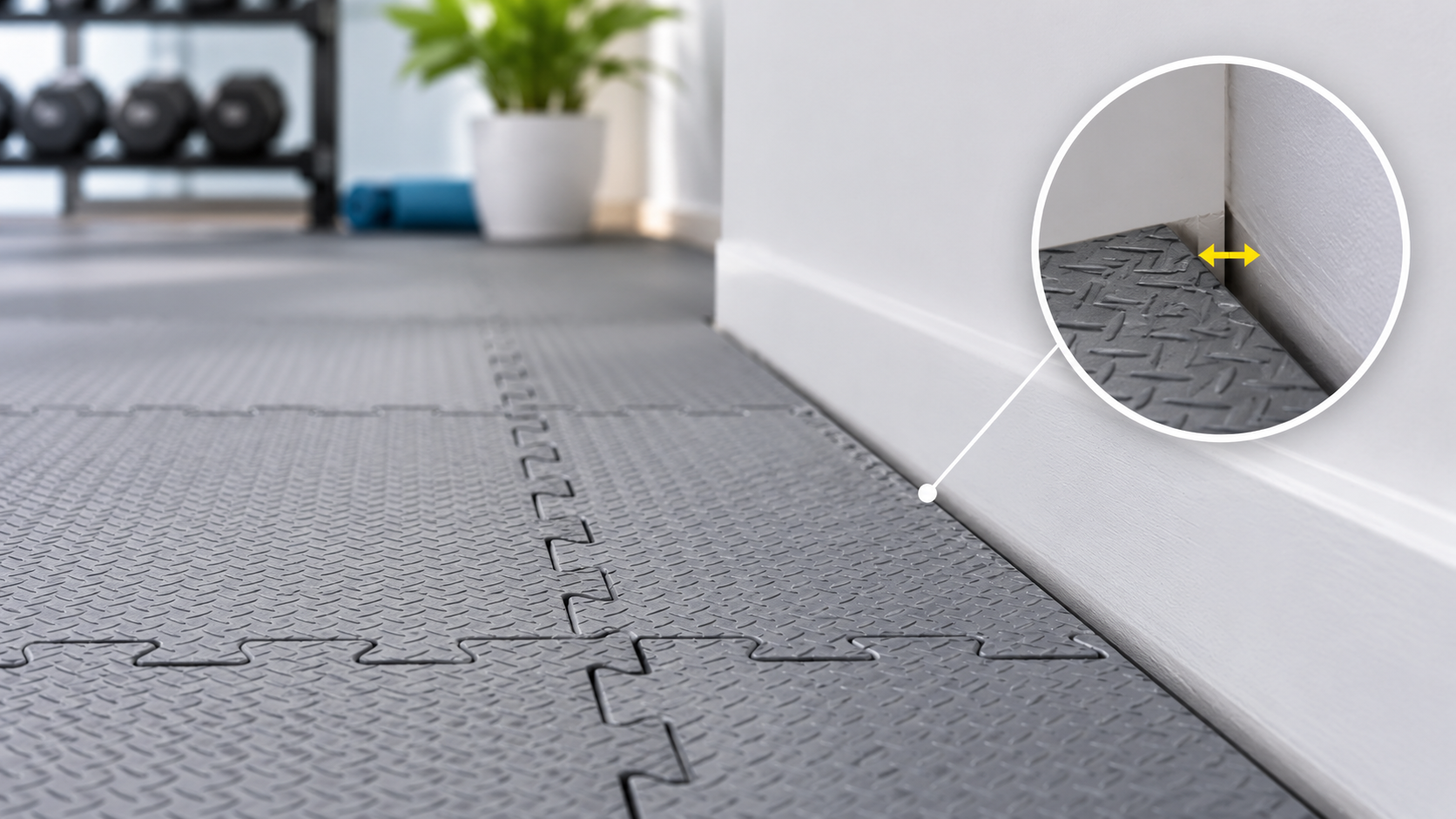
Have you noticed small gaps around your PVC interlocking mats and wondered why they were left during installation? These spaces are intentional and are not necessarily a sign of poor workmanship. In fact, they allow the material to accommodate temperature-related movement while helping protect the flooring and surrounding walls.
A small perimeter clearance gives the mats room to expand without creating unnecessary pressure across the installed surface. But why does this space matter, and what problems can arise when there is not enough room for movement? Keep reading to learn why they are essential to prevent costly mistakes.
The Importance of Expansion Gaps in PVC Interlocking Mats Installation
Temperature-Induced Thermal Expansion
PVC is sensitive to temperature fluctuations, which can cause the material to expand in warm conditions and contract as temperatures drop. This gradual movement might seem minor, but it can become significant over large floor plans or in spaces with shifting temperatures. Leaving the recommended clearance around the perimeter gives the material room to accommodate these natural changes without restricting its movement.
Prevents Buckling and Warping
One visible consequence of insufficient expansion space is an uneven floor surface. As the mats push against surrounding boundaries, pressure can build across the installed area, causing certain sections to lift, form waves or develop raised joints. These changes can affect how comfortably and safely people walk across the surface. Adequate clearance reduces the pressure that causes installation problems and tripping hazards that ruin both the utility and appearance of your space.
Protects Interlocking Mechanisms
The connecting edges hold individual PVC interlocking mats together and help maintain a stable flooring surface. However, when expansion is restricted, pressure can transfer to these joints, placing additional strain on the connecting pegs, loops or locking edges. Repeated stress may weaken these connections or cause sections to separate. Following the recommended spacing requirements helps protect the joining mechanism from unnecessary pressure. Check the locks periodically to identify early signs of separation or movement.
Avoids Wall Damage
When PVC mats are installed too close to walls, pillars, or fixed equipment, temperature-related expansion can leave insufficient room for movement. As the material expands, it may press against skirting boards, wall edges or nearby fixtures, potentially damaging surrounding finishes or forcing the outer sections to lift. Leaving sufficient gaps allows the mats to expand without putting unnecessary pressure on adjacent structures.
Preserves Manufacturer Warranties
Installation specifications are strict requirements, not suggestions. They can also form part of the manufacturer's warranty conditions. Most manufacturers mandate precise perimeter clearances to accommodate material movement. Ignoring these guidelines immediately voids your coverage for buckling or joint damage. Always review your product documentation before fitting the floor. Keep your purchase receipts safe, as you will need them to file a warranty claim later.
These are the reasons why gaps are crucial for the proper installation of the mat and floor stability. If you want PVC interlocking mats for your property, contact Custom Branded Mats. They offer a wide range of customized matting solutions across Mozambique, Lesotho, Swaziland, and South Africa. Visit custombrandedmats.co.za for more details.