
There are places in India that quietly rearrange your understanding of what a landscape can be.
Araku Valley is one of them. Tucked 115 kilometres from Visakhapatnam inside the Eastern Ghats of Andhra Pradesh, Araku exists at a different altitude — literally and metaphorically. At roughly 900–1100 metres above sea level, it wears a cool green haze that most coastal cities in this part of the country never experience. Waterfalls come down hard through dense forest.
Tribal communities have lived here for centuries, growing some of India's most celebrated coffee. Million-year-old limestone formations sit inside caves that feel like cathedrals carved by water. And yet, Araku Valley remains genuinely undiscovered by the mass-tourism machinery that has overrun places like Coorg, Ooty, or Munnar. That is both its greatest asset and the reason this guide exists — to help you understand exactly what awaits, plan every detail intelligently, and arrive not as a tourist, but as someone who knows how to receive what Araku actually offers.
This is the most comprehensive Araku Valley travel guide available online. Whether you are planning a quick one-day trip from Vizag, a romantic weekend escape with your partner, a family holiday, or a multi-day nature immersion, this guide covers everything: how to reach Araku Valley, the best time to visit, every major place worth seeing, itinerary options, accommodation choices across all budgets, food, culture, photography, and the tour packages that make the entire journey seamless.
Let us begin.
Introduction to Araku Valley — History, Geography and Why It Matters
Geography and the Eastern Ghats
Araku Valley sits inside the Visakhapatnam district of Andhra Pradesh, cradled within the Anakapalle range of the Eastern Ghats. Unlike the Western Ghats, which receive aggressive monsoon attention and have consequently become well-touristed, the Eastern Ghats are an older, more weathered mountain range — quieter, less dramatic in form, but extraordinarily rich in ecology and culture. The valley itself is a highland bowl formed by ancient geological uplift, drained by the Sarada River and its tributaries. The surrounding hills — Galikonda, Raktakonda, Chitramudi — form a natural amphitheatre that traps moisture, moderates temperature, and produces the microclimate that makes Araku's coffee so distinctive.
Elevation in the main Araku town area hovers between 900 and 1000 metres. The higher ridges and surrounding peaks climb past 1300 metres. This elevation differential creates varied microclimates within a single valley, which partly explains why Araku's biodiversity — flora, fauna, birds, butterflies — is so unexpectedly rich for an area of its size.
A Brief Historical Context
Araku Valley has been inhabited by indigenous tribal communities for thousands of years. The Kondh, Bagata, Gadaba, Valmiki, and Porja communities are the primary tribes of this region, and their presence predates recorded history. Their agricultural practices, forest knowledge, oral traditions, and craft forms are living archives of a civilisation that developed in productive isolation.
The British colonial administration's engagement with this region began in the 19th century, primarily through efforts to bring the hill tribes under administrative control and to exploit forest resources. The famous mountain railway that connects Vizag to Araku — the Kirandul Line — was originally commissioned to transport iron ore from the interior. It became, almost accidentally, one of the most scenic railway journeys in all of Asia.
Post-independence, Araku's tribal communities became subjects of various development programmes. Coffee cultivation, introduced and later transformed into a genuine cooperative success story through the Girijan Cooperative Corporation and the Araku Coffee brand, has lifted thousands of families economically while preserving ecological balance.
Today, the valley sits at a fascinating intersection: it is both a functioning tribal homeland and an emerging tourism destination, a functioning coffee economy and a nature sanctuary. Understanding this complexity will make your visit significantly more meaningful.
The Araku Coffee Story
No introduction to Araku Valley is complete without its coffee. Araku coffee is grown between 900 and 1100 metres above sea level, under a dense canopy of native forest trees, without chemical inputs. The beans are processed using natural fermentation methods, dried in the mountain air, and roasted to profiles that bring out the valley's characteristic terroir — fruit-forward, low acidity, with a clean, sweet finish.
The Araku Coffee brand, developed through the Girijan Cooperative and later championed by the ITC-supported Naandi Foundation, has won international acclaim. Araku coffee has been featured in specialty coffee circles in Paris, Tokyo, and New York. It is now considered one of India's finest single-origin coffees.
For the traveller, this means you have access to genuinely world-class coffee at the source. The Araku Coffee Museum and surrounding plantations offer guided tours that walk you through cultivation, processing, and cupping — an experience that serious coffee drinkers will rank among the most memorable of their lives.
Where Is Araku Valley Located?
Araku Valley is located in the Visakhapatnam district of Andhra Pradesh, approximately 115 km from Visakhapatnam (Vizag) city. For a detailed geographical orientation including district maps, terrain profiles, and neighbourhood localities within the valley, refer to this comprehensive location overview at ArakuTrip.in.
Quick coordinates: 18.3275° N, 82.8747° E
Administrative position: Araku Valley Mandal, Alluri Sitharama Raju District (formerly Visakhapatnam District), Andhra Pradesh.
The valley is bordered by:
- North: Odisha border, Koraput district
- South/West: Paderu region and the deeper Eastern Ghats
- East: The gradual descent toward Visakhapatnam through the rail corridor
This geographic positioning means Araku is a natural gateway between the Andhra coast and the tribal highlands that extend northward into Odisha — a transition zone of ecological and cultural significance.
How to Reach Araku Valley
Araku is more accessible than most people realise — and the journey itself, particularly by train, is one of the finest travel experiences in South India.For a fully detailed breakdown of all route options, road distances, timings, and cab fare estimates, visit ArakuTrip.in's complete guide to reaching Araku Valley.
By Train — The Vistadome Experience
The Kirandul Passenger train route from Visakhapatnam to Araku is widely regarded as one of the most scenic rail journeys in India, and arguably in Asia. The line climbs from near sea level at Vizag to over 1000 metres at Araku through a series of engineered marvels: 58 tunnels, 84 bridges, and curves so tight that you can see the engine from the last carriage. The track hugs valley edges, disappears into mountainsides, and emerges over gorges draped in mist. It is railway engineering as landscape art.
The IRCTC Vistadome train — operating on this route — takes the experience further with floor-to-ceiling glass windows and a transparent roof section that opens the sky above you. Watching the Eastern Ghats rise around you through those glass walls is not something any road journey can replicate.
For everything you need to know about booking, timing, coach classes, and photography tips for the glass train, read ArakuTrip.in's complete Vistadome guide.
Key train details:
- Origin: Visakhapatnam Railway Station
- Duration: Approximately 5–6 hours
- Distance: ~115 km
- Vistadome coach: Book via IRCTC website (fills up quickly; book weeks in advance)
- Best seats: Window-facing seats on the right side for ghat ascent views
By Car — The Scenic Road Route
Driving from Vizag to Araku is a solid three to four hour journey (115 km) that passes through tribal villages, coffee estates, and increasingly dense Eastern Ghats forest. The road quality is generally acceptable, though certain sections near Araku become narrow with hairpin bends. A dedicated guide to the Vizag to Araku road trip by car covers the best stops, road conditions, and what to expect at different seasons.
If you would rather travel without the stress of driving, ArakuTrip.in provides cab booking services with experienced local drivers who know the route in all weather conditions. For current fare structures and vehicle options, check the Vizag to Araku cab fare page.
By Flight
Visakhapatnam Airport (VTZ) is the nearest airport to Araku Valley, approximately 140 km from the valley. Vizag is well-connected to major Indian cities including Hyderabad, Chennai, Mumbai, Bengaluru, Delhi, and Kolkata via daily flights. From Vizag airport, you can hire a cab directly to Araku or take the Vistadome train from Visakhapatnam railway station (approximately 12 km from the airport).
By Bus
APSRTC operates regular bus services from Visakhapatnam to Araku Valley. Journey time is approximately 4–5 hours. While buses are the most economical option, they offer limited flexibility for stopping at viewpoints and do not match the scenic quality of the train.
From Hyderabad to Araku Valley
Hyderabad to Araku Valley is approximately 640 km by road (9–10 hours of drive time) or accessible via a Hyderabad–Vizag flight followed by the Vistadome train or cab. The complete Hyderabad to Araku Valley travel guide covers the most practical routing options for visitors travelling from Telangana, including combined Vizag–Araku packages that make the most of the longer travel investment.
Best Time to Visit Araku Valley
Araku Valley is one of those rare destinations that has a distinct character in every season — none of them bad, but each suited to a different traveller and a different purpose. For a month-by-month weather breakdown with temperature data, rainfall patterns, and activity suitability, visit the dedicated Best Time to Visit Araku Valley guide and the extended seasonal travel guide.
October to February — The Peak Season
This is when Araku Valley is at its most comfortable and most photographically arresting.
Post-monsoon, the entire valley has been washed clean. The coffee plantations are dense and dark green, the waterfalls are in their full flow, and the air carries a crispness that feels extraordinary compared to the humid coastal plains below.
From November onward, temperatures drop into the high teens at night (sometimes lower at elevation) and settle in the mid-20s during the day. December and January are the coldest months — morning fog fills the valley before the sun burns through, creating the kind of landscape photography conditions that professional travel photographers travel specifically for. For what to expect during the cooler months, see the Araku Valley weather in December guide.
Weekends and public holidays between October and January see Araku's highest visitor numbers. Book accommodation and tour packages well in advance for this window.
June to September — Monsoon Season
Monsoon Araku is for the specific kind of traveller who finds beauty in rain, who can sit in a misty forest and feel at home. Rainfall between June and September is substantial. The waterfalls — Katiki, Chaparai, Duduma — are at their absolute most powerful and impressive. Every hillside streams water. The tribal villages are surrounded by paddy cultivation. The entire landscape turns an almost implausible shade of green.
Road conditions can deteriorate in heavy rain, and certain trekking trails may be closed. But for those willing to accept these constraints, the monsoon waterfalls experience in Araku is unlike anything available in the dry season.
March to May — Summer Season
Contrary to what many travellers assume, Araku Valley summers are genuinely pleasant. While the coastal plains bake in 40°C+ heat, Araku's elevation keeps temperatures in a comfortable 25–32°C range through most of the day. Summer is also when the valley is least crowded — an advantage for travellers who prefer space and quiet. The coffee harvest has usually concluded, and the plantations enter a calmer phase. What Araku is like in summer surprises most visitors from Vizag and Hyderabad who expect mountain cold but find a temperate, agreeable climate instead. For current conditions whenever you plan your trip, the Araku Valley temperature today tracker provides real-time climate data.
Top Places to Visit in Araku Valley
Araku Valley rewards visitors who move through it slowly. The major attractions are well-distributed across the valley and its surroundings, and a well-planned route can cover multiple sites in a single day without feeling rushed.
1. Borra Caves
No visit to Araku Valley is complete without the Borra Caves, and calling them merely "impressive" understates what you actually encounter.
The Borra Caves are among the largest limestone cave systems in India, formed over approximately 150 million years through the dissolution of limestone by mildly acidic groundwater. The resulting formations — stalactites descending from the cave roof, stalagmites rising from the floor, and the bizarre junction structures called "columns" where the two meet — reach heights of 70 feet in the largest chambers.
The caves take their name from the Telugu word "borra," meaning hole — referring to the opening through which the Gosthani River disappears underground. There is a naturally occurring formation inside that tribal communities have venerated for centuries as a Shiva lingam, and a small shrine within the cave continues to draw pilgrims alongside tourists.
Guided lighting within the caves emphasises the drama of the formations. The temperature inside stays around 20°C year-round — a notable contrast to the heat outside in summer or the chill outside in winter.
For the complete visitor guide including timings, entry fees, photography tips, and what to avoid, see the Borra Caves complete guide.
Location: Borra Guhalu, Ananthagiri Mandal, ~90 km from Vizag, ~30 km from Araku town Timings: 10:00 AM – 5:30 PM Best for: Families, photography, geology enthusiasts
2. Katiki Waterfalls
Katiki Waterfalls sit deep inside forest reserve territory, which means accessing them requires either a short trek through dense canopy or a brief jeep ride from the forest edge — and the journey is very much part of the experience.
The falls drop approximately 50 feet into a natural pool, surrounded by rock and tree cover that blocks direct sunlight for much of the day. The pool at the base is clear enough to reveal the rocky bottom in the shallow edges. Swimming is a popular activity here, and the pool's depth varies seasonally.
Reaching Katiki requires some coordination — the forest entry is managed, and local jeep operators handle the transport inside. The complete Katiki Waterfalls guide covers the practical logistics including the nearest entry point, whether trekking is currently permitted, and seasonal access conditions.
Best time: July to February (post-monsoon for maximum flow)
3. Chaparai Waterfalls — The Picnic Falls
While Katiki is dramatic and somewhat remote, Chaparai Waterfalls sit closer to the main road and are structured more as a picnic destination. The falls here cascade across a wide rock face in multiple streams, creating natural rock pools that are ideal for families with children.
The site's accessibility makes it one of Araku's most visited spots, and on weekends it has genuine energy — families cooking, children playing in the water, vendors selling coconuts and corn. It is the kind of place where Araku's casual, unpretentious tourism character shows most clearly.
For a detailed guide including the best time to visit and how to combine it with nearby attractions, see ArakuTrip.in's Chaparai picnic guide.
4. Padmapuram Gardens
Padmapuram is a botanic garden and horticultural park developed by the Andhra Pradesh government, located about 10 km from Araku town. What makes it worth visiting beyond standard garden interest is the rare bamboo tree house — a structure built among bamboo groves that offers an elevated perspective over the surrounding forest.
Children find the treehouse structure genuinely exciting, and the variety of exotic plant species — including many not commonly seen in Andhra's coastal plains — makes it interesting for nature-inclined visitors. The gardens are well maintained and the pathways are accessible for older family members.
More details at the Padmapuram Gardens guide.
5. Tribal Museum (Ananthagiri)
Araku Valley's tribal communities — Kondh, Bagata, Gadaba, Valmiki, Porja — have developed rich material cultures that are poorly documented in mainstream Indian cultural histories. The Tribal Museum in Araku, operated under government cultural institutions, attempts to address this gap.
The collection includes traditional agricultural implements, weapons, hunting tools, ceremonial dress, musical instruments, and household objects that document centuries of tribal life across the Eastern Ghats. For visitors who approach Araku as a cultural destination rather than purely a scenic one, this museum provides essential context that transforms how you see everything else in the valley.
Read the full Tribal Museum guide before visiting.
6. Araku Coffee Museum and Plantations
The Coffee Museum at Araku is one of the finest destination-based museum experiences in Andhra Pradesh — not because the building is elaborate (it is not), but because the content is genuinely compelling and the opportunity to connect it immediately with the surrounding landscape is unique.
The museum traces the complete journey of Araku coffee: the tribal communities who cultivate it, the shade-grown organic farming methods that have earned international certification, the processing stages from cherry to green bean to roasted product, and the global recognition the coffee has received.
Adjoining the museum, guided plantation walks take visitors through actual coffee groves where they can see the plants in various stages of growth, smell the flowers during blooming season (typically February-March), and observe the natural canopy system that makes Araku's coffee distinctively low-impact.
The on-site café serves Araku coffee prepared to specialty standards — a rare opportunity to drink world-class Indian coffee at the source.
Full details at the Araku Coffee Museum and Plantations guide.
7. Galikonda View Point
At 1415 metres, Galikonda is one of the highest accessible viewpoints in the Araku region, and the panoramic view from its peak extends across multiple ridges of the Eastern Ghats in every direction. On clear days — most common in October-February — you can see the valley spreading below in a green patchwork of coffee estates, tribal villages, and forest reserve.
The drive to Galikonda involves a narrow road with tight bends that rewards careful, patient driving. The summit has a government-maintained viewpoint with basic amenities. Sunrise visits, when the valley fills with mist before the light burns through, are particularly recommended.
See the Galikonda View Point guide for driving directions and best visiting times.
8. Ananthagiri Hills
The Ananthagiri area, approximately 30 km from Araku town toward the Vizag side, is where the Eastern Ghats' forest cover is densest. Several resorts and eco-stays operate in this zone, taking advantage of the thick tree canopy and the relative coolness even in warmer months.
The area around Ananthagiri is particularly good for birdwatching — the transition zone between the ghats and the valley supports a significant variety of bird species. Trek routes through forest land are available through local guides.
For a comprehensive exploration of this area, including accommodation options, visit the Ananthagiri Hills exploration guide.
9. Balda Cave
Less visited than Borra but genuinely worth the detour for cave enthusiasts, Balda Cave is a smaller limestone formation in the deeper tribal areas of the Araku region. The cave has its own distinctive formation character — drier than Borra, with different mineral colour expressions in the rock surfaces.
Because Balda receives far fewer visitors than Borra, the experience is quieter and more contemplative. Local guides from nearby tribal villages can navigate the interior formations.
See the Balda Cave guide for access details.
10. Matsyagundam
Matsyagundam — translating roughly as "fish pool" — is a natural rock pool formation in a forested location where fresh spring water collects in a deep natural basin. The pool's characteristic feature is its fish population, which has attracted the same kind of tribal veneration as many natural water bodies in this region.
The site sits within forest territory and has a quiet, sacred quality that distinguishes it from the more actively tourist-managed attractions. Read the Matsyagundam fish pool guide before visiting.
11. Paderu
Paderu is the headquarters town of the Alluri Sitharama Raju district (the tribal district that encompasses Araku and the surrounding region). While less visited by tourists who tend to focus on Araku town itself, Paderu has genuine character as the administrative and commercial hub of the tribal highlands.
The weekly tribal market at Paderu, held on specific weekdays, brings in communities from the surrounding hills to trade traditional produce, handicrafts, and agricultural goods. For visitors interested in authentic tribal commerce and culture beyond the sanitised museum presentation, the Paderu market is invaluable.
The Paderu sightseeing guide covers the town's key attractions and how to integrate a Paderu visit into a broader Araku itinerary.
Nearby Destinations Worth Combining with Your Araku Trip
Lambasingi — Andhra Pradesh's "Ooty"
Lambasingi occupies an unusual position in Andhra Pradesh's tourism imagination: it is the only place in the state that regularly experiences sub-zero temperatures in winter, earning it the informal designation of "Andhra's Ooty" or the "Kashmir of Andhra."
Located approximately 90 km from Vizag and around 45 km from Araku (via mountain roads), Lambasingi sits at around 1000 metres elevation in an apple and coffee-growing area. In November and December, overnight temperatures drop below 5°C, and frost occasionally forms on the surrounding vegetation — a genuinely unusual sight in peninsular India.
The complete Lambasingi travel guide covers accommodation options, how to reach Lambasingi from both Vizag and Araku, and what to expect in different seasons. If you are trying to decide between Lambasingi and Araku for your trip, the Lambasingi vs Araku comparison guide breaks down both destinations by purpose and suitability.
For travellers who want both, the Araku-Lambasingi tour package from ArakuTrip.in makes the combination logistically simple.
Vanjangi Hills — The Sea of Clouds
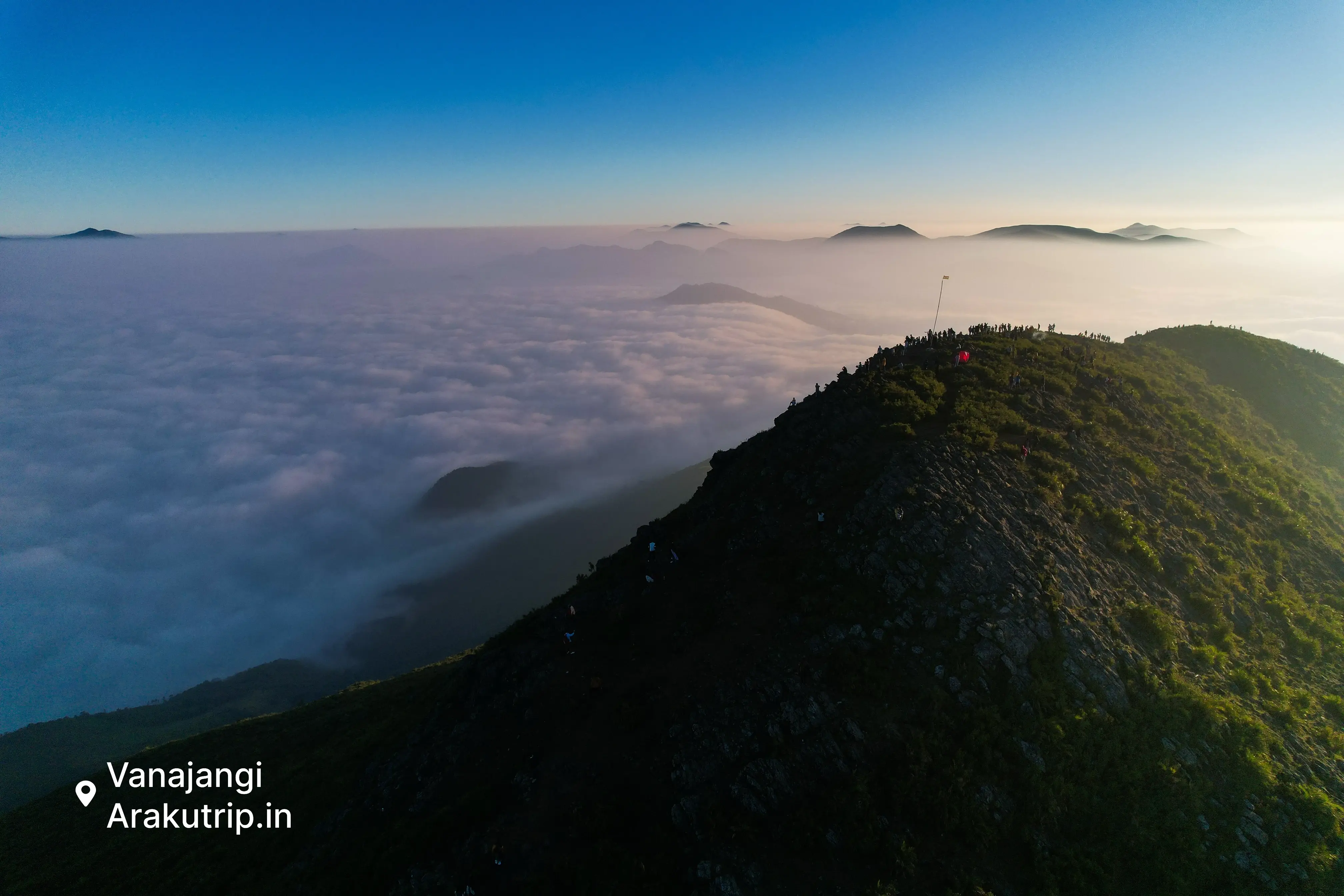
Vanjangi has become one of the most talked-about sunrise destinations in Andhra Pradesh over the past few years, and the reason is specific: on clear mornings between October and February, the valleys below Vanjangi fill with cloud, and from the hilltop at sunrise, you look out across what appears to be a white ocean stretching to the horizon.
The effect — technically known as a temperature inversion fog — is not unique to Vanjangi globally, but it is rare in South India, and the quality of the phenomenon at Vanjangi is reliably excellent in the right season.
Reaching Vanjangi requires an early morning start (ideally leaving Araku or Vizag by 3–4 AM) and a jeep ride over rough terrain, plus a short uphill walk to the viewing ridge. The effort is non-negotiable for the result.
Read the complete Vanjangi Hills guide for logistics, best months, and realistic expectations. ArakuTrip.in offers dedicated Vanjangi tour packages and the Araku-Vanjangi-Lambasingi combined circuit for visitors who want to cover all three destinations in a single extended trip.
Duduma Waterfalls
Located near the Odisha border in the deeper forested areas of the Eastern Ghats, Duduma Waterfalls are among the most powerful waterfalls in this part of India. The Machkund River drops approximately 175 metres in a series of cascades before reaching the plains below.
Because of its relative remoteness, Duduma is best included in a planned 3-day Araku itinerary rather than as a standalone day trip. The Duduma Waterfalls guide covers access routes, distance from Araku, and best visiting seasons.
What Makes Araku Valley Special? An Honest Assessment
Araku Valley's appeal is not dramatic in the way of the Himalayas or the Andaman coast. It works differently — through accumulation. Through the particular quality of light in a coffee plantation at 7 AM. Through the sound of a waterfall you can hear before you see. Through food cooked in bamboo over an open fire. Through a 150-million-year-old cave that makes the scale of human time feel briefly manageable.
What Araku offers that its more famous counterparts do not is authenticity at accessible distance. You are three hours from a major international airport. You are inside a living tribal civilisation. You are drinking genuinely world-class coffee. You are walking into caves that most Indians have never heard of.
For a curated exploration of what specifically makes Araku worth visiting, see What is Special in Araku — a deeper editorial perspective from the ArakuTrip.in team.
Things to Do in Araku Valley — Activity Guide
Beyond sightseeing, Araku Valley offers a range of activities suited to different traveller types. For a complete activity breakdown, visit Things to Do in Araku Valley.
Trekking and Forest Walks: Several forest department-managed trek routes operate in the Araku area, particularly around Ananthagiri and in the forest reserve corridors leading to Katiki Waterfalls. Routes range from short 2-km walks to half-day treks. Local guides are mandatory in the reserved forest zones.
Tribal Village Visits: With the right local contact (which ArakuTrip.in packages include), visits to tribal villages in the surrounding mandals offer the most culturally significant experience available in the region. These are not performance-oriented "tribal tourism" setups — they are actual working communities where, with appropriate respect and guidance, genuine interaction is possible.
Coffee Estate Walks: Beyond the formal Coffee Museum experience, some Girijan Cooperative-affiliated estates accept guided visitors during the harvest season (October–January). Walking through active harvest is a sensory experience of considerable quality.
Bird Watching: The Eastern Ghats forests around Araku support over 200 recorded bird species. Early morning sessions with a local naturalist guide yield sightings of hornbills, flycatchers, sunbirds, and — in the right zones — larger raptors.
Photography: Araku Valley's combination of mist, forest, tribal culture, waterfalls, and the Vistadome railway produces extraordinary photography conditions. For serious photographers, the Araku Valley photography spots guide identifies the best locations, ideal lighting windows, and seasonal opportunities.
Kayaking and Outdoor Sports: A limited number of adventure operators offer kayaking and related activities near certain reservoir and river sections in the area.
Araku Valley Food Guide — What to Eat and Where
The food culture of Araku Valley is one of the most underappreciated aspects of visiting the region. Tribal culinary traditions, largely invisible in coastal Andhra's restaurant landscape, are authentically present here.
For a complete food guide covering every major dish and the best places to eat in Araku, visit the Araku Valley local food guide.
Bamboo Chicken
Bamboo Chicken is the signature dish of the Araku tribal highlands and the single most talked-about food experience among Araku visitors. The preparation is deceptively simple and precisely right: marinated chicken pieces (typically with red chilli, ginger, garlic, turmeric, and local spices) are stuffed inside a freshly cut green bamboo tube, sealed at both ends, and placed directly over hardwood fire. The bamboo roasts slowly, imparting a subtle woody sweetness to the chicken while the steam generated inside keeps the meat profoundly moist.
The result is a dish that has no urban equivalent. The bamboo flavour is not something that can be replicated in a kadai or a tandoor. It exists only in the forest, at that heat, inside that material. For the full story of this dish and where to find the best versions in Araku, read the Bamboo Chicken guide.
Tribal Cuisine and Forest Produce
Beyond bamboo chicken, the tribal kitchen tradition includes preparations using wild mushrooms, bamboo shoots, forest tubers, and cultivated millets that have all but disappeared from mainstream Indian food culture. Local restaurants in Araku town — particularly those catering to tribal food traditions — serve versions of these dishes that are worth seeking out.
Araku Coffee
Discussed in the introduction, Araku coffee deserves another mention here in its gastronomic context. The Araku Coffee Museum café, several hotel restaurants, and the main town market all offer Araku coffee in various preparations. If you drink coffee, drinking Araku coffee in Araku is the equivalent of drinking Darjeeling tea on the plantation — contextually irreplaceable.
Hotels, Resorts and Accommodation in Araku Valley
Araku Valley's accommodation landscape spans a wide range — from basic government guesthouses to well-designed forest resorts and romantic tent-stay experiences. Choosing the right accommodation significantly affects the quality of your visit.
For the complete accommodation directory with current options across all budget ranges, visit the Araku Valley hotels guide and the comprehensive accommodation guide.
Premium and Mid-Range Resorts
The best resorts in Araku Valley are located away from the main town, inside or at the edge of forest land. This positioning gives them natural sound insulation, cooler temperatures, and the visual context of actual forest rather than developed landscape.
Key resorts in this category include:
- Haritha Hill Resort (APTDC): Government-run but positioned with excellent valley views. Reliable and family-friendly.
- Araaku Nature Resort: Private property with well-designed cottages in a forest setting.
- Araku Valley Resorts (multiple private operators): Several newer private resorts have opened in the 2020s that offer better interior design and service standards.
For curated recommendations with current pricing, availability, and what each property genuinely offers, the best resorts in Araku Valley guide is the most reliable current resource.
Couple-Friendly Resorts
Araku has a growing category of resorts specifically designed around the couple-travel use case — private cottages, forest settings, in-room amenities for romantic stays, and packages that include sunset viewpoints and private dining. The Araku Valley resorts for couples guide covers this category in detail.
Budget Hotels
For travellers prioritising experience over accommodation quality, Araku's budget hotel options in the main town area provide clean, functional rooms at reasonable prices. The low price hotels in Araku Valley guide covers the most reliable options with honest assessments. For direct room booking, visit ArakuTrip.in's rooms booking page.
Tent Stays — Camping in the Eastern Ghats
For travellers willing to accept the physical terms of outdoor accommodation, tent-stay experiences in Araku are among the most distinctive anywhere in Andhra Pradesh. Sleeping in a well-equipped tent on a forest edge, waking to mist and birdsong, and having coffee delivered before the valley fully wakes up — these are experiences with no urban equivalent. The Araku Valley tent stay guide covers the available tent-stay operators, what to expect, what to bring, and how to book.
Ananthagiri Hills Accommodation
For visitors who want to stay in the forested approach zone rather than Araku town itself, the Ananthagiri area offers distinctive forest resort options. See the Ananthagiri Hills resort booking guide for current options.
Araku Valley Tour Packages — What's Available and How to Choose
Tour packages exist to solve a specific problem: Araku Valley's attractions are spread across considerable distance, local transport is limited, and navigating tribal terrain without local knowledge is less rewarding than doing so with it. A well-designed package removes every logistical friction.
ArakuTrip.in specialises in Araku Valley and surrounding region travel, offering packages built by people who know the valley — not generic travel aggregators working from a database. For the complete range of available packages, visit Araku Tour Packages and the detailed Araku Valley tour packages page.
1-Day Tour Packages
For Vizag-based travellers or those with a single free day, the 1-day Araku Valley tour package covers the core attractions — Borra Caves, Chaparai Waterfalls, Coffee Museum — in an efficient itinerary that maximises time without feeling rushed.
2-Day Tour Packages
The 2-day Araku Valley package allows for deeper exploration including Katiki Waterfalls (which requires more time), a morning in the tribal museum, a coffee plantation walk, and an evening in the valley before departure the following morning.
Vizag to Araku Tour Packages
For visitors arriving at Visakhapatnam who want to include Araku as part of a Vizag region holiday, the Vizag to Araku tour package combines city-side attractions with the valley experience.
Specialty Packages
Araku + Balda Caves: The Araku Balda Caves tour includes the less-visited second cave system for travellers who want to go beyond the standard itinerary.
Araku + Lambasingi: The Araku-Lambasingi combination package is one of ArakuTrip.in's most popular offerings, combining the valley experience with the frost-prone highland village in a 2-day circuit.
Araku + Vanjangi: The Araku-Vanjangi package builds the Vanjangi sunrise experience into a full itinerary — ideal for October to February travel.
Araku + Vanjangi + Lambasingi: The triple-destination circuit is the comprehensive Eastern Ghats highlands experience — three distinct characters in a single trip.
Vizag + Araku + Lambasingi: The Vizag-based 3-day circuit starts and ends in Visakhapatnam and covers Araku and Lambasingi as inland excursions.
Vizag + Araku + Vanjangi: Similarly, the Vizag-Araku-Vanjangi tour pairs the sea-of-clouds experience with the full Araku Valley programme from a Vizag base.
All packages from ArakuTrip.in can be customised — different accommodation categories, additional sites, extended durations, and cab-only options are all available. The team's local expertise ensures recommendations are grounded in current ground conditions rather than outdated travel blog content.
Suggested Itineraries — Day-by-Day Plans
1-Day Araku Itinerary (From Vizag)
For the full detailed 1-day plan, see Best Places to Visit in Araku in One Day.
5:30 AM — Depart Vizag by cab or catch the Vistadome train 8:00–9:00 AM — Arrive at Borra Caves. Enter at opening time (10 AM) — explore for 60–75 minutes 10:00 AM — Borra Caves visit 11:30 AM — Drive toward Araku town, stop at Chaparai Waterfalls 1:00 PM — Lunch in Araku town. Order Bamboo Chicken (advance booking with restaurant recommended) 2:30 PM — Coffee Museum and Plantation walk 4:00 PM — Tribal Museum or Padmapuram Gardens (choose based on interest) 5:30 PM — Galikonda Viewpoint for sunset (weather permitting) 7:00 PM — Depart for Vizag
Best for: First-time visitors. Light walkers. Families with limited time.
2-Day Araku Itinerary
For the detailed 2-day plan, see ArakuTrip.in's 2-day trip plan.
Day 1:
- Morning: Vistadome train from Vizag (5:45 AM departure)
- Mid-morning: Arrive Araku, check into resort/hotel
- Afternoon: Borra Caves
- Evening: Coffee Museum, tribal village walk
Day 2:
- Pre-dawn: Vanjangi Hills sunrise (3:30 AM departure)
- Morning: Return to Araku. Breakfast
- Mid-morning: Katiki Waterfalls (forest jeep + walk)
- Afternoon: Chaparai Waterfalls, market visit
- Evening: Drive back to Vizag or Hyderabad
Best for: Couples, nature lovers, photography-focused travellers.
3-Day Vizag-Araku-Lambasingi Itinerary
For the complete 3-day plan, see the Vizag-Araku 3-day itinerary.
Day 1: Vizag to Araku via Vistadome. Borra Caves afternoon. Overnight in Araku. Day 2: Vanjangi sunrise. Full Araku Valley exploration — Katiki, Chaparai, Coffee Museum. Overnight in Araku. Day 3: Morning drive to Lambasingi. Explore the village, apple orchards, viewpoints. Return to Vizag by evening.
Best for: Hyderabad visitors. First-timers who want comprehensive coverage. Couples and families.
Essential Travel Tips for Araku Valley
Budget Planning
Araku Valley is a genuinely affordable destination compared to hill stations in the Western Ghats or Himalayas. Accommodation ranges from ₹500 (basic guesthouse) to ₹5,000+ (premium forest resort) per night. Bamboo Chicken meals are typically ₹150–300. Borra Caves entry is ₹65 (Indian adults) with an additional photography fee. A comfortable 2-day trip budget for two people, including mid-range accommodation, all meals, Borra Caves, and local transport, falls between ₹5,000–₹8,000 — remarkable value by any comparative standard.
What to Pack
- Light woolens or fleece jacket (October–February, particularly for nights)
- Waterproof layer or compact umbrella (June–September)
- Good walking shoes — not sandals for waterfall treks
- Insect repellent for forest zones
- Portable charger (power cuts occur in the ghat areas)
- Cash — ATM availability in Araku town is limited; carry adequate cash from Vizag
- Sunscreen for October–February when sun intensity is higher at elevation
Mobile Network and Connectivity
BSNL has the most consistent network coverage inside the valley and on ghat roads. Airtel and Jio coverage is present in Araku town itself but becomes patchy in the surrounding forest areas. Do not plan critical video calls or data-heavy tasks in remote attraction areas. Download offline Google Maps before departing.
Photography Guidance
The Araku Valley photography spots guide provides professional-grade guidance for travel photographers. Key recommendations:
- Galikonda Viewpoint: Best at golden hour (5:00–6:00 PM) in October–February
- Vanjangi: First 15 minutes of sunrise in November–January
- Borra Caves: Long exposure with a tripod for cave formations (tripod permitted with permission)
- Vistadome Journey: Right-side window seats for ghat ascent
- Coffee Plantations: Early morning diffuse light, February–March for flowering season
Safety
- Ghat roads after dark are genuinely hazardous — plan to complete waterfall visits before 5 PM
- During heavy monsoon, check road conditions before driving deeper into the ghats
- Do not enter forest reserve areas without permitted guides
- Respect tribal community privacy — ask before photographing people
- Keep emergency contacts saved: district hospital Araku town, Vizag city hospitals
Frequently Asked Questions (FAQ)
1. What is Araku Valley famous for?
Araku Valley is famous for its scenic mountain landscape inside the Eastern Ghats, the world-famous Borra Caves (India's largest stalactite-stalagmite cave system), organic specialty coffee grown by tribal farmers, the spectacular Vistadome train journey from Vizag, tribal culture and food (particularly Bamboo Chicken), and waterfalls including Katiki and Chaparai. It is also the starting point for visits to Lambasingi and Vanjangi Hills.
2. How far is Araku Valley from Visakhapatnam?
Araku Valley is approximately 115 km from Visakhapatnam (Vizag) by road and rail. The drive takes 3–4 hours. The Vistadome train journey takes approximately 5–6 hours due to the scenic mountain routing.
3. How far is Araku from Hyderabad?
Araku Valley is approximately 640 km from Hyderabad by road (9–10 hours). Most Hyderabad visitors fly to Vizag (1.5 hours) and then travel to Araku by train or cab — the total combined travel time is significantly less.
4. What is the best time to visit Araku Valley?
October to February is the most popular period, offering pleasant temperatures (15–25°C), clear skies, and maximum scenic value. The monsoon season (June–September) is ideal for waterfall enthusiasts. Summer (March–May) is surprisingly comfortable at Araku's elevation and offers far fewer crowds.
5. How cold does Araku Valley get?
In December and January, nighttime temperatures in Araku can drop to 10–12°C. Morning fog is common. During winter days, temperatures typically stay between 18–24°C. This is cool but not cold — light woolens are sufficient for most visitors.
6. Is Araku Valley worth visiting in summer?
Yes. While most travellers assume a mountain destination is only good in winter, Araku's elevation keeps summer temperatures 8–10°C lower than the coastal plains. Crowds are minimal, and the off-season pricing on accommodation is more favourable.
7. What is Araku coffee and where can I buy it?
Araku coffee is an internationally acclaimed specialty coffee grown organically by tribal farming cooperatives at 900–1100 metres elevation. It is shade-grown, naturally processed, and has won awards in specialty coffee competitions globally. You can buy it at the Coffee Museum in Araku, at the Girijan Cooperative outlets, and through the Araku Coffee brand's online and retail channels.
8. How to reach Araku Valley from Hyderabad?
The most efficient route is: Hyderabad to Vizag by flight (1.5 hours), then Vistadome train or cab from Vizag to Araku (3–5 hours). Direct road from Hyderabad is possible but is a long 10-hour drive.
9. Can I visit Borra Caves and Araku Valley in one day?
Yes. A day trip from Vizag covering Borra Caves, Chaparai Waterfalls, Coffee Museum, and Araku town is manageable with an early 5:30 AM departure and a return by 7:00–8:00 PM.
10. What is the Vistadome train and how do I book it?
The Vistadome train is an IRCTC tourist special train running on the Visakhapatnam–Kirandul line with glass-ceiling coaches designed for scenic mountain viewing. Book it through the IRCTC website under the Vistadome category. Tickets sell out quickly — book 2–4 weeks in advance for peak season travel.
11. Is Araku Valley good for couples?
Araku Valley is an excellent couples' destination. The combination of forest, waterfalls, scenic train journey, tribal culture, and the relatively undiscovered character of the valley makes it naturally romantic. Several resorts specifically cater to couple travel. The Vanjangi sunrise experience is considered one of the most spectacular natural moments in the region.
12. What are the best hotels in Araku Valley?
APTDC's Haritha Hill Resort is reliable and well-positioned. Several private resorts offer better interior quality at comparable or higher prices. For the current best options by category (budget, mid-range, premium, couple-focused), see ArakuTrip.in's accommodation guides.
13. What is Bamboo Chicken?
Bamboo Chicken is a traditional tribal dish where marinated chicken is cooked inside a sealed green bamboo tube over open fire. The bamboo imparts a subtle woody flavour while steam-roasting the chicken inside. It is unique to the Araku tribal highlands and cannot be authentically replicated elsewhere.
14. Is it safe to visit Araku Valley?
Araku Valley is generally safe for all traveller types including solo women, families, and couples. The tribal communities in this region have a long history of peaceful coexistence with visitors. Standard sensible precautions apply: avoid forest roads after dark, carry adequate cash, and use reputable local guides for forest treks.
15. How many days are enough for Araku Valley?
Two days is the minimum for a satisfying visit. Three days allows you to add Vanjangi Hills and Lambasingi to the itinerary. One day is possible for Vizag-based travellers who want a quick introductory experience.
16. What is Vanjangi Hills famous for?
Vanjangi is famous for the "sea of clouds" phenomenon visible from its ridge at sunrise between October and February. On clear cold mornings, the valleys below fill with cloud, and from the Vanjangi hilltop, this creates the visual effect of a white ocean extending to the horizon.
17. Is Lambasingi near Araku Valley?
Lambasingi is approximately 45–60 km from Araku Valley by mountain road. Both are accessible from Vizag and are commonly combined in a 2–3 day Eastern Ghats itinerary.
18. What is the entry fee for Borra Caves?
The entry fee for Borra Caves is approximately ₹65 for Indian adults and ₹20 for children, with additional charges for professional photography equipment. Timings are 10:00 AM to 5:30 PM. Fees are subject to revision; check current rates at ArakuTrip.in.
19. Can I hire a cab from Vizag to Araku?
Yes. ArakuTrip.in provides cab booking services from Vizag (or any point in Andhra Pradesh) to Araku Valley with experienced local drivers. For current rates, see the Vizag to Araku cab fare page on ArakuTrip.in.
20. What is the distance from Araku to Borra Caves?
Borra Caves are approximately 30–35 km from Araku town, toward Vizag on the main highway.
21. What food is famous in Araku Valley?
Bamboo Chicken is the signature dish. The broader tribal food tradition includes preparations with bamboo shoots, wild mushrooms, millet, and forest produce. Araku coffee is the definitive beverage. Corn (bhutta) roasted over charcoal is a ubiquitous roadside snack on the ghat routes.
22. Are there ATMs in Araku Valley?
There are limited ATM options in Araku town, and they are occasionally out of service. Carry adequate cash from Visakhapatnam before your trip. Most resort and hotel bookings can be prepaid online.
23. Does Araku Valley have mobile network coverage?
BSNL has the widest coverage in and around Araku Valley and on the ghat roads. Airtel and Jio work in the main town but can be unreliable in remote attraction areas and on forest roads.
24. Is the Vistadome train journey better in a specific season?
The Vistadome journey is rewarding year-round, but the best conditions are during October–February when clear air maximises visibility across the ghats, and during the monsoon when the entire route is draped in cloud and waterfall. Each season offers a fundamentally different visual experience.
25. What is the Araku Valley temperature in December?
December temperatures in Araku Valley range from approximately 10–12°C at night to 20–22°C during the day. Morning fog is common. Pack light woolens or a fleece jacket.
26. Is Araku Valley suitable for a family trip with elderly members?
Yes, with planning. The main town, Coffee Museum, Tribal Museum, Padmapuram Gardens, and APTDC resort are all accessible for elderly family members. Borra Caves involves some walking on uneven surfaces but has handrails. Katiki Waterfalls and the Vanjangi trek are not suitable for elderly or mobility-limited travellers.
27. Can I visit Araku Valley during monsoon?
Yes, with appropriate expectations. Monsoon Araku (June–September) offers the most powerful waterfall experience but involves heavy rain, limited visibility, and occasionally problematic road conditions. It is not recommended for first-time visitors or families with young children unless you have a local guide.
28. What are the best photography spots in Araku Valley?
Galikonda Viewpoint, Vanjangi Hills at sunrise, Borra Caves interior, the Vistadome train journey, Katiki Waterfalls, coffee plantation rows at early morning light, and tribal market scenes. See the dedicated photography guide at ArakuTrip.in.
29. How do I book Araku Valley tour packages?
ArakuTrip.in offers the full range of Araku Valley tour packages — 1-day, 2-day, 3-day, and customised itineraries including Lambasingi and Vanjangi combinations. Visit arakutrip.in/araku-tour-packages/ or contact the team directly for customised booking.
30. What tribal communities live in Araku Valley?
The primary tribal communities of the Araku region include the Kondh, Bagata, Gadaba, Valmiki, and Porja tribes. The Girijan Cooperative Corporation, which manages the Araku coffee enterprise, is the primary economic institution connecting tribal farmers to national and international markets.
31. Is Araku Valley good for solo travel?
Araku is well-suited for solo travellers, particularly for those interested in nature, photography, or cultural tourism. The valley is safe, the main town is traveller-friendly, and the community character is welcoming. ArakuTrip.in can arrange shared or solo cab options for independent travellers.
32. What is Padmapuram Gardens in Araku?
Padmapuram is a government-maintained botanical garden approximately 10 km from Araku town featuring exotic plant species and a distinctive bamboo treehouse. It is a family-friendly attraction best visited in the morning when the light is good and crowds are manageable.
33. Can I combine Araku Valley with a Vizag beach trip?
Absolutely. Visakhapatnam has excellent beaches (Ramakrishna Beach, Rishikonda Beach, Rushikonda). A combined 3–4 day trip covering Vizag beaches, a Vistadome train journey, and 2 days in Araku Valley is one of the most satisfying AP travel circuits available. ArakuTrip.in's Vizag-based packages can accommodate this combination.
34. Is Galikonda View Point accessible by car?
Yes, there is a road to the Galikonda summit, but it is narrow with tight bends. The road is manageable in a standard SUV or even a hatchback if driven carefully. Two-wheelers are comfortable on this road.
35. What is the altitude of Araku Valley?
The main Araku town sits at approximately 900–1000 metres above sea level. Surrounding peaks and viewpoints — Galikonda (1415 m), Raktakonda (1396 m) — are considerably higher. The Borra Caves area is at approximately 705 metres.
36. How long does it take to explore Borra Caves?
A thorough visit to Borra Caves takes approximately 60–90 minutes including the guided formation tour and return to the entrance. The guided lighting sequence adds about 15 minutes of narrated stops. Photography enthusiasts may spend up to 2 hours.
37. Are there waterfalls near Araku Valley that are active in summer?
Most waterfalls in the Araku region are seasonal and at their lowest flow (or dry) in April–May. Katiki Waterfalls may have some flow from natural springs even in dry months, but the main spectacle requires post-monsoon volume. Plan waterfall-focused visits for July–February.
38. Can I reach Araku Valley by two-wheeler from Vizag?
The route from Vizag to Araku by two-wheeler is popular among motorcycle enthusiasts. The ghat roads are challenging but manageable in dry weather. Riding during monsoon on ghat roads is genuinely dangerous and not recommended.
39. Is there a night stay option inside forest areas near Araku?
Some forest department eco-development camps and private tent-stay operators offer within-forest-buffer overnight experiences. These require advance booking and are subject to forest department approvals. ArakuTrip.in can help arrange these experiences through authorised channels.
40. What are the best local souvenirs to buy from Araku?
Araku Coffee (whole bean or ground from the GCC or Araku Coffee outlets), tribal handicrafts (bamboo work, floor paintings, textile items) from the main market, and seasonal forest produce (honey, bamboo shoots in season) are the most authentic purchases. Avoid mass-produced "tribal" items sold at highway tourist stops.
Article produced for ArakuTrip.in. All rights reserved. For booking tour packages, hotels, cab services, and customised Araku Valley trips, visit arakutrip.in.