

Scapula Length Index :
Scapula length divided by Forelimb length. Higher score Indicates greater speed of movement via relative proportions of components of the proximal forelimb as well as exertion of greater force from the forelimb.
P.Pardus : 33%
P.Onca : 34%
Edge: P.Onca
Glenoid Process Index :
Glenoid Process/scapula Length.Lower score Indicates greater shoulder mobility.
P.Pardus : exact value unknown
P.Onca : exact value unknown
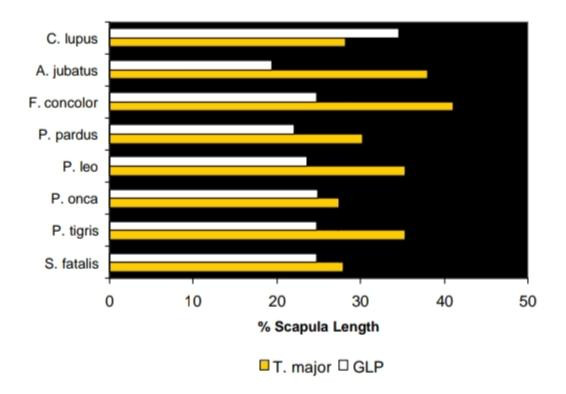
Edge : P.Pardus
Spina Scapula Index :
Spina scapula/scapula length. Higher score Increases attachment point for several muscles such as trapezius muscles.
P.Pardus(open triangle) : exact value unknown
P.Onca(open circle) : exact value unknown
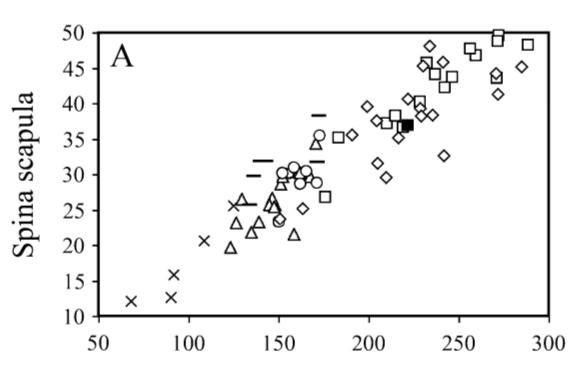
Edge : P.Onca
M.teres Major Index :
Higher score Indicates greater power for shoulder extension.
P.Pardus : exact value unknown
P.Onca : exact value unknown
Edge : P.Pardus
Infraspinous Fossa Index :
Higher score Indicates greater infraspinatus muscle attachement which functions a rotator cuff muscle providing glenohumeral stability.
P.Pardus(open triangle) : exact value unknown
P.Onca(open circle) : exact value unknown
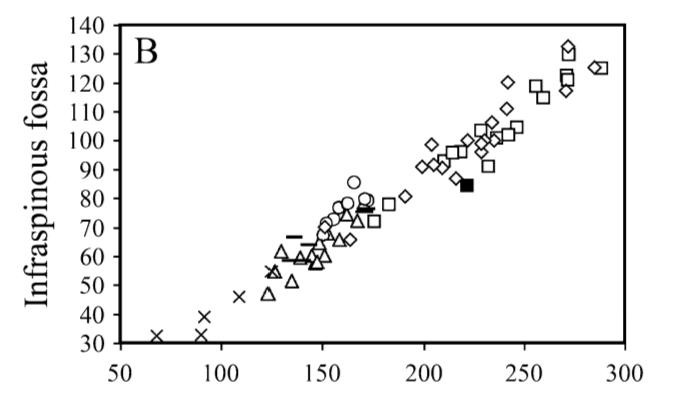
Edge : P.Onca
Supraspinous Index :
supraspinous fossa / scapula length. Higher score Indicates greater supraspinatus muscle attachement. This muscle helps to resist the gravitational forces which act on the shoulder joint to pull from the weight of the upper limb downward and to stabilize the shoulder joint by keeping the head of the humerus firmly pressed medially against the glenoid fossa of the scapula resulting in exertion of greater force from the forelimb.
P.Pardus(open triangle) : exact value unknown
P.Onca(open circle) : exact value unknown
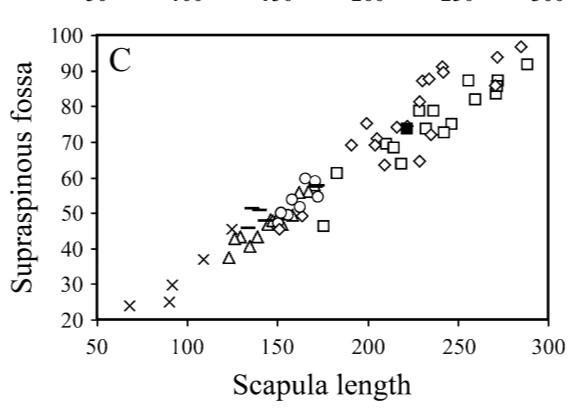
Edge : P.Onca
M.teres Major Index 2 :
Higher score Indicates greater power for shoulder extension.
P.Pardus : 16%
P.Onca : 14%
Edge : P.Pardus
GL/LI :
Lower score provides greater power and higher velocity to the Forelimb.
P.Pardus : 300%
P.Onca : 268%
Edge : P.Onca
Deltoid Index :
Deltoid crest length divided by humerus articular length. Higher score Displays greater mechanical advantage of deltoid muscles at the shoulder joint.
P.Pardus : exact value unknown
P.Onca : exact value unknown
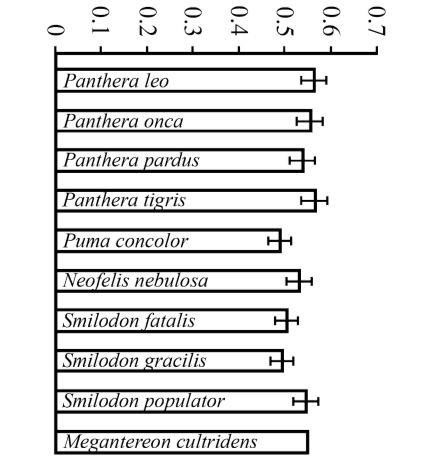
Edge : P.Onca
HRI :
It is humerus mediolateral diameter at mid-shaft/humerus length. Robust forelimb bones protect the animal from violent stresses during grappling and increase muscle mass.
P.Pardus : 8%
P.Onca : 9%
Edge : P.Onca
HRI2 :
It is humerus anteroposterior diameter at mid-shaft/humerus length. Robust forelimb bones protect the animal from violent stresses during grappling and increase muscle mass.
P.Pardus : 12%
P.Onca : 12%
Edge : Draw
HCMI :
Often-used variable in analyses of bone strengths in locomotion. The higher the ratio is, the thicker the Humeral bone is.
P.Pardus : 29%
P.Onca : 32%
Edge : P.Onca
values closer to 100% signify relatively thinner cortical bone and values closer to 0% signify relatively thicker cortical Humeral bone.
P.Pardus : 67%
P.Onca : 64%
Edge : P.Onca
KML :
values closer to 100% signify relatively thinner cortical bone and values closer to 0% signify relatively thicker Humeral cortical bone.
P.Pardus : 60%
P.Onca : 60%
Edge : Draw
CA/Length :
This measure is used to estimate aspects of long Humeral strength in axial compression.
P.Pardus : 82%
P.Onca : 126%
Edge : P.Onca
Lx/length :
This measure is used to estimate aspects of long Humeral strength in bending about mediolateral plane.
P.Pardus(n°21) : exact value unknown
P.Onca(n°20) : exact value unknown

Edge : P.Onca
Ly/length :
This measure is used to estimate aspects of long Humeral strength in bending about craniocaudal plane.
P.Pardus(n°21) : exact value unknown
P.Onca (n°20) : exact value unknown
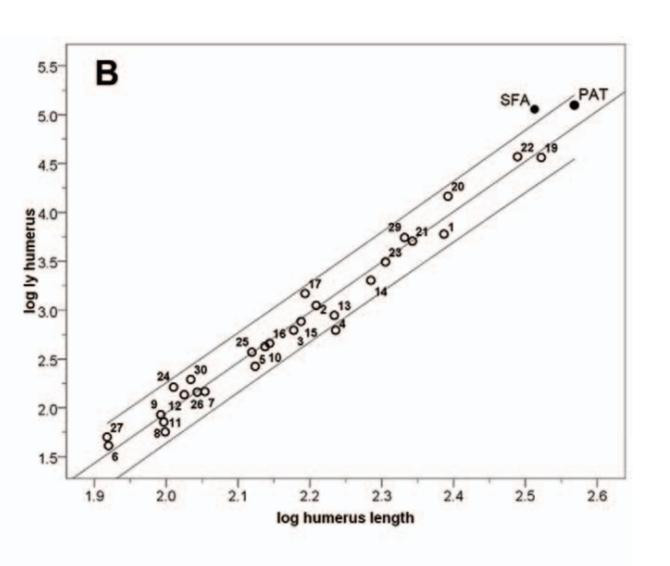
Edge : P.Onca
J/2/length :
This measure is used to estimate aspects of long Humeral strength in average rigidity in non-axial loading.
P.Pardus(n°21) : exact value unknown
P.Onca (n°20) : exact value unknown
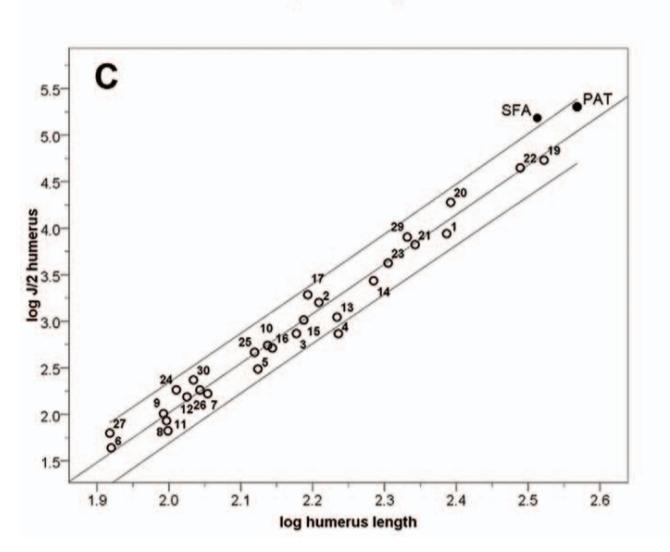
Edge : P.Onca
HCSI:
Cross-Section/divided by Length of humerus. A higher score determines a greater Humeral robusticity.
P.Pardus : exact value unknown
P.Onca : exact value unknown

Edge : P.Onca
HDWI :
It is Humeral distal width/length ratio, correlated with resistance to stresses at the elbow joint. A higher ratio also increases muscle attachement.
P.Pardus : 24%
P.Onca : 26%
Edge : P.Onca
HEI :
The HEI index measures the relative size of wrist stabilizing muscles and well as several grasping muscles in area which facilitate prey grasping. These muscles also likely helps stability, pushing, and agility when legs are on ground.
P.Pardus : 23%
P.Onca : 26%
Edge : P.Onca
HCI :
This is a measure of the humerus joint surface size near elbow. More positive PC1 scores indicate greater forearm mobility and stability during grappling and also likely when feet are on ground during a struggle as well as an increased ability to better distribute large loads.
P.Pardus(n°22) : exact value unknown
P.Onca(n°21) : exact value unknown
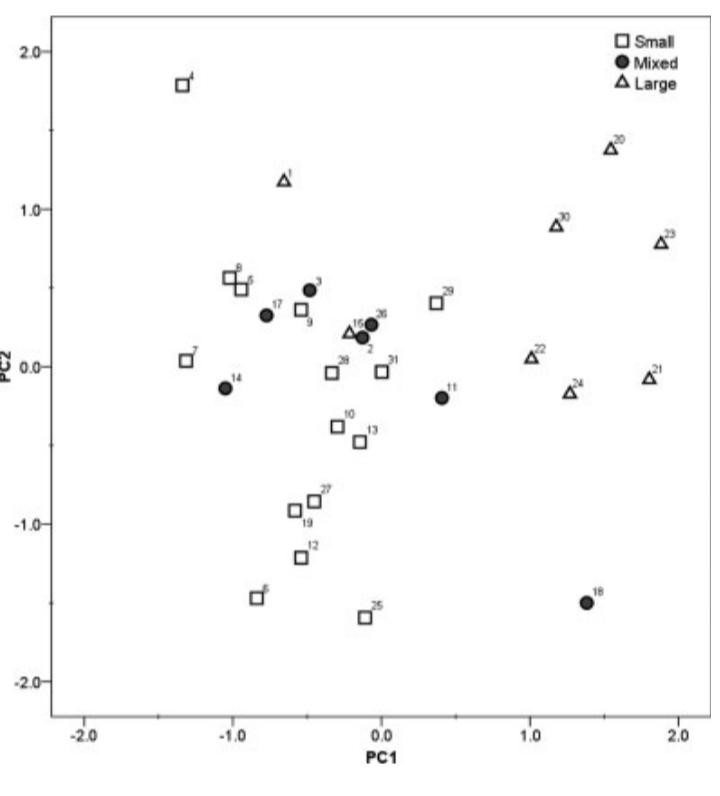
Edge : P.Onca
PC2 :
Scoring intermediate or low on PC2 are carnivorans that use their forelimbs to subdue,manipulate or excavate food items.Carnivorans scoring low on PC2, i.e. grapplers like felids, have relatively shallow trochlear furrows and relatively large and distally-projecting medial trochlear flanges. These features provide extra stability against forces acting in a nonparasagittal plane.
P.Pardus : 1,072
P.Onca : -1,713
Edge : P.Onca
HAA :
This is another measure of area of where humerus terminates in elbow. More positive PC1 scores are associated with better grappling and distributing heavier loads.
P.Pardus(n°22) : exact value unknown
P.Onca(n°21) : exact value unknown
Edge : P.Onca
Brachial Index :
This measures radius length/humerus length. Lower scores in this ratio indicate greater forelimb muscle mechanical advantage and results in stronger muscles all else being equal.
P.Pardus : exact value unknown
P.Onca : exact value unknown
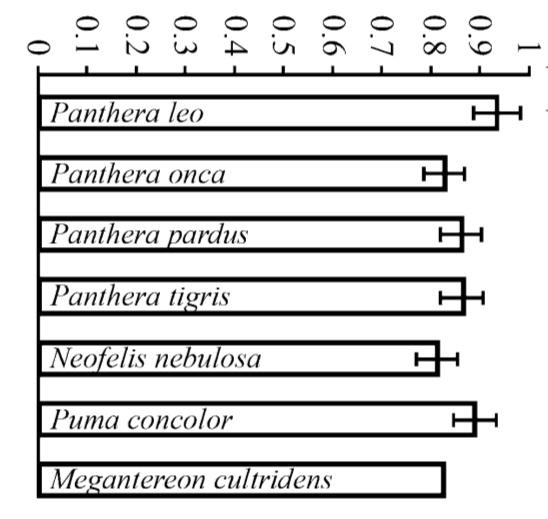
Edge : P.Onca
Brachial Index 2 :
This measures ulna length/humerus length. Lower scores in this ratio indicate greater forelimb muscle mechanical advantage and results in stronger muscles all else being equal.
P.Pardus : exact value unknown
P.Onca : exact value unknown
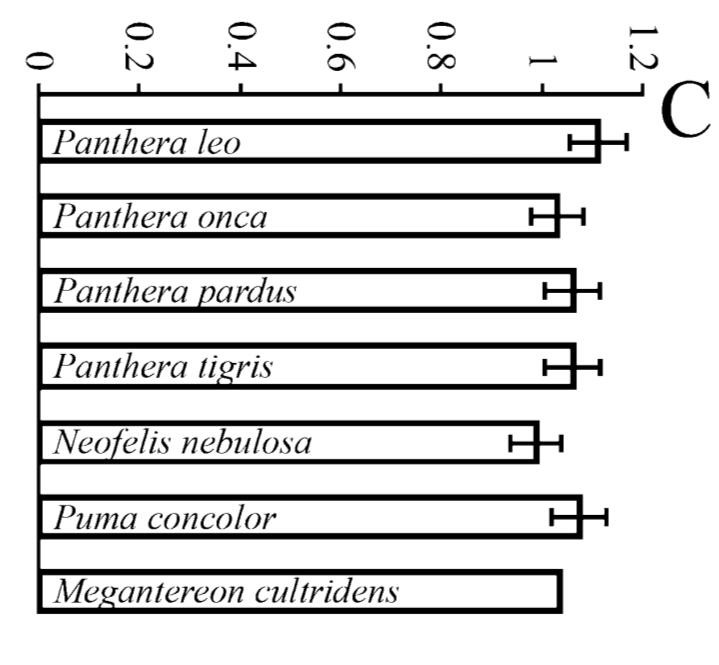
Edge : P.Onca
OI :
This metrics estimates tricep muscle strength. High values indicate greater ability to push with arms all else being equal. This helps a grappling cat hold prey and also helps a canid push and knock down an opponent. In addition, higher values may indicate greater stability and ability to change direction in a fight.
P.Pardus : 21%
P.Onca : 24%
Edge : P.Onca
URI :
This measures ulna anteroposterior diameter at midshaft divided by ulna length. As mentioned above for humerus robusticity, a robust ulna resists stresses on bones during fights and increases resistance to bites to the forelimb as well as muscle mass.
P.Pardus : 9%
P.Onca : 10%
Edge : P.Onca
RRI :
This measures radius mediolateral diameter at midshaft divided by radius length. As mentioned above for humerus robusticity, a robust radius resists stresses on bones during fights and increases resistance to bites to the forelimb as well as muscle mass.
P.Pardus : 9%
P.Onca : 11%
Edge : P.Onca
RRI2 :
This measures radius anteroposterior diameter at midshaft divided by radius length. As mentioned above for humerus robusticity, a robust radius resists stresses on bones during fights and increases resistance to bites to the forelimb as well as muscle mass.
P.Pardus : 7%
P.Onca : 8%
Edge : P.Onca
RAA :
This is another measure of radius where it terminates at wrist. More positive PC1 scores help to reinforce the forelimbs against the stresses encountered by large, struggling prey and to distribute heavier loads.
P.Pardus(n°22): exact value unknown
P.Onca (n°21) : exact value unknown
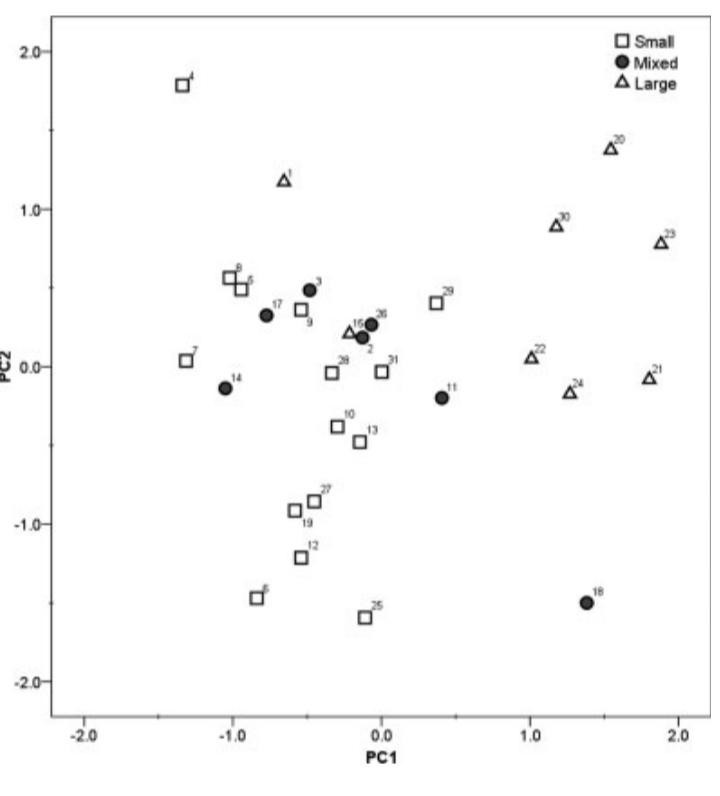
Edge : P.Onca
RAI :
This is a measure of joint area where radius meets wrist joint. More positive PC1 scores indicate larger forces are put on joints either through larger muscles, or external stresses which helps grappling or ability to fight with feet on ground (i.e. ability to quickly change directions, stability, etc.).
P.Pardus(n°22): exact value unknown
P.Onca (n°21) : exact value unknown
Edge : P.Onca
PAW :
This is a measurement of paw width on forelimbs and gives us an idea of how well-paws are designed to hold prey. In addition, relatively wider paws likely increase stability while feet are on ground.
P.Pardus : 73%
P.Onca : 82%
Edge : P.Onca
MCP :
proximal phalanx to metacarpal ratio, more negative PC2 and DF1 scores offer increased surface area for grasping and grappling and greater relative proportions of proximal and distal elements of the manus and size of the palmar surface.
P.Pardus(n°22) : exact value unknown
P.Onca(n°21) : exact value unknown
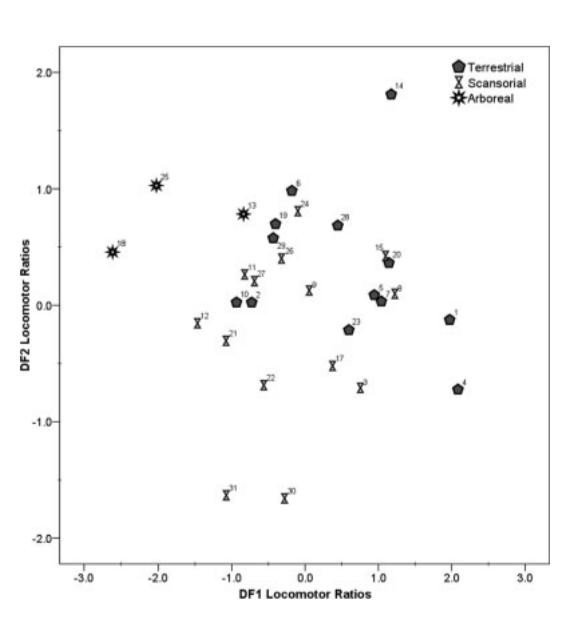
Edge : P.Onca
MC3RI :
This measures the robusticity of metacarpal 3 or longest finger/digit. More negative PC1 scores may assist with grappling or stresses exerted with feet on ground during a fight.
P.Pardus(n°22) : exact value unknown
P.Onca(n°21) : exact value unknown
Edge : P.Pardus
MC3AA :
This is a measure of size of metacarpal at joints of finger. Higher PC1 Scores help stabilize the metacarpals against stresses from prey and climbing.
P.Pardus(n°22) : exact value unknown
P.Onca(n°21) : exact value unknown
Edge : P.Onca
Studies Used For The Above Comparison :
https://publikationen.uni-tuebingen.de/xmlui/handle/10900/48480
https://www.researchgate.net/publication/7531697_Body_size_ofSmilodon_Mammalia_Felidae
As can be seen, Panthera Onca has relatively overall stronger shoulders, thicker Forelimb bones with larger articular areas,epicondyles,condyles,olecrana,wider humeri distal ends, shorter forelimbs,wider paws, greater manus proportions and metacarpal articular areas while Panthera Pardus simply has relatively more robust metacarpals. Additionally, the Jaguar has a proportionally more powerful bite and stronger teeth :
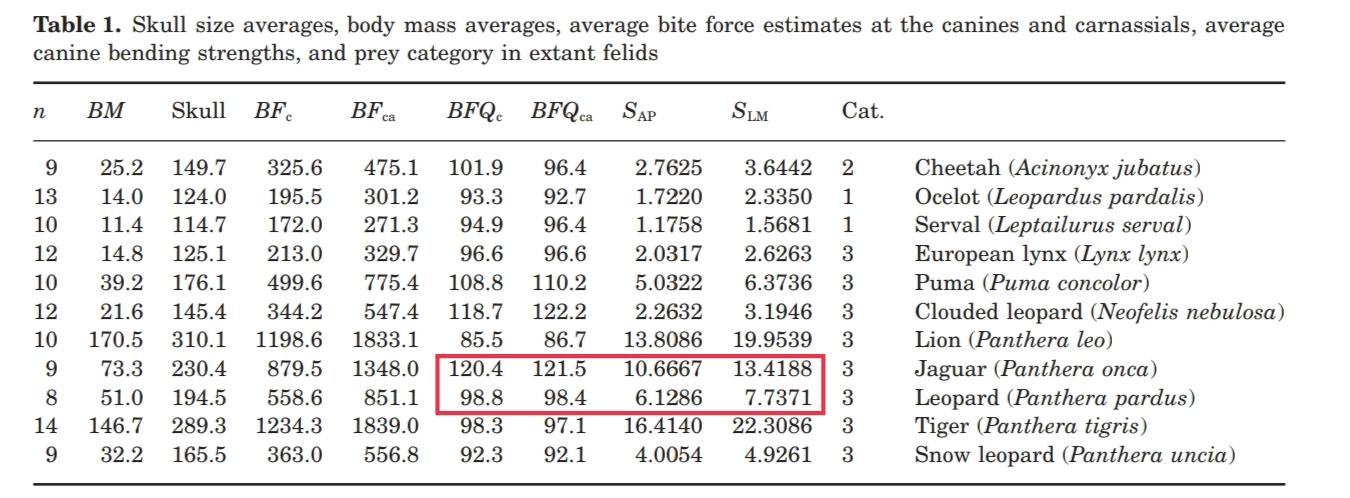
https://academic.oup.com/zoolinnean/article/151/2/423/2630862
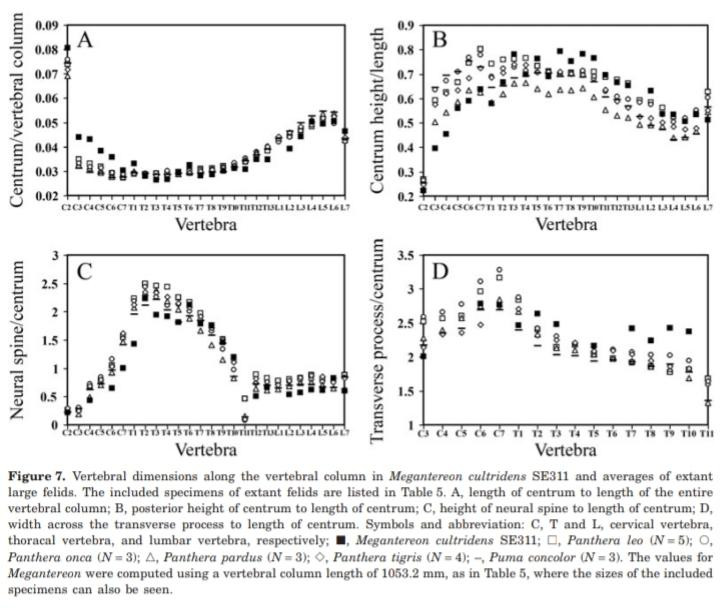
Jaguars also seem to benefit from having proportionally more powerfully built backs based on these graphs :
Having a stronger back would improve the Jaguar's strength and stability as explained here :
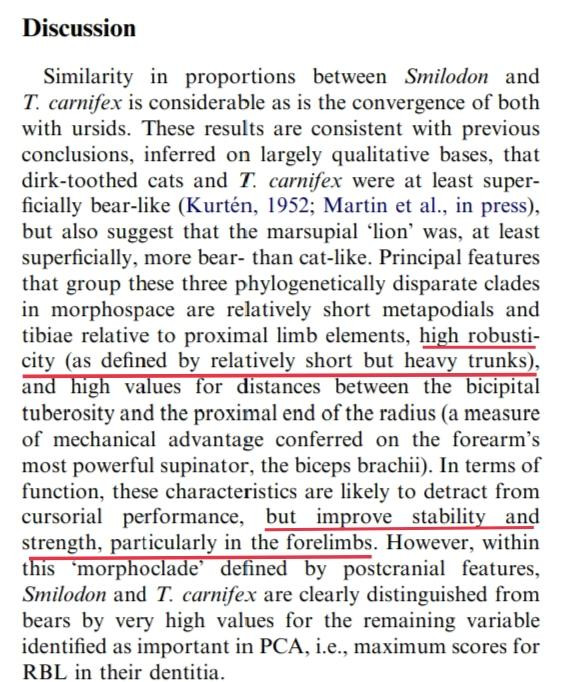
https://www.researchgate.net/publication/5538150_How_to_Build_a_Mammalian_Super-Predator
All of the Jaguar's physical advantages would enable it to outgrapple a similarly-sized Leopard and since the former is significantly heavier on average :

Odds would increase in the Jaguar's favor to the point where it becomes totally one-sided !