
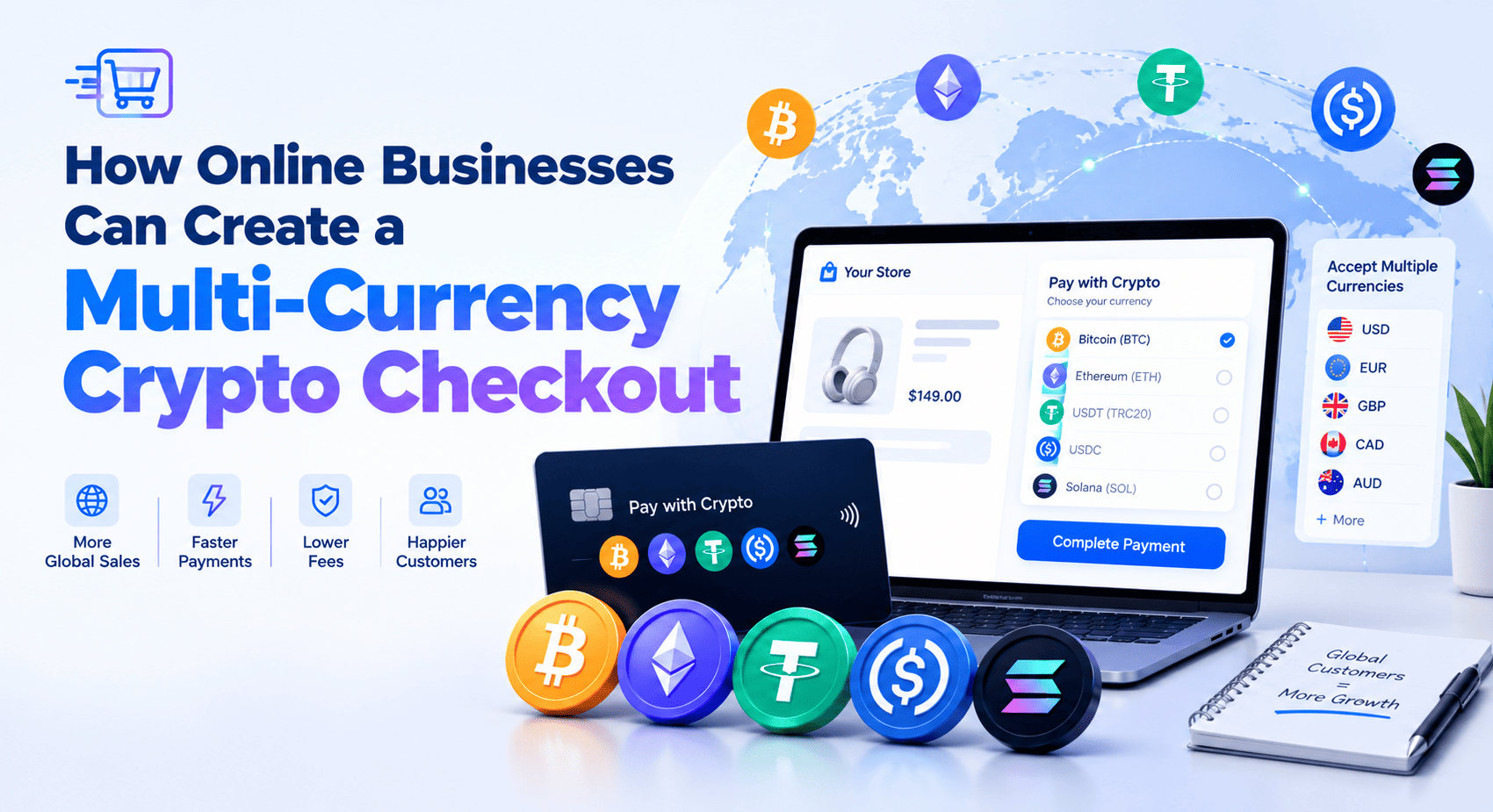
Online businesses are no longer limited to accepting payments through cards and bank transfers. Cryptocurrency can also be added as a payment option for customers who prefer to pay from a digital wallet.
However, accepting one cryptocurrency is different from building a multi-currency crypto checkout.
Customers may want to pay with Bitcoin, Ethereum, USDT, USDC or another supported asset. These assets can also exist on different blockchain networks, which means a checkout needs to handle more than simply displaying a list of coins.
A well-designed multi-currency crypto checkout should make it easy for customers to select a payment asset, understand the amount they need to send, complete the transaction and receive clear confirmation.
For the business, the system should connect payments with orders, manage transaction status, support reconciliation and provide a clear process for refunds and settlement.
What Is a Multi-Currency Crypto Checkout?
A multi-currency crypto checkout allows customers to choose from multiple supported cryptocurrencies or stablecoins when paying for a product or service.
For example, an online business could offer:
|
Payment Asset |
Example Use |
|
Bitcoin (BTC) |
General crypto payments |
|
Ethereum (ETH) |
Digital products and services |
|
USDT |
Stablecoin payments |
|
USDC |
Stablecoin payments |
|
Other supported assets |
Based on customer demand |
The exact assets and blockchain networks available depend on the payment infrastructure being used.
The goal is not simply to accept as many cryptocurrencies as possible. The goal is to offer relevant payment choices without making the checkout confusing.
Why Create a Multi-Currency Crypto Checkout?
Customers hold different digital assets.
One customer may hold BTC, another may have USDC, while another may prefer USDT. If an online business accepts only one cryptocurrency, some potential customers may not be able to use their preferred payment method.
Supporting multiple assets can therefore provide more flexibility.
Potential benefits include:
-
Giving customers more payment choices
-
Supporting international customers
-
Serving crypto-active audiences
-
Reducing dependence on a single cryptocurrency
-
Supporting stablecoin payments
-
Creating flexible payment workflows
-
Integrating crypto payments into an existing checkout
However, more currencies also mean more operational complexity.
Each additional asset can create requirements around pricing, transaction monitoring, network support, refunds, accounting and settlement.
This is why businesses should select supported currencies carefully.
How Does a Multi-Currency Crypto Checkout Work?
A typical checkout can follow a relatively simple process.
1. Customer selects a product
The customer adds a product or service to the basket and proceeds to checkout.
2. Customer selects crypto
The checkout displays the supported cryptocurrencies and stablecoins.
3. Payment amount is calculated
The system calculates how much cryptocurrency the customer needs to send based on the product price and current conversion rate.
4. Payment details are displayed
The customer receives the relevant payment address, QR code or wallet payment option, depending on the checkout design.
5. Customer completes the transaction
The customer sends the required asset using a supported blockchain network.
6. Payment is monitored
The payment infrastructure checks the transaction and updates its status.
7. Order status is updated
Once the payment reaches the required confirmation status, the online business can mark the order as paid.
8. Customer receives confirmation
The customer receives confirmation and can access the purchased product or service where applicable.
This process can be automated through a payment API or handled through a hosted payment page.
Step 1: Decide Which Cryptocurrencies to Accept
The first decision is which currencies your business should support.
It is tempting to add as many assets as possible, but this is not always the best approach.
Start by looking at your customers.
For example:
International e-commerce business:
BTC, USDT and USDC may be useful starting options.
Web3 business:
ETH and selected stablecoins may be more relevant.
Travel business:
Stablecoins may be useful for customers making international payments.
Digital services business:
A smaller selection of widely used assets may provide a simpler checkout.
The right combination depends on customer demand, supported markets and your payment provider.
Why Stablecoins Can Be Useful
Stablecoins can be particularly useful for online businesses that want to accept crypto while reducing exposure to the price movements of more volatile cryptocurrencies.
USDT and USDC are examples of widely used stablecoins.
For example, if a service costs £100, a business may prefer a payment asset designed to maintain a relatively stable value rather than pricing the service directly in a volatile cryptocurrency.
This does not remove all risks or costs. Businesses still need to consider network fees, provider fees, settlement, compliance and accounting.
Step 2: Understand Blockchain Networks
Supporting a cryptocurrency is not always enough.
The business also needs to understand the blockchain network on which the payment will be made.
A stablecoin such as USDT can be available across multiple blockchain networks. Sending funds through a network that the merchant does not support can result in payment problems.
The checkout should therefore clearly communicate:
-
Supported cryptocurrency
-
Supported blockchain network
-
Payment amount
-
Payment address
-
Payment deadline
-
Payment status
For example, instead of simply displaying:
Pay with USDT
the checkout could clearly identify the supported network as well.
This reduces the possibility of customers selecting the wrong network.
Step 3: Choose How You Will Process Payments
Online businesses generally have two broad approaches.
Build Directly With Crypto Infrastructure
A business with a strong development team can build parts of the payment workflow into its own platform.
This provides greater control but also requires the business to manage more technical components.
These can include:
-
Wallet addresses
-
Blockchain monitoring
-
Payment status
-
Transaction confirmation
-
Exchange-rate calculations
-
Payment expiry
-
Refund workflows
-
Reconciliation
For many businesses, building everything internally can be unnecessary.
Use a Crypto Payment Gateway
A crypto payment gateway can provide payment infrastructure that sits between the customer's wallet and the merchant's checkout.
Depending on the provider, it may support:
-
Multiple cryptocurrencies
-
Stablecoins
-
Payment addresses
-
QR codes
-
Payment status tracking
-
APIs
-
Hosted checkout
-
Settlement options
-
Transaction reporting
Businesses should compare the actual features rather than assuming every crypto payment gateway provides the same functionality.
For businesses evaluating this approach, Oppi Payment is one option to consider alongside other providers based on supported currencies, networks and integration requirements.
Step 4: Connect the Checkout With an API
An API can connect the crypto payment system with an online business's existing website or application.
For example:
Customer places order → Checkout creates payment → Customer pays → Payment status is received → Order is updated
This is important because the business should not need to manually check blockchain transactions every time someone places an order.
An API integration can also allow the business to associate a payment with:
-
Order ID
-
Customer account
-
Product
-
Invoice
-
Payment amount
-
Selected cryptocurrency
-
Transaction status
Businesses considering an API-based setup can review a crypto payment API for online checkout integration to understand how this type of connection can work.
Step 5: Handle Exchange Rates Correctly
A customer may see a product price in GBP, EUR or USD while paying in cryptocurrency.
The checkout therefore needs to calculate the crypto amount.
For example:
Product price: $100
Selected payment: USDC
Required payment: Equivalent amount based on the applicable conversion rate
For volatile assets such as BTC or ETH, the exchange rate can change during the checkout process.
The business should define how long a quoted crypto amount remains valid.
A payment request may therefore have an expiry period.
This helps avoid situations where a customer receives one amount at checkout but sends a materially different amount later.
Step 6: Make the Payment Experience Simple
Crypto terminology can make a checkout look complicated.
Most customers do not need to understand blockchain technology to complete a payment.
A good checkout should clearly show:
Product price
Show the original product price in the customer's selected fiat currency where appropriate.
Available crypto assets
List only the relevant payment options.
Network
Clearly identify the blockchain network that must be used.
Amount to pay
Show the exact crypto amount required.
Payment status
Tell the customer whether the payment is:
-
Waiting for payment
-
Payment detected
-
Processing
-
Confirmed
-
Expired
-
Failed
Confirmation
After the required payment status is reached, clearly tell the customer what happens next.
This is particularly important for e-commerce because customers expect immediate clarity about their order.
Step 7: Handle Underpayments and Overpayments
A multi-currency checkout should have a process for payments that do not match the expected amount.
For example, a customer may accidentally send less than the requested amount.
Another customer may send more.
The business needs to decide how these cases will be handled.
Possible workflows include:
-
Automatically identifying the payment
-
Requesting the remaining amount
-
Sending a refund
-
Manually reviewing the transaction
-
Contacting the customer
The exact approach depends on the payment provider and the business's policies.
The important point is to define these situations before launch.
Step 8: Build a Clear Refund Process
Refunds require particular attention when accepting cryptocurrency.
A business should decide:
-
Whether crypto payments are refundable
-
Which asset will be returned
-
How the refund value is calculated
-
Which wallet receives the refund
-
Who pays any applicable network fee
-
How long refunds normally take
For example, a customer who paid 0.02 BTC may not necessarily receive exactly 0.02 BTC back if the business's refund policy is based on the fiat value of the original purchase.
The refund terms should therefore be clearly communicated before the customer pays.
Step 9: Consider Settlement
Receiving crypto is only one part of the payment process.
The business also needs to decide what happens after receiving the payment.
Depending on its payment provider and business requirements, it may want to:
|
Settlement Approach |
Why a Business May Choose It |
|
Hold cryptocurrency |
The business wants to retain digital assets |
|
Hold stablecoins |
The business wants a digital asset with lower price volatility |
|
Convert to fiat |
The business wants traditional currency for operating expenses |
|
Use selected settlement assets |
The business wants greater control over treasury management |
Settlement requirements can influence which payment provider is suitable.
Step 10: Keep Payments Easy to Reconcile
A growing online business can quickly accumulate many transactions.
Each payment should be connected to the correct order or invoice.
A useful transaction record can include:
-
Order number
-
Customer reference
-
Original order value
-
Cryptocurrency used
-
Network
-
Crypto amount
-
Transaction ID
-
Payment status
-
Date and time
-
Settlement status
This information can make accounting and customer support easier.
Multi-Currency Checkout: Common Mistakes to Avoid
Supporting Too Many Cryptocurrencies
More options do not automatically mean a better checkout.
Supporting assets that customers rarely use can increase operational complexity without providing much value.
Start with a focused selection and expand based on demand.
Ignoring Network Differences
A token can exist on multiple networks.
Always make supported networks clear.
Using Unclear Exchange Rates
Customers should know how the crypto amount was calculated and how long the quoted amount remains valid.
Treating an Unconfirmed Transaction as Complete
A transaction appearing on the blockchain does not necessarily mean the business should immediately release the product.
The required payment confirmation process should be defined in advance.
Making the Checkout Too Technical
Customers should not need to understand blockchain terminology to make a payment.
Keep technical information available where needed, but make the primary checkout instructions simple.
Forgetting Refunds
A business should have a refund process before accepting the first crypto transaction.
Multi-Currency Crypto Checkout vs Single-Currency Checkout
|
Feature |
Single-Currency Crypto Checkout |
Multi-Currency Crypto Checkout |
|
Payment choices |
Limited |
Multiple |
|
Customer flexibility |
Lower |
Higher |
|
Integration complexity |
Lower |
Higher |
|
Currency management |
Simpler |
More involved |
|
Network management |
Usually simpler |
Potentially more complex |
|
Customer reach |
Depends on asset |
Potentially broader |
|
Reporting |
Simpler |
Requires more detailed records |
|
Maintenance |
Lower |
Higher |
A single-currency checkout can be a good starting point for a business testing crypto payments.
A multi-currency approach may make more sense when customer demand justifies the additional complexity.
Example of a Multi-Currency Crypto Checkout
Imagine an online software company selling a subscription for $100.
At checkout, the customer sees:
Pay $100 with:
-
BTC
-
ETH
-
USDT
-
USDC
The customer selects USDC.
The checkout then displays the required USDC amount, supported network and payment instructions.
The customer completes the transaction from their crypto wallet.
The payment system detects the transaction and updates the payment status.
Once the required confirmation is reached, the software platform activates the customer's subscription.
The entire process can happen without the business manually checking the blockchain.
How to Choose the Right Crypto Payment Infrastructure
Before selecting a provider, online businesses should compare several areas.
Supported cryptocurrencies
Does the provider support the assets your customers actually want to use?
Supported networks
Can customers pay through the networks you intend to support?
API functionality
Can the payment system connect with your existing website, app or e-commerce platform?
Hosted checkout
Is there an option for businesses that do not want to build a custom payment interface?
Payment status
Can your system receive reliable payment-status information?
Refunds
Does the provider support the refund workflow your business needs?
Settlement
Can you receive funds in the form that works for your business?
Reporting
Can transactions be exported or reconciled with your accounting systems?
Geographic availability
Are the service and relevant payment methods available in the markets where your business operates?
Compliance
Does the provider support the compliance requirements applicable to your business and markets?
Should Every Online Business Create a Multi-Currency Crypto Checkout?
Not necessarily.
The decision should be based on customer demand and business requirements.
A company with very little crypto-related customer demand may be better off testing one or two relevant assets first.
A global digital business with an established crypto customer base may benefit more from supporting several cryptocurrencies and stablecoins.
A practical approach is:
Start small → Measure demand → Review payment data → Add relevant currencies → Improve the checkout
This allows the business to expand its payment options without adding unnecessary complexity from the beginning.
Final Thoughts
A multi-currency crypto checkout can give online businesses more flexibility when serving customers who prefer digital assets.
But successful implementation involves much more than adding several cryptocurrency logos to a payment page.
Businesses need to think about supported assets, blockchain networks, exchange rates, payment confirmation, APIs, refunds, settlement, reconciliation and customer support.
The best checkout is usually not the one with the longest list of cryptocurrencies. It is the one that gives customers relevant choices while keeping the payment process clear and manageable for the business.
For companies considering crypto payments, starting with a small selection of widely used cryptocurrencies and stablecoins can be a practical approach. The business can then expand its supported currencies as customer demand and payment volumes grow.
Suggested Articles:
How Travel Companies Can Use Stablecoins for International Customer Payments
Crypto Payments in Gaming: Understanding the Opportunities and Challenges
Frequently Asked Questions
What is a multi-currency crypto checkout?
A multi-currency crypto checkout allows customers to choose from multiple cryptocurrencies or stablecoins when paying for an online product or service.
Which cryptocurrencies should an online business accept?
There is no universal list. Businesses should consider customer demand, supported markets, transaction costs, network availability and settlement requirements. BTC, ETH, USDT and USDC can be considered where they fit the business model and payment infrastructure.
Do stablecoins work for multi-currency checkout?
Yes. Stablecoins such as USDT and USDC can be included in a multi-currency crypto checkout when they are supported by the payment provider and relevant network.
Why do blockchain networks matter?
The same cryptocurrency or stablecoin can be available on different blockchain networks. A customer needs to send the payment through a network supported by the merchant's payment infrastructure.
Does a business need a crypto payment gateway?
Not necessarily. A business can build parts of its own crypto payment infrastructure, but a crypto payment gateway can simplify payment processing, transaction monitoring, checkout integration and other operational requirements.
Can a crypto checkout connect to an e-commerce website?
Yes. A payment API can connect crypto payment requests and payment-status information with an e-commerce website, application or other online platform.
How are crypto refunds handled?
Refunds depend on the business's refund policy and payment infrastructure. The business should define the refund asset, calculation method, destination wallet and applicable fees before accepting crypto payments.
Is a multi-currency crypto checkout better than accepting one cryptocurrency?
It depends on customer demand. Supporting multiple currencies provides more choice but also increases operational and technical complexity. Businesses should support the assets that are genuinely relevant to their customers.
What is the biggest challenge when creating a multi-currency crypto checkout?
One of the biggest challenges is managing the additional complexity created by different cryptocurrencies and blockchain networks. Pricing, payment confirmation, refunds, reconciliation and customer support all need to be considered.
How can an online business start accepting multiple cryptocurrencies?
A business can start by identifying the most relevant payment assets, choosing suitable payment infrastructure, integrating an API or hosted checkout, testing payment and refund workflows, and then launching with a limited number of supported currencies.