
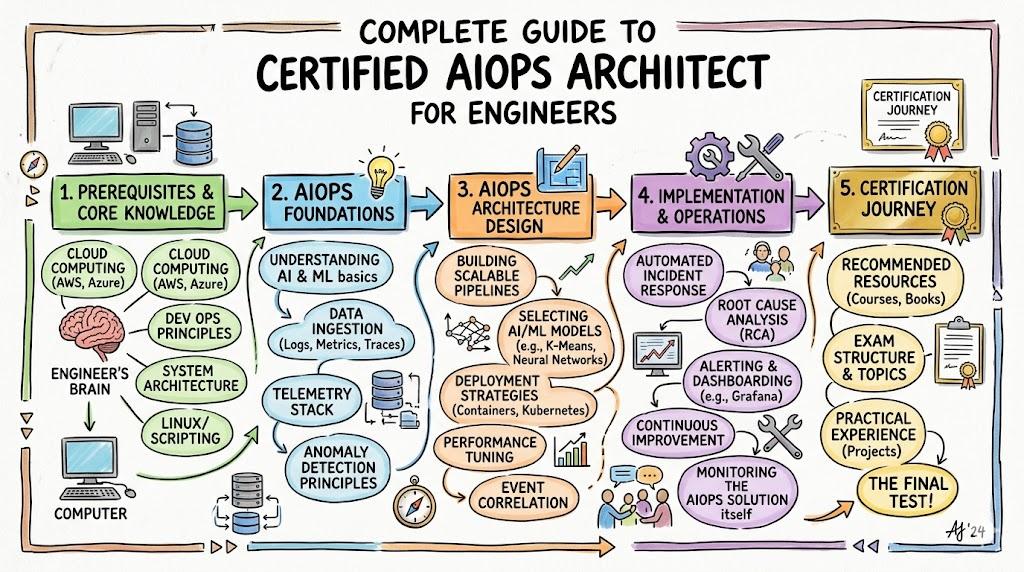
Introduction
AIOps is becoming an important skill area for modern IT teams, software engineers, DevOps teams, SRE teams, platform engineers, engineering managers, and technology leaders. As applications become more distributed, cloud-based, automated, and data-heavy, traditional monitoring is no longer enough. Teams need intelligent systems that can detect issues early, reduce alert noise, support faster root-cause analysis, and help automate operations.The Certified AIOps Architect certification is designed for professionals who want to move beyond basic AIOps concepts and understand how to design large-scale AIOps platforms, reference architectures, operational data lakes, automation systems, and enterprise-ready observability models. The official certification page describes it as an expert or architect-level certification focused on designing large-scale AIOps platforms and leading enterprise-wide operational transformation.
This guide is written for working engineers, software engineers, managers, DevOps professionals, SRE leaders, cloud engineers, automation engineers, and global technology professionals who want to understand whether this certification is the right next step.
About Certified AIOps Architect
The Certified AIOps Architect is an advanced certification for professionals who want to design, govern, and scale AIOps adoption across teams and organizations. It is not only about using tools. It is about creating the architecture, data flow, platform strategy, automation model, governance structure, and implementation roadmap for AI-driven IT operations.
Certification at a Glance
| Area | Details |
|---|---|
| Certification Name | Certified AIOps Architect |
| Track | AIOps |
| Level | Expert / Architect |
| Who It’s For | Senior engineers, architects, managers, DevOps leaders, SRE leaders, platform engineers, CTO-level learners |
| Prerequisites | AIOps Professional certification or strong hands-on experience in AIOps, observability, or platform engineering |
| Skills Covered | AIOps architecture, platform engineering, scalability, data lake design, security, compliance, organizational transformation |
| Recommended Order | AIOps Foundation → AIOps Engineer → AIOps Professional → Certified AIOps Architect |
| Official Link | Certified AIOps Architect |
The official certification page lists the level as Expert / Architect, exam duration as 180 minutes, format as 60 MCQs plus an architecture design challenge, passing score as 78%, and validity as 3 years.
Why Certified AIOps Architect Matters
Many organizations already use monitoring, logging, tracing, incident management, cloud dashboards, and automation scripts. But the real challenge is not only tool usage. The bigger challenge is connecting all these systems into one intelligent operating model.
Certified AIOps Architect helps professionals understand how to design that model.
This certification matters because organizations need experts who can answer practical architecture questions such as:
How should logs, metrics, traces, alerts, events, and incidents flow into one data platform?
How can ML models support anomaly detection, noise reduction, and incident prediction?
How can automation be controlled safely in production?
How can AIOps support hundreds of engineering teams without creating tool chaos?
How can security, compliance, and governance be built into the AIOps architecture?
For managers, this certification helps in planning AIOps adoption, team structure, platform investment, and long-term operational maturity. For engineers, it helps in building real platforms, pipelines, automation flows, and observability-driven operations.
What It Is
The Certified AIOps Architect is an expert-level credential focused on designing enterprise-grade AIOps architectures. It helps professionals learn how to create scalable AIOps platforms, operational data lakes, automation frameworks, security models, and organizational adoption plans.
It is best suited for people who want to lead AIOps platform design, not only operate individual tools.
Who Should Take It
This certification is useful for:
Software engineers who want to move toward AI-driven operations and platform architecture.
DevOps engineers who want to design intelligent automation and observability systems.
SRE professionals who want to reduce incident noise and improve reliability using AIOps.
Cloud engineers who manage large-scale infrastructure and want smarter operations.
Platform engineers who build internal developer and operations platforms.
Engineering managers who want to lead AIOps adoption across teams.
Enterprise architects who define standards, reference models, and technology direction.
Technology leaders who want to understand the structure, cost, risks, and benefits of AIOps platforms.
Skills You’ll Gain
After preparing for Certified AIOps Architect, you should gain practical understanding of:
- AIOps reference architecture design
- Observability architecture using logs, metrics, traces, and events
- Operational data lake planning
- Telemetry ingestion and processing patterns
- Alert correlation and noise reduction design
- ML model lifecycle for operations
- Auto-remediation architecture
- Security-first AIOps platform design
- Compliance and audit readiness
- Platform engineering for AIOps
- Scalable architecture for large teams
- Governance and operating model design
- AIOps maturity planning
- Enterprise adoption roadmap creation
The official curriculum highlights areas such as AIOps reference architecture, platform engineering, scalability patterns, data lake design for operations, security and compliance architecture, and organizational transformation.
Real-World Projects You Should Be Able to Do After It
After completing the learning journey, a strong candidate should be able to work on projects such as:
- Design an enterprise AIOps reference architecture
- Build a telemetry flow covering logs, metrics, traces, events, and incidents
- Create an operational data lake blueprint
- Design alert correlation and event intelligence workflows
- Plan ML-based anomaly detection for production systems
- Create auto-remediation workflows with approval controls
- Build an AIOps platform roadmap for multiple teams
- Define observability standards for engineering teams
- Design security controls for AIOps data and automation
- Create a governance model for AI-driven operations
- Prepare an AIOps adoption maturity model
- Present an architecture design to leadership and implementation teams
Core Learning Areas
AIOps Reference Architecture
This is the foundation of the certification. You learn how to design an end-to-end AIOps architecture that includes data collection, processing, analytics, machine learning, automation, dashboards, alerts, and feedback loops.
A strong reference architecture helps teams avoid random tool adoption. It creates a clear blueprint that different teams can follow.
Platform Engineering
AIOps architecture becomes more powerful when it is treated as an internal platform. This means engineering teams should get self-service access to observability, alerting, automation, dashboards, and incident insights.
The architect’s job is to design a platform that is useful, scalable, secure, and easy for teams to adopt.
Scalability Patterns
Large organizations generate huge amounts of telemetry data. Logs, metrics, traces, and events can grow very fast.
Certified AIOps Architect focuses on patterns such as partitioned ingestion, tiered storage, stream processing, query federation, and back-pressure management. These concepts help keep the AIOps platform reliable under heavy load.
Data Lake Design for Operations
An operational data lake helps collect and organize operational signals for analytics, ML model training, incident history, capacity planning, and reliability improvement.
A good architect should know how to design schemas, governance, data pipelines, access controls, retention rules, and analytics usage for operations data.
Security and Compliance Architecture
AIOps platforms handle sensitive operational data. They may include infrastructure details, application behavior, customer-impacting events, access patterns, and incident records.
That is why security should not be added later. It should be part of the design from the start. This includes encryption, access control, audit logs, compliance mapping, and safe automation controls.
Organizational Transformation
AIOps is not only a technical change. It changes how teams respond to incidents, how they use data, how they trust automation, and how they improve reliability.
The architect must understand people, process, governance, adoption challenges, and change management.
Preparation Plan
7–14 Days Plan
This plan is suitable for senior professionals who already have strong experience in observability, DevOps, SRE, cloud, or platform engineering.
Focus areas:
- Read the full certification outline
- Review AIOps reference architecture concepts
- Study logs, metrics, traces, events, and incident data flow
- Review architecture patterns for scalability
- Practice one AIOps design scenario
- Prepare notes on security and governance
- Review common AIOps implementation mistakes
- Create one sample architecture diagram
- Practice explaining the design in simple language
This plan is intense and should be used only if you already have strong background knowledge.
30 Days Plan
This is a balanced plan for working engineers and managers.
Week-wise focus:
First phase: Understand AIOps basics, architecture goals, observability signals, and enterprise use cases.
Second phase: Study platform engineering, telemetry pipelines, data lake design, alert correlation, and ML model usage.
Third phase: Focus on security, compliance, governance, automation control, and organizational transformation.
Final phase: Practice architecture design challenges, write solution documents, and revise key concepts.
By the end of this plan, you should be able to explain how AIOps fits into real production environments.
60 Days Plan
This plan is best for professionals who want deep preparation and practical confidence.
Focus areas:
- Build a strong foundation in AIOps and observability
- Study real-world incident management workflows
- Design small architecture diagrams
- Learn telemetry ingestion and storage patterns
- Understand data governance and retention
- Practice ML use cases in operations
- Study auto-remediation safety models
- Prepare a complete AIOps adoption roadmap
- Practice multiple architecture scenarios
- Review leadership-level communication
- Prepare for MCQs and architecture design challenge
This plan gives enough time to learn, apply, revise, and practice design thinking.
Common Mistakes
Many candidates make mistakes because they treat architect-level learning like a tool tutorial. This certification needs broader thinking.
Common mistakes include:
- Focusing only on tools instead of architecture
- Ignoring data quality and telemetry design
- Not understanding logs, metrics, traces, and events together
- Designing automation without safety controls
- Missing security and compliance planning
- Not considering scale, cost, and performance
- Ignoring team adoption challenges
- Not practicing architecture design scenarios
- Giving generic answers instead of practical design decisions
- Forgetting governance, ownership, and operating model
Best Next Certification After This
After Certified AIOps Architect, the best next certification depends on your career direction.
For professionals who want to stay close to reliability and operations, an SRE-focused certification is a strong next step.
For professionals moving toward AI engineering and model operations, an MLOps certification can be useful.
For leaders managing cost, governance, and platform maturity, FinOps or DataOps certifications can also add strong value.
A practical next path can be:
Certified AIOps Architect → SRE Certification → MLOps Certification → FinOps or DataOps Certification
Choose Your Path
DevOps Path
If you are from a DevOps background, Certified AIOps Architect helps you move from CI/CD and automation into intelligent operations. You can learn how deployment pipelines, monitoring, incident response, and automation can connect with AI-driven insights.
Best focus areas:
- Automation architecture
- Monitoring integration
- Incident response workflows
- Self-healing systems
- Platform engineering
DevSecOps Path
If you work in DevSecOps, this certification helps you understand how security and compliance should be designed inside AIOps platforms.
Best focus areas:
- Secure telemetry handling
- Zero-trust access
- Audit logging
- Compliance reporting
- Risk-aware automation
SRE Path
For SRE professionals, AIOps can support reliability goals, SLO monitoring, alert reduction, faster incident response, and better root-cause analysis.
Best focus areas:
- SLO-based operations
- Incident intelligence
- Alert correlation
- Reliability dashboards
- Auto-remediation with controls
AIOps/MLOps Path
This is the most direct path. If you want to work deeply in AI-driven operations, ML-based anomaly detection, model lifecycle, and intelligent automation, this certification is highly relevant.
Best focus areas:
- ML for operations
- Anomaly detection
- Model governance
- Predictive analytics
- Operational intelligence
DataOps Path
AIOps depends heavily on clean, reliable, governed data. DataOps professionals can use this certification to understand operational data pipelines, telemetry data lakes, and analytics readiness.
Best focus areas:
- Data pipelines
- Operational data lakes
- Data quality
- Metadata and governance
- Analytics enablement
FinOps Path
FinOps professionals can use AIOps to understand cloud cost anomalies, usage patterns, resource optimization, and intelligent operational cost control.
Best focus areas:
- Cost anomaly detection
- Capacity planning
- Cloud usage intelligence
- Optimization automation
- Governance reporting
Recommended Learning Order
The best learning order depends on your current experience, but a safe path is:
- Learn basic AIOps concepts
- Understand observability fundamentals
- Study DevOps, SRE, and incident management basics
- Learn AI/ML use cases in operations
- Study AIOps platform architecture
- Practice data lake and telemetry design
- Learn governance, security, and compliance
- Practice architecture design scenarios
- Prepare for Certified AIOps Architect
For beginners, it is better to complete foundation and engineer-level learning first. For experienced professionals, direct preparation may be possible if they already understand enterprise architecture, platform engineering, and operational systems.
Institutions That Help in Training cum Certification
DevOpsSchool
DevOpsSchool is known for DevOps, DevSecOps, SRE, cloud, automation, and related professional training programs. For learners preparing for Certified AIOps Architect, it can help build strong background knowledge in DevOps practices, CI/CD, monitoring, automation, and enterprise delivery models. This is useful because AIOps architecture often connects deeply with DevOps workflows.
Cotocus
Cotocus supports consulting, technology implementation, and training-style enablement in modern IT practices. Professionals preparing for AIOps architecture can benefit from learning practical implementation thinking, automation planning, and enterprise solution design. It is useful for learners who want a more project-oriented understanding.
Scmgalaxy
Scmgalaxy is associated with software configuration management, DevOps, automation, and modern engineering practices. It can help learners strengthen their foundation in release management, CI/CD, infrastructure automation, and operations workflows. These skills are helpful before moving into advanced AIOps architecture.
BestDevOps
BestDevOps focuses on DevOps-related learning, certification awareness, and career guidance. It can help professionals understand how DevOps certifications, role-based learning paths, and skill roadmaps connect with AIOps career growth. This is useful for engineers planning long-term certification progression.
devsecopsschool
devsecopsschool is useful for learners who want to connect AIOps with security, compliance, and DevSecOps practices. Since Certified AIOps Architect includes security and compliance architecture, DevSecOps knowledge can help professionals design safer automation, better access control, and audit-friendly platforms.
sreschool
sreschool is useful for professionals who want to connect AIOps with reliability engineering. SRE concepts such as SLOs, incident response, observability, error budgets, and production readiness are closely related to AIOps architecture. This makes it a strong supporting institution for AIOps learners.
aiopsschool
aiopsschool is the official provider for Certified AIOps Architect. It offers AIOps and MLOps certification pathways from foundation to architect level, along with training and certification-focused resources. For this certification, it should be treated as the primary institution because the official certification page and provider information come from AIOpsSchool.
dataopsschool
dataopsschool can help learners understand data pipelines, governance, data quality, and operational data management. Since AIOps platforms depend on logs, metrics, traces, events, and historical operational data, DataOps knowledge is useful for building reliable AIOps data foundations.
finopsschool
finopsschool is helpful for professionals who want to connect AIOps with cloud cost control, financial governance, and resource optimization. AIOps can support FinOps by detecting cost anomalies, forecasting resource usage, and improving operational efficiency.
Career Value of Certified AIOps Architect
Certified AIOps Architect can be valuable for professionals aiming for senior technical and leadership roles. The official page lists related roles such as AIOps Platform Architect, Enterprise Architect, VP of Site Reliability, CTO, and Principal Engineer in Observability.
For engineers, this certification can support movement toward architecture, platform leadership, and intelligent operations roles.
For managers, it can help in planning enterprise AIOps strategy, selecting platforms, building teams, and managing transformation.
For organizations, certified architects can help reduce tool confusion, improve incident response, build scalable observability systems, and create safer automation practices.
Final Checklist Before You Start
Before starting preparation, check whether you are comfortable with:
- Basic DevOps concepts
- Monitoring and observability
- Logs, metrics, traces, and events
- Incident management process
- Cloud infrastructure basics
- Automation concepts
- Security and compliance basics
- Architecture diagrams
- Platform engineering ideas
- Team adoption and process change
If you are weak in these areas, spend time strengthening the foundation before attempting architect-level preparation.
Conclusion
The Certified AIOps Architect certification is a strong choice for professionals who want to lead the future of intelligent IT operations. It is especially useful for working engineers, software engineers, DevOps professionals, SRE teams, platform engineers, cloud engineers, managers, and enterprise architects who want to design scalable, secure, and practical AIOps platforms.
This certification is not only about learning definitions. It is about thinking like an architect. You need to understand systems, data, automation, security, governance, people, process, and business value together. A successful AIOps architect should be able to design platforms that reduce operational noise, improve reliability, support automation, and help teams make faster decisions.
For professionals in India and across the global market, this certification can help build a strong profile in AI-driven operations, observability, platform engineering, and enterprise technology leadership. Start with the official certification page, understand the scope clearly, choose your learning path, prepare with real architecture scenarios, and focus on practical skills that can be used in real production environments.