
Study #1:

Note at first that these are two different studies from two different books but with the same author. I don't know how you came to your conclusions but they're wrong. In the first table the sub species are given, for example, and nothing's said on the sex just in the first table. Here's the weight of the used lion and tigers in the first table (for weights I'll use rounded numbers from now on):
Panthera Leo (n=2): 123.14 kg
Panthera Tigris Altaica (n=5): 142.48 kg
Panthera Tigris ssp. (n=1): 88.02 kg
For the second table:
Panthera Leo, no 1 (male): 145.00 kg
Panthera Leo, no 2 (female): 114.13 kg
Panthera Leo, no 3 (female): 104.57 kg
Panthera Tigris Altaica (female): 149.81 kg
Panthera Tigris ssp., no 1 (female): 136.46 kg
Panthera Tigris ssp., no 2 (female): 136.22 kg
You can see that tigresses larger than the male lions were used. Ssp. doesn't mean they were Javan tigers, the sub species are just not known. Probably bengals as they're the most held tigers in captivity, though one seemed to be particularly small, I agree.
Study #2:
Sample size is given, as well as sexes (both sexes for both animals). But, here I can't calculate anything as the humerus length isn't given.
Study #3:
Sample size is given. Subspecies and sexes not, but do you really want to know? Although the lion on average has the larger humerus it had the somewhat shorter humerus - and it still was somewhat thicker. here are the weights for the used lions and tigers:
Panthera Leo (n=4): 119.55 kg
Panthera Tigris (n=2): 132.32 kg
Study #4:
Sample size was given, just count how many tigers and how many lions were used. One lion and two tigers, which doesn't suffice to make a real conclusion but as there are more studies it's well usable. Weights and humeri lengths were given, so nothing to calculate here.
Study #5:
The only thing you questioned was sex. But, I have no idea why, it was given. Just look behind the species names, you'll see it. Humeri lengths and weights given, nothing to calculate.
Now I'll come to the last mentioned study, the study on shoulder strength. I know I left out the first one but that is due to the fact that the humeri given in this study don't belong to the scapulae and thus I can't calculate their weights. However, we got more info, from Christiansen & Harris, 2005:
“Scapula length in Megantereon is comparable
with lions (N = 17; ♀: 175.7–242.1 mm; ♂:
210.2–288.4 mm) and Bengal tigers (N = 15; ♀:
190.7–241.7 mm; ♂: 199.1–241.3 mm), and far larger
than in leopards (N = 16; ♀: 123.2–150.8 mm; ♂:
144.6–170.3 mm), and jaguars (N = 8; ♀: 152.1–
158.2 mm; ♂: 163.3–172.6 mm). Scapula length in
Smilodon is 266–358 mm (Merriam & Stock, 1932),
far exceeding the scapula size in even Siberian tigers
(N = 3; ♂: 270.5–284.8 mm), despite Smilodon being
lion-sized overall (Kurtén & Anderson, 1980; Akersten,
1985), albeit substantially more massive in
build. ” Mushiya, who posted this study first also stated the following: "Large subspecies of lion seems to have the same scapula length as the Siberian tiger." - A tiger supporter who thinks objectively, it seems. Bengal tigers have scapulae the size of lionesses' scapulae on average! While siberian tigers score much higher there but still the largest lions have as large (and in this case even larger) shoulder blades as the largest tigers. Now look at the shoulder blades given in this study, how long they're in mm I'll show now: From left to right for the first lion it was about 254 mm, for the second one it was about 287 mm and for the third one it was about 228.6 mm. The average was 256.5 mm. For the tiger it was 228.6 mm.
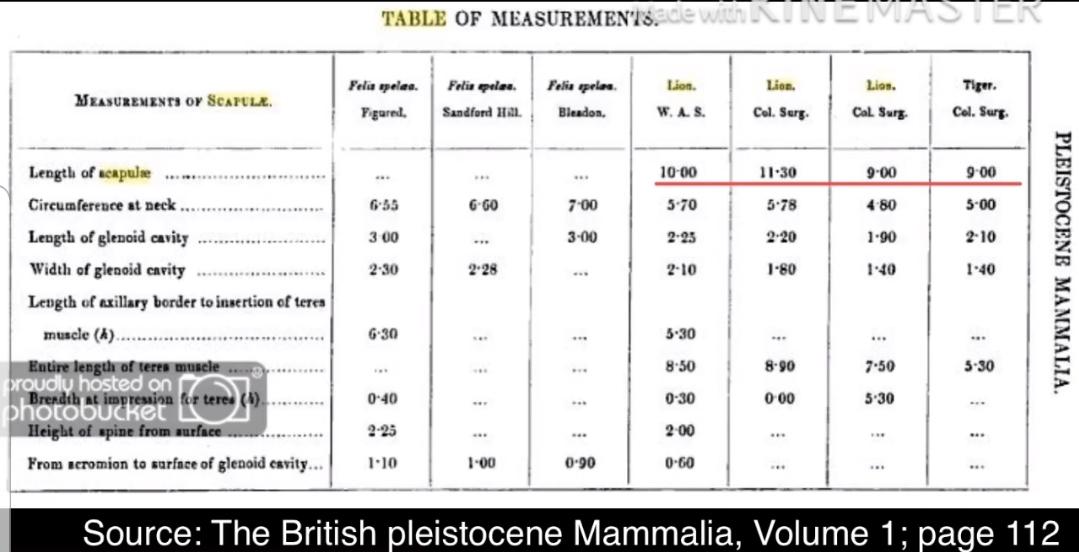
Perfectly in the given ranges (and in Christiansens study tigers over 220 kg were used, partially, while I know that the weight of one lion was 203 kg, relatively big sample sizes were used so it's accurate). I don't see the problem with this one. Obviously the lions were males while it isn't certain but it's also not important if the tiger was male or female, the scapulae are equally long.
Shortly Explained:
I. SCAPULAR SIZE:
(Sibirian Tiger Sample size to small... not Included)
Study: Christiansen and Adolfssen, 2007.
Metric: Scapular length.
Correlated With: Space for muscle attachment in the shoulders.
Sample Size: 17 lions, 15 tigers.
Lion: 210.2-288.4 mm.
Bengal Tiger: 199.1-241.3 mm.
Edge: Lion.
However, now I'll come to the last mentioned study, finally:
Shoulder study #2:

Source: http://tobias-lib.uni-tuebingen.de/dbt/volltexte/2003/828/pdf/Diplomarbeit.pdf
First of all i want to note that Schmieder seems to have made a typing mistake. The percentage for GL/T. Major wasn't 13.9% but 19.3%. Here the used humeri for the lions were 315.5 mm and 345 mm, for the tiger it was 326 mm and 315.5 mm. SO, if we go by the regression formula the lions weighed 175 kg and 151.81 kg and the tigers weighed 166.51 kg and 151.81 kg. However, this doesn't really matter as these are relative numbers and therefore not influenced by size differences. As you've seen in the scapula data male tigers and tigresses have equally large scapulae and therefore similar Teres muscles while that of lionesses are quite a bit shorter than that of male lions. So, this study's result isn't unreasonable. Sample size is too small to be really conclusive but together with the other existing data it's not inconclusive, either. This shoulder strength advantage is real.
(Note that these are only approximate numbers but still show which animal was larger in which study.)
Conclusions:
Now, let's come to the conclusions: In study #1 the average for the first table for lions was 123.13 kg and 133.40 kg for tigers - advantageous for the tigers, which resulted in a slightly higher overall deltopectoral crest (however, the difference was about 8% which is again advantage for the tiger). However, if we divide it by humerus length to get the relative numbers we can use for average specimens the lion has the advantage. In the second table the average weight for lions was 121.23 kg, for tigers it was 140.83 kg. So again the tiger was heavier. However, this time the weight difference was about 14% which is over the normal weight difference.
About study #2 everything is said. About study #3: The weight difference is about 10%.. again advantage for the tiger. So, these are accurate numbers. The lion got the higher A-P diameter, also called strength index and the higher M-L diameter here. Clearly, this study is accurate, not 100% conclusive as the sample size was very small (at least for tigers) but still well usable. To the other studies I have nothing to add, everything's said. To the shoulder strength studies as well.