
n= How many Animals used..... (Sample Size)
Datas + Expert Analyses.
Lion
Fat: 12% n=17
Muscle: 59% n=2
Tiger
Fat: 13,4% n=2
Muscle: 56% n=1
I dont include captive tiger because then the average percentage would be much much more.
Female Tiger 135 kg had a fatpercentage of 7.8 %.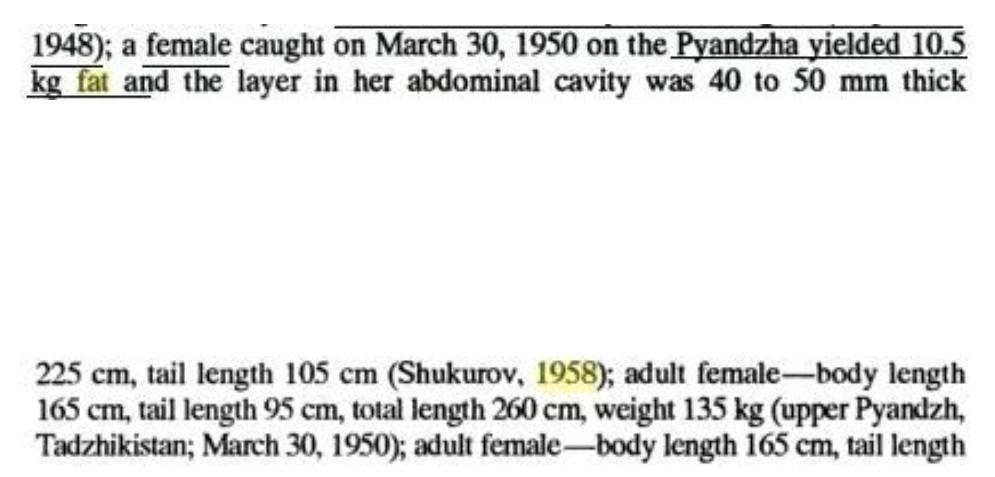
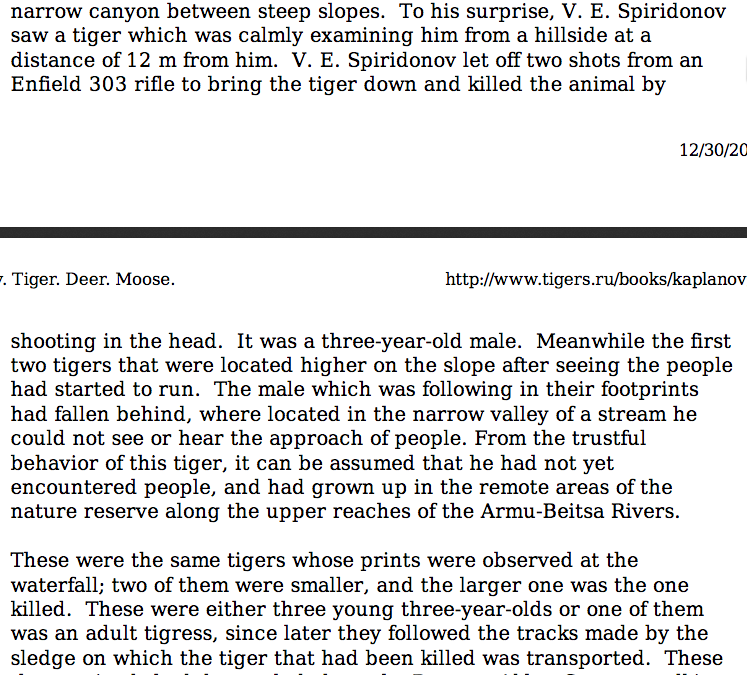
Tiger male, between 3-4 years of age, weighed 160 kg. The skeleton, without the skin, internal organs or fat weighed 110 kg (242.5 lbs) 69%. Skin weighed 10 kg (10,000 grms) (22 lbs) 6.27%. Fat weighed 30 kg (30,000 grms) (66 lbs) 19%. Internal organs weighed 10 kg (22 lbs) 6.27%. Very Well-fed male, 85 cm in height. The skeleton alone should be some 13% of body weight (estimate), meaning that muscle comprises some 56% (89.6 kg) body weight, in this tiger. Thats 197.5 lbs of muscle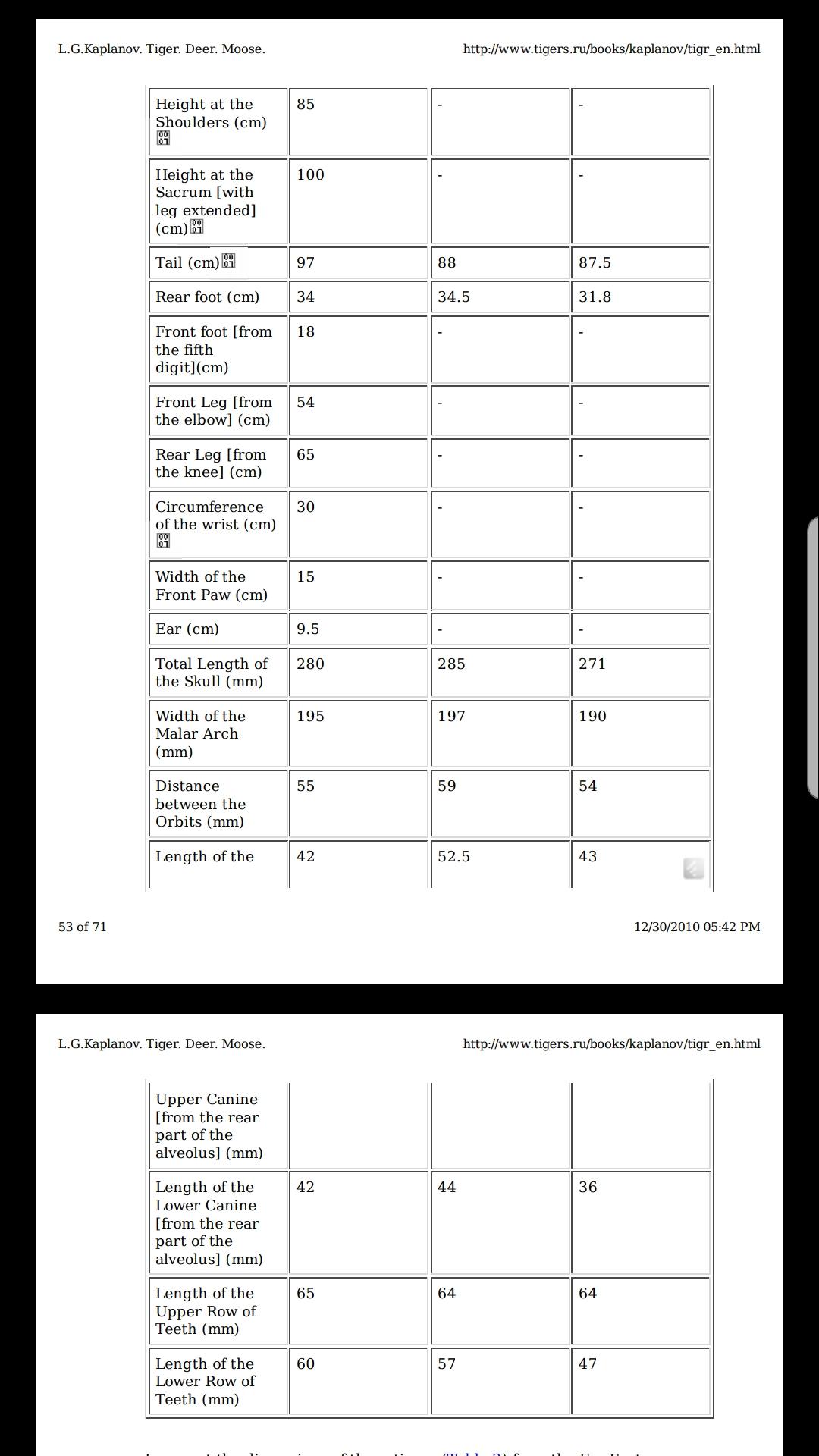
( Full Data: https://cutt.ly/2rvR18R )
The source on the tiger having 72% muscle mass seems to be false. The 'study' was based upon ONE individual. Let me quote PoCheol who actually posted the 'study':
it was a 4-6-yr-old, '161.1 kg' male siberian tiger which was poached in Heilongjiang Province of China in 1989. the muscle mass of the tiger was 117 kg, which constituted 72.7% of the 'total body weight'. the tiger's skeleton weighed 15.8 kg (9.8%), skin weighed 16.7 kg (10.4%) and internal organs weighed 11.3kg (7.0%). what percentage of the tiger's weight was blood and subcutaneous fat? the answer is 0.2%._
After PoCheol`s got a message from another poster, he posts his reply:
The study must had a error. A animal with a body which is only ~0.2% (0.18%) of blood and fat is impossible.
PoCheol's response:
_sorry i do not know if the '161.1 kg' tiger was emaciated or not. some sources claimed that it was a 200 kg healthy specimen and according to one source, the tiger was seen frolicking with 2 tigresses right before he and his playmates were killed by poachers. for comparison, L.G. Kaplanov reported on a 3-4-yr-old male tiger cub which was killed in Velikaya Kema Russia on 16.02.1940. the animal's total weight was 160 kg, of which 30 kg was internal fat._
200 kg was in my opinion 100% the case. Then the Musclepercentage would be 58.5% which is proved to be a good number from the lions and the other tiger.
The only 1989 source i could find on a tiger close to 161 kg, was the 160 kg tiger quoted by Mammals Of The Soviet Union, that had 30 kg of fat. PoCheol claimed some sources say that tiger was seen frolicking with 2 tigresses right before they were killed, and thats the same circumstances in which the 160 kg tiger was killed:
Female Lioness had a fat percentage of 5.3% and a Muscle percentage of 62.5%. And a 109kg ill male Lion had a Muscle Percentage of 55%. Average Musclerpercentage for these Lions were 59%. (Btw this is the studie who gives the average musclepercentage for the lion)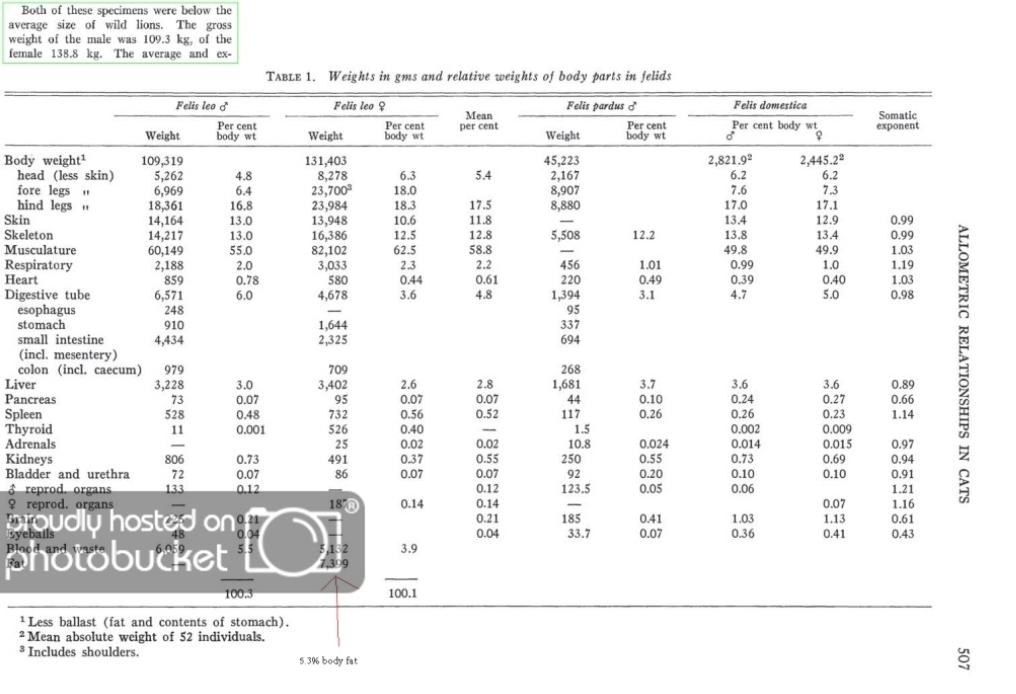
Another lioness, of 167 kg, had a fat content of 13%, more than the previous lioness and tigress because of her greater weight( 33kg more) and the fact that pregnant lionesses contain nealry always more fat: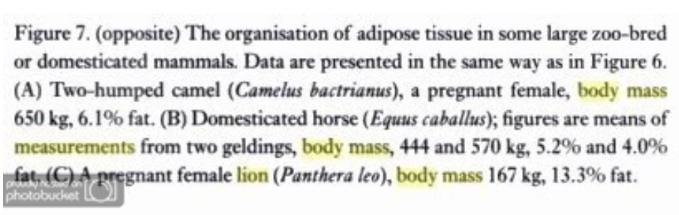
14 Lions had a Fat Percentage of 13%.
http://www.aza.org/uploadedFiles/Animal_Care_and_Management/Animal_Programs/Animal_Programs_Database/Animal_Care_Manuals/Lion%20Care%20Manual%202012%281%29.pdf
Page 54
_"More specific body composition techniques exist and can further validate BCS scales in exotic animals, however these techniques are challenging or expensive to apply. Beyond the data reported above, body composition has not been assessed in lions, however it has been estimated from total body water from 14 wild lions in 2 studies (Clarke & Berry, 1992; Green et al., 1984). Average total body water was 64% and did not differ between males and females or immature vs. mature lions (P>0.05). This corresponds to an average fat mass of 13% bodyweight (range 3 to 21%)...._"
Expert Opinions and Analysis
George Schaller, the worlds most preeminent field zoologist says the lion is stronger than the tiger, and the tiger is afraid of the lion. Schaller goes on to say, the lion is the better fighting cat, and wins when kept together in zoological gardens.
Schaller also states, the tiger has a higher fat storage in its skin and stomach than the lion.
George H. Schaller
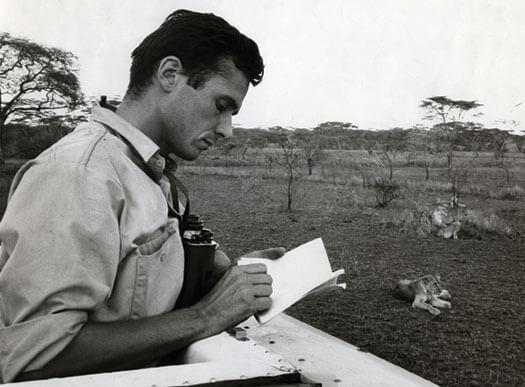
The Dr.Giuliano Russini – Biologist Zoologist, in a below message stated that Schaller in an Italian encyclopedia from 1977, called "Life of wild animals" did a comparative analysis between lions and tigers stating the lion was stronger, and the tougher better fighting cat.
https://www.monaconatureencyclopedia.com/felidae/?lang=en
" I helped Giuseppe Mazza for a period and I used informations presnt on several zoology books mine and Encyclopaedia, in relation to Dr Schaller, I took information by an Italian Encyclopaedia, of 1977 where he wrotes his contributes on great felines. He said to have visitated India, several times simply for travel and so compared the two biggest felines for what saw also into zoological gardens. The Italian Encyclopedia is "La vita degli animali selcatci" translated "Life of wild animals"
The Encyclopedia is too much old exist only on paper 1977, he during description explain that also comparate anatomical studies show in lion greatest muscles mass, and he no really smallest of tiger. Yes in captivity tiger show to be fear of lion (male) said." Giuliano Russini, Biologist and Zoologist
Source, "La vita degli animali selcatci" 1977
Also the dimensions which, in an almost legendary way are often rendered in favour of the tiger, in reality have true and proper equivalences. On the contrary, the tiger has an inferior muscular mass compared to the African lion and a greater adipose panniculus(thicker layer of fat in the subcutaneous tissue). This caused by overheating corporeal overheating phenomena, is in fact a handicap in case of prolonged fights, drawback not found in the lion who, as they say, “will struggle up to the death”.
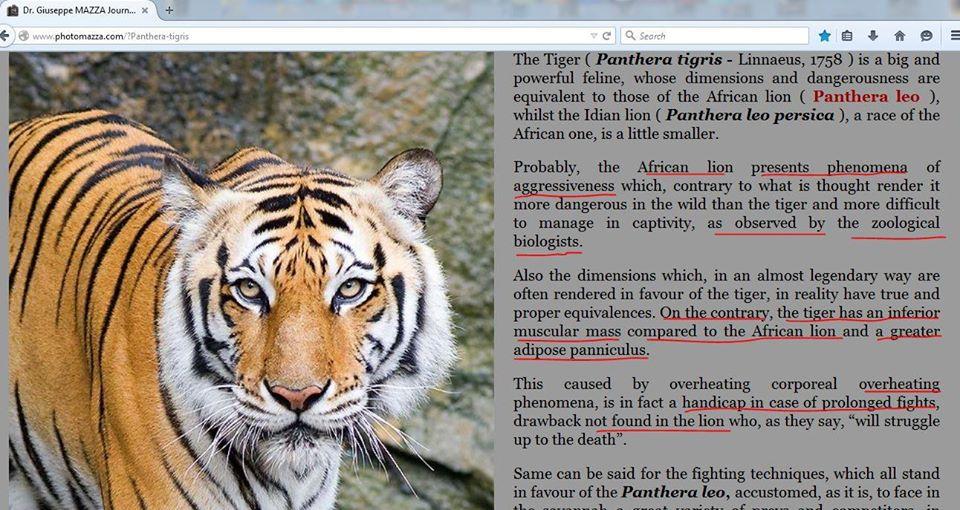
https://www.monaconatureencyclopedia.com/panthera-tigris/?lang=end
" Also in terms of fighting techniques and ferocity, the lion, which has more competitors than the tiger in its ecotype, is therefore more dangerous and smart than the Asiatic feline. As a matter of fact, in the zoos and the zoo-safaris, the lions create many more problems of adaptation and are much more dangerous for the visitors than the tigers; and when the males of the two species fight in captivity, the tiger is always the loser. In any case, the tiger remains always, in the wild, a terrible and dangerous predator." DrSc Giuliano Russini – Biologist Zoologist, Source George Schaller, "La vita degli animali selcatci" Italian encyclopedia, 1977
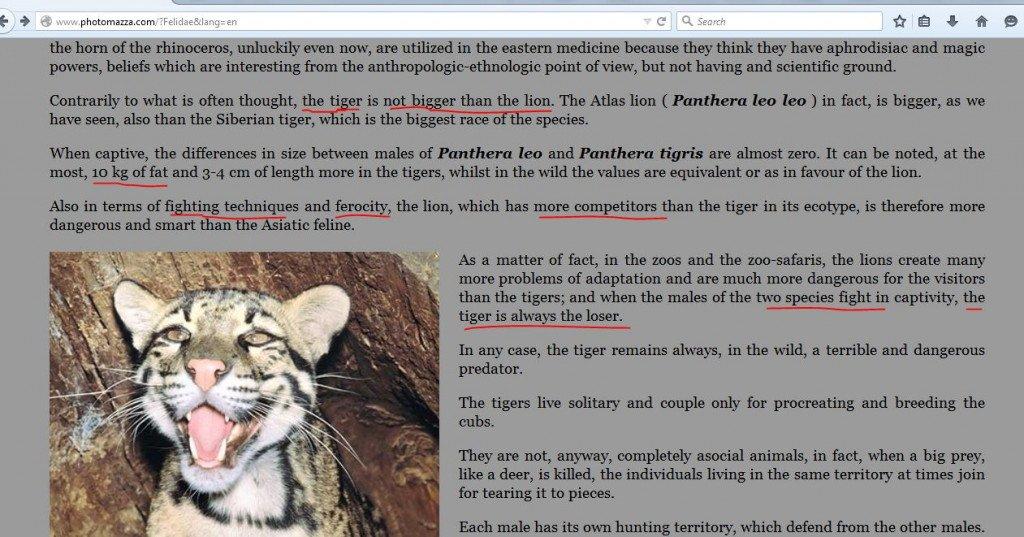
https://www.monaconatureencyclopedia.com/felidae/?lang=en
