
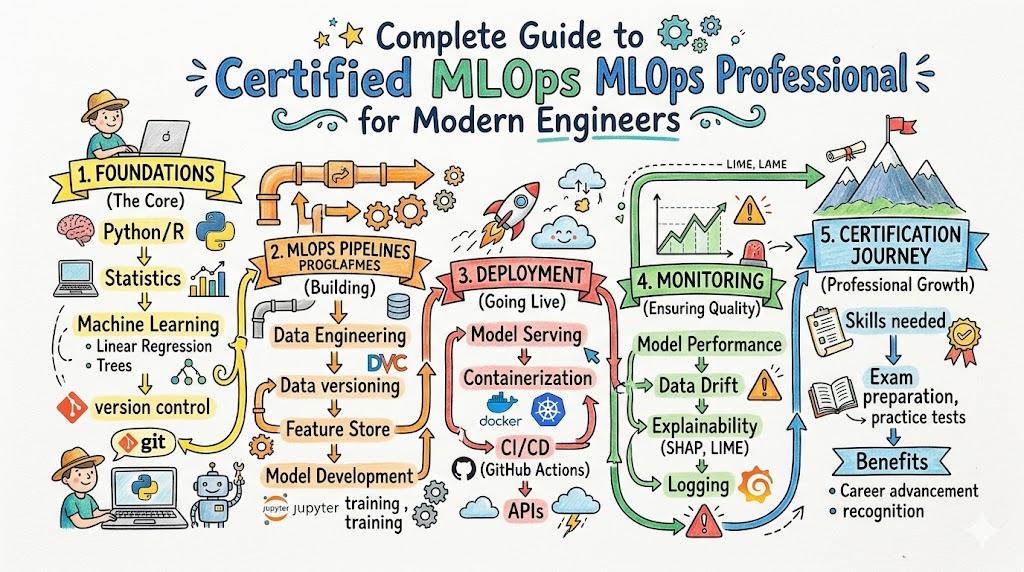
Introduction
Machine Learning is no longer limited to research teams and data science labs. Today, many companies use machine learning models in real products, business systems, customer platforms, automation workflows, fraud detection systems, recommendation engines, chatbots, forecasting systems, and decision-making tools.
But building an ML model is only the first step.The real challenge starts when the model has to run in production. It must be deployed, monitored, retrained, governed, tested, optimized, and protected from failure. This is where MLOps becomes important.The Certified MLOps Professional certification is designed for engineers, managers, software professionals, DevOps teams, data teams, and ML platform teams who want to prove their ability to operate machine learning systems in real production environments.This guide explains the certification in simple English. It is written for working engineers, managers, software engineers, DevOps professionals, SRE teams, data engineers, AI/ML professionals, and technology leaders in India and across the world.
What Is Certified MLOps Professional?
Certified MLOps Professional is an advanced-level certification focused on production machine learning systems. It validates your ability to manage ML models after deployment, especially in complex environments where reliability, governance, performance, and scale matter.
This certification is useful for professionals who already understand DevOps, CI/CD, containers, cloud platforms, model deployment, monitoring, and production operations.
Certification Overview
| Track | Level | Who it’s for | Prerequisites | Skills covered | Recommended order | |
|---|---|---|---|---|---|---|
| MLOps | Advanced / Professional | Software Engineers, ML Engineers, DevOps Engineers, SREs, Managers, Platform Engineers | Certified MLOps Engineer or 3+ years of hands-on ML production experience | Production ML systems, A/B testing, governance, monitoring, performance optimization, multi-model serving, continuous training | Foundation → Engineer → Professional → Architect |
Why Certified MLOps Professional Matters
Many organizations are investing in artificial intelligence and machine learning. But many ML projects fail after the proof-of-concept stage because teams do not know how to operate models in production.
A model may work well in a notebook, but it can fail in production due to:
- Poor data quality
- Data drift
- Model performance decay
- Slow inference
- High cloud cost
- Weak monitoring
- No rollback plan
- No governance
- No retraining process
- Poor collaboration between data science and engineering teams
Certified MLOps Professional helps professionals understand how to solve these problems in a structured way.
For software engineers, it creates a bridge between application engineering and machine learning operations. For managers, it helps in understanding how ML platforms should be planned, governed, and scaled.
Who Should Take Certified MLOps Professional?
This certification is suitable for professionals who want to move beyond basic ML deployment and learn how to manage production ML systems at scale.
It is especially useful for:
- Software Engineers working with AI-enabled applications
- DevOps Engineers moving into MLOps
- ML Engineers managing production models
- Data Engineers supporting ML pipelines
- SRE professionals responsible for ML reliability
- Engineering Managers leading AI/ML teams
- Platform Engineers building ML infrastructure
- Cloud Engineers supporting ML workloads
- Technical Consultants working with AI/ML clients
- Architects designing enterprise ML platforms
This certification is not only for data scientists. It is also valuable for engineers who manage infrastructure, automation, release pipelines, monitoring, reliability, and production systems.
What It Is
Certified MLOps Professional is an advanced certification for professionals who operate machine learning systems in production. It focuses on real production challenges such as model performance, monitoring, governance, experimentation, scaling, and continuous training.
It is designed for professionals who want to validate their ability to manage ML systems that directly affect business outcomes.
Skills You’ll Gain
After preparing for this certification, you should gain strong knowledge in:
- Production ML system design
- Model deployment strategies
- A/B testing for machine learning models
- Canary release and blue-green deployment for ML
- Model governance and compliance
- Model lineage and audit documentation
- Data drift and model drift detection
- Advanced monitoring for ML systems
- Performance optimization for inference
- Multi-model serving architecture
- Continuous training pipelines
- Safe model promotion workflows
- ML incident response
- Cost-aware ML operations
- Reliability planning for ML platforms
These skills are useful in both Indian and global organizations because production ML challenges are similar across markets.
Real-World Projects You Should Be Able to Do After It
After completing this certification path, a learner should be able to work on practical projects such as:
- Build a production ML deployment pipeline
- Create a model monitoring dashboard
- Set up drift detection for live models
- Design an A/B testing strategy for model comparison
- Create a safe model rollback process
- Build a retraining pipeline based on data freshness
- Optimize model inference latency
- Manage multiple models in one serving platform
- Create model governance documentation
- Build approval workflows for model promotion
- Design alerting for prediction quality issues
- Plan MLOps architecture for enterprise teams
These projects are highly useful for real jobs because companies need engineers who can take ML from development to production safely.
Core Topics Covered in Certified MLOps Professional
1. Production ML Systems
This area focuses on how machine learning systems behave in production. A production ML system is not just a model. It includes data pipelines, APIs, infrastructure, deployment pipelines, monitoring, rollback, governance, and support processes.
You learn how to think about reliability, capacity planning, disaster recovery, model release patterns, and production stability.
2. A/B Testing and Experimentation
A/B testing is very important in MLOps. It helps teams compare two or more model versions using real traffic.
You learn how to design experiments, split traffic, define success metrics, use guardrail metrics, and make safe rollout decisions.
3. Model Governance and Compliance
In many industries, ML models must be explainable, traceable, documented, and auditable.
This topic helps you understand model risk, compliance checks, documentation standards, approval workflows, and model lineage.
4. Performance Optimization
A model may be accurate, but if it is too slow or expensive, it may not be suitable for production.
You learn how to improve latency, throughput, cost, batching, caching, model compression, quantization, pruning, and hardware-aware optimization.
5. Multi-Model Serving
Many companies do not run only one model. They may run dozens or hundreds of models for different use cases.
This topic covers model routing, dynamic model loading, ensemble methods, resource sharing, dependency management, and large-scale serving design.
6. Advanced Monitoring
Traditional monitoring checks CPU, memory, disk, and network. ML monitoring goes deeper.
You learn how to monitor prediction quality, data drift, model drift, custom ML metrics, feedback loops, anomaly patterns, and business impact.
Exam and Certification Details
The Certified MLOps Professional certification is advanced and scenario-focused. It is designed to check practical decision-making, not only theory.
Important exam details include:
- Exam format: Multiple-choice and scenario-based questions
- Number of questions: 80
- Duration: 150 minutes
- Passing score: 75%
- Delivery: Online proctored exam
- Prerequisite: Certified MLOps Engineer or 3+ years of hands-on ML production experience
- Retake: One free retake within 60 days, as mentioned on the official certification page
Because the exam includes scenario-based questions, candidates should focus on practical understanding, not only definitions.
Preparation Plan
7–14 Days Preparation Plan
This plan is suitable for experienced professionals who already work with ML systems, DevOps, cloud, or production platforms.
Days 1–2: Understand the Certification Scope
Study the certification objectives. Understand production ML systems, monitoring, governance, and performance optimization.
Days 3–5: Focus on Production ML and Deployment
Revise deployment patterns such as canary release, blue-green deployment, rollback, versioning, and model promotion.
Days 6–8: Study Monitoring and Drift
Learn data drift, model drift, prediction monitoring, feedback loops, and alerting strategy.
Days 9–11: Practice Governance and A/B Testing
Understand model lineage, documentation, approvals, compliance, experiment design, and traffic splitting.
Days 12–14: Practice Scenarios
Solve case-based questions. Think like a production owner. Focus on trade-offs, cost, performance, reliability, and risk.
30 Days Preparation Plan
This plan is best for working engineers and managers who can study a little every day.
Week 1: MLOps Foundation Refresh
Revise ML lifecycle, CI/CD, containers, APIs, model registry, feature stores, and deployment basics.
Week 2: Production Operations
Study monitoring, incident response, rollback, model versioning, environment management, and reliability.
Week 3: Advanced MLOps Topics
Focus on governance, A/B testing, continuous training, multi-model serving, and performance optimization.
Week 4: Practice and Review
Work on practical labs, prepare notes, revise scenarios, and attempt mock questions.
60 Days Preparation Plan
This plan is suitable for software engineers who are new to production ML or managers who want strong conceptual clarity.
Days 1–15: Learn the ML Production Lifecycle
Understand how models move from development to production. Learn about data pipelines, model packaging, deployment, serving, and monitoring.
Days 16–30: Learn DevOps for ML
Focus on CI/CD, containers, Kubernetes basics, cloud deployment, infrastructure automation, and release strategies.
Days 31–45: Learn Advanced MLOps
Study governance, model risk, drift detection, A/B testing, model retraining, and multi-model serving.
Days 46–60: Build and Practice
Build small projects. Create deployment pipelines, monitoring dashboards, and retraining workflows. Practice scenario-based questions.
Common Mistakes to Avoid
Many candidates prepare only from theory and fail to understand real production situations. Avoid these mistakes:
- Learning definitions without practical examples
- Ignoring monitoring and drift detection
- Treating ML deployment like normal software deployment
- Not understanding data quality issues
- Skipping governance and compliance topics
- Not practicing scenario-based questions
- Ignoring inference cost and latency
- Not learning rollback and safe release strategies
- Focusing only on model accuracy
- Underestimating continuous training pipelines
- Not understanding business impact of model failures
A good MLOps professional must think about reliability, speed, cost, compliance, and user impact together.
Best Next Certification After This
The best next certification after Certified MLOps Professional is usually Certified MLOps Architect.
Certified MLOps Professional focuses on operating production ML systems. Certified MLOps Architect is the next logical step for professionals who want to design large-scale enterprise ML platforms, define architecture standards, lead teams, and manage organization-wide MLOps strategy.
Recommended order:
- MLOps Foundation
- MLOps Engineer
- Certified MLOps Professional
- Certified MLOps Architect
Choose Your Path
Different professionals can use Certified MLOps Professional in different ways. Choose your path based on your current role and future goal.
1. DevOps Path
If you are from a DevOps background, MLOps is a natural career extension.
You already understand CI/CD, automation, cloud, containers, monitoring, and release management. Now you need to understand how ML models are different from normal applications.
Focus areas:
- Model deployment
- Model registry
- ML pipelines
- Feature stores
- Drift monitoring
- Continuous training
- Model rollback
This path is best for DevOps Engineers who want to move into AI/ML platform engineering.
2. DevSecOps Path
If you work in DevSecOps, MLOps gives you a new area of security and governance.
ML systems need security at the data level, model level, pipeline level, and serving level. You also need to think about model risk, data privacy, access control, audit logs, and compliance.
Focus areas:
- Secure ML pipelines
- Model governance
- Compliance checks
- Access control
- Data privacy
- Risk documentation
- Secure deployment
This path is best for security-focused engineers working with AI systems.
3. SRE Path
SRE professionals are very important in MLOps because production ML systems must be reliable.
A model service can fail due to infrastructure problems, data issues, poor latency, prediction errors, or model drift. SRE skills help teams build stable and measurable systems.
Focus areas:
- Reliability engineering for ML
- SLOs and SLIs for model services
- Incident response
- Alerting
- Capacity planning
- Disaster recovery
- Root cause analysis
This path is best for SRE professionals who want to support AI-powered platforms.
4. AIOps/MLOps Path
This is the most direct path.
If you are already working in AI operations, ML platforms, or model deployment, Certified MLOps Professional can help you move to a senior level.
Focus areas:
- Production ML architecture
- Advanced monitoring
- Model experimentation
- Multi-model serving
- Continuous retraining
- Governance
- Performance optimization
This path is best for ML Engineers, MLOps Engineers, and AI platform engineers.
5. DataOps Path
DataOps professionals play a major role in MLOps because ML models depend on clean, reliable, and fresh data.
Bad data can break even the best model. DataOps knowledge helps improve data pipelines, validation, quality checks, lineage, and freshness.
Focus areas:
- Data quality
- Data validation
- Data lineage
- Pipeline automation
- Data freshness
- Feature engineering support
- Data governance
This path is best for Data Engineers and DataOps professionals moving toward ML systems.
6. FinOps Path
ML systems can become expensive very quickly. Training models, serving predictions, storing data, and using GPUs can increase cloud bills.
FinOps helps teams manage cost without reducing performance.
Focus areas:
- ML infrastructure cost
- GPU cost planning
- Inference optimization
- Cost monitoring
- Resource right-sizing
- Performance versus cost trade-offs
- Budget governance
This path is best for cloud cost managers, platform managers, and engineering leaders.
Role-Based Benefits
For Software Engineers
Software engineers can use this certification to understand how ML-powered applications work in production. It helps them build better APIs, deployment workflows, monitoring systems, and reliable services around ML models.
For DevOps Engineers
DevOps professionals can expand into MLOps by applying automation, CI/CD, infrastructure as code, containerization, and monitoring to ML systems.
For Managers
Managers can use this certification to understand how to plan ML teams, manage production risks, estimate platform needs, and communicate better with engineering and data science teams.
For ML Engineers
ML Engineers can strengthen their production skills. They can move beyond model development and become more confident in deployment, monitoring, optimization, and governance.
For SRE Teams
SRE teams can learn how model reliability is different from application reliability. This helps them create better incident response and monitoring systems for ML workloads.
Training Cum Certification Support Institutions
Several institutions provide training, mentoring, certification preparation, consulting, and career guidance around DevOps, MLOps, AIOps, DataOps, SRE, DevSecOps, and FinOps. These organizations can help learners understand practical implementation, project-based learning, and certification preparation.
DevOpsSchool
DevOpsSchool helps professionals learn DevOps, DevSecOps, SRE, cloud, automation, and related engineering practices. For Certified MLOps Professional preparation, it can support learners with practical DevOps-to-MLOps understanding, CI/CD concepts, automation workflows, and production engineering practices.
Cotocus
Cotocus focuses on technology consulting, digital transformation, software engineering, cloud, DevOps, and automation solutions. It can help organizations and learners connect MLOps concepts with real business implementation, platform modernization, and enterprise technology adoption.
ScmGalaxy
ScmGalaxy is known for software configuration management, DevOps, build and release engineering, automation, and IT training support. It can help learners strengthen the engineering foundation needed for MLOps, especially version control, CI/CD, release workflows, and toolchain management.
BestDevOps
BestDevOps provides certification and career-focused guidance in DevOps and related technology areas. It can support learners who want to compare certification paths, understand professional growth options, and plan their journey from DevOps to MLOps and platform engineering.
devsecopsschool
devsecopsschool supports learning in DevSecOps, security automation, compliance, and secure software delivery. For Certified MLOps Professional learners, it can help build awareness around secure ML pipelines, governance, model risk, access control, and compliance-driven AI operations.
sreschool
sreschool focuses on Site Reliability Engineering concepts such as reliability, observability, incident response, SLOs, SLIs, and production stability. These skills are highly useful for MLOps because production ML systems need strong reliability engineering and monitoring practices.
aiopsschool
aiopsschool is the official provider mentioned for Certified MLOps Professional. It focuses on AIOps and MLOps certifications, hands-on learning, production ML operations, AI-driven operations, monitoring, automation, and advanced certification pathways.
dataopsschool
dataopsschool supports DataOps learning, data pipeline automation, data quality, governance, and analytics operations. It is useful for MLOps learners because high-quality machine learning depends on reliable data pipelines, validation, freshness, and lineage.
finopsschool
finopsschool focuses on cloud cost management, financial operations, budget control, and cost optimization. It can help MLOps professionals understand the cost side of ML infrastructure, especially GPU usage, inference cost, storage cost, and cloud resource planning.
Final Advice for Candidates
Certified MLOps Professional is not a beginner-level certification. It is best for professionals who already understand software delivery, production systems, cloud, DevOps, or ML deployment.
Before attempting this certification, make sure you are comfortable with:
- CI/CD basics
- Containers and cloud platforms
- Model deployment concepts
- Monitoring and alerting
- APIs and production services
- Data pipelines
- Basic machine learning lifecycle
- Incident response and rollback
If you are weak in these areas, take more time and follow the 60-day preparation plan.
If you already work with production ML systems, the 30-day plan may be enough. If you are highly experienced, the 7–14 day plan can work as a revision and exam-readiness path.
Conclusion
The Certified MLOps Professional certification is a strong choice for working engineers, managers, and software professionals who want to grow in production machine learning operations.
It helps professionals understand how to manage ML models after deployment, how to monitor model behavior, how to optimize inference, how to build governance, how to run experiments, and how to support ML systems at scale.For India and global markets, MLOps is becoming an important skill because companies are moving from AI experiments to real AI products. Businesses need people who can operate ML systems safely, reliably, and cost-effectively.If you are a Software Engineer, DevOps Engineer, ML Engineer, SRE, Data Engineer, Platform Engineer, or Engineering Manager, this certification can help you build a serious career path in modern AI operations.