
The resistance of the Kurdish and Baloch peoples against oppression and genocide was the subject of discussion in an X space organised by the Ronahi Youth Centre for Public Relations on Saturday evening.
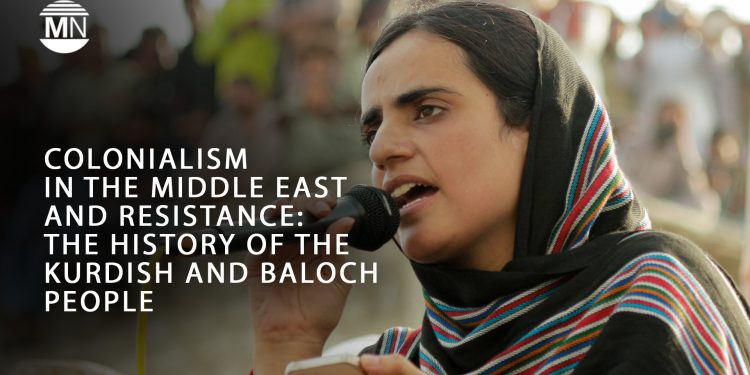
The resistance of the Kurdish and Baloch peoples against oppression and genocide was discussed in an X space organised by the Ronahi Youth Centre for Public Relations on Saturday evening.

The war in northern Syria is only the latest in a series of violent developments that have shaken the greater Middle East – from Gaza to the Balochistan region of Pakistan. Saturday’s X space was held with the intention of shedding light on the war against women and minorities that seems to have no end in the Middle East. The focus was on the people of Kurdistan – straddling Turkey, Syria, Iraq and Iran – and the people of Balochistan – straddling Pakistan, Iran and Afghanistan. These people have been working and struggling for decades for a future of freedom and non-violence.
Four panelists joined the discussion. Taj Baloch from the Human Rights Council of Balochistan and Asghar Ali Baloch as former President of the Baloch National Movement (Germany Chapter) spoke, as did Mahir Amed from Ronahi and Elefteria Ali from the Internationalist Commune of Rojava. The discussion was moderated by Dur Bibi from the Baloch community.
Speakers from the Baloch community explained that Balochistan – most of which has been part of the state of Pakistan since 1948 – is a region rich in natural resources. Despite this, it lacks services such as hospitals and roads, has been polluted by uranium dumping and has a high drug consumption rate. Structural and social decay has occurred with the cooperation of the Pakistani state, said Asghar Ali Baloch. The area is also a key transit point for the China-Pakistan Economic Corridor (CPEC). The economic importance of this project clashes with the material and social situation of Balochistan, he said.
Taj Baloch continued, saying that the Pakistani state perpetrates crimes against the Baloch people, and that the number of disappearances and extrajudicial killings has reached the thousands, underlining the human rights crisis.
Related Article:
Baloch activist exposes atrocities in Medya News interview, raises alarm over ‘systematic genocide’ in Pakistan
Since 2000, the Baloch people have organised themselves to ensure their existence and survival against the policies of oppression and annihilation. “The Baloch people are now facing two formidable adversaries: Pakistan and China. The resistance […] is not only a struggle for independence, but also a struggle for the survival and dignity of the Baloch people,” he concluded.
Speakers from the Kurdish community pointed out that Kurdistan is treated like a colony. Mahir Amed explained that in Turkey, which encompasses most of the Kurdish region, the rights of Kurds are violated and their identity is denied. In Iran, Kurds are arrested and sentenced for human rights activities or cultural works related to Kurdish identity. Even in Iraq, the Kurdistan Regional Government (KRG) and the ruling Kurdistan Democratic Party (KDP) support the war against the Kurdish people, paving the way for the Turkish army to carry out attacks in northern Iraq.
However, in North and East Syria, also known as Rojava, the Kurdish people have established an autonomous administration based on confederalism in cooperation with the other people living there. “While nationalism divides people, confederalism unites them,” explained Elefteria Ali. She also argued that the realities of Balochistan and Kurdistan are similar because of the similar imperialist and denialist approach that negates the identities of the Baloch people and the Kurdish people.
Related Article:
Kurdish women’s movement: we stand with Balochi women to fight fascism
She addresses the solution in terms of the democratic confederalism proposed by the founder of the Kurdistan Workers’ Party (PKK), Abdullah Öcalan. His paradigm placed the figure of the woman at the centre as a pillar for the reorganisation of society on the principles of democracy, inclusiveness, equality, and representation of all ethnic and religious groups.
The X space concluded with encouragement from the moderator Dur Bibi to all participants to read the books of Abdullah Öcalan. She stated that Öcalan is a leader for all oppressed people.
The recording of the X Space is available here.