
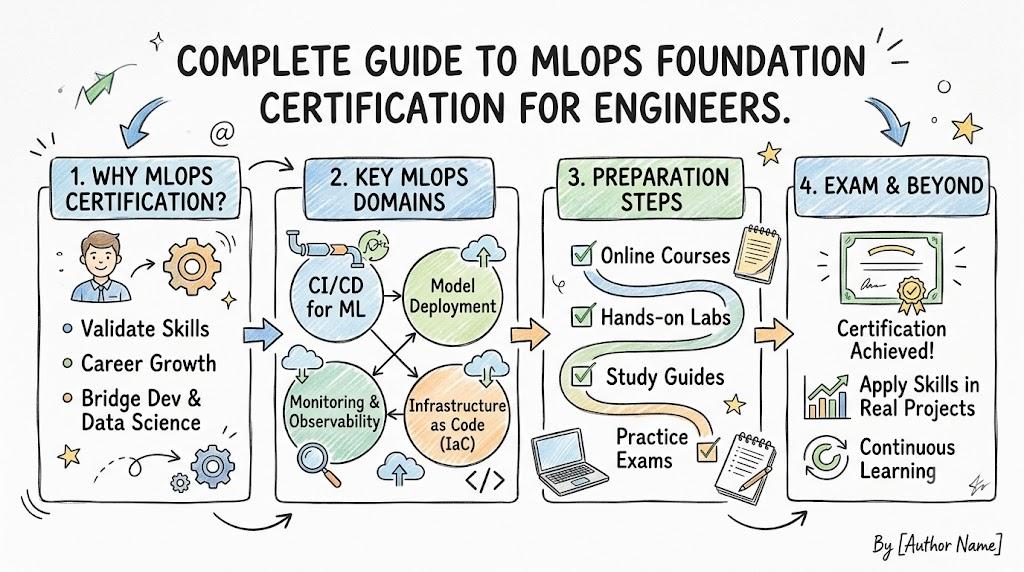
Introduction
Machine Learning is no longer only a research topic. Many companies are now using machine learning models in real products, business workflows, customer platforms, fraud detection systems, recommendation engines, automation systems, and analytics pipelines.
But building a model is only one part of the journey. The bigger challenge starts when teams need to deploy, monitor, scale, retrain, secure, and manage those models in production. This is where MLOps becomes important.The MLOps Foundation Certification is designed to help professionals understand the core practices of Machine Learning Operations. It gives engineers, managers, DevOps teams, data professionals, and software teams a structured way to learn how ML systems move from experiment to production.
This guide is written for working engineers, managers, software engineers, DevOps professionals, SRE teams, and technology leaders in India and across the global market who want to understand the value of MLOps Foundation Certification and how it can help in career and project growth.
What Is MLOps Foundation Certification?
MLOps Foundation Certification is a beginner-to-foundation level certification focused on the core concepts of Machine Learning Operations.It helps learners understand how machine learning models are developed, versioned, tested, deployed, monitored, and improved in real-world production environments.
This certification is useful for professionals who want to connect software engineering, DevOps, data science, cloud, automation, and AI delivery practices in one practical learning path.
Why MLOps Foundation Certification Matters
Many organizations are investing in AI and machine learning, but they often struggle to take models from notebooks to production. A model may work well during testing, but it can fail when exposed to real user data, changing business conditions, security rules, latency requirements, and scaling needs.
MLOps helps solve this gap.It brings discipline, automation, monitoring, governance, and repeatability to machine learning workflows. For working professionals, MLOps Foundation Certification gives a clear starting point to understand this growing field.For software engineers, it explains how ML delivery is different from normal application delivery. For DevOps engineers, it shows how CI/CD ideas apply to data and ML pipelines. For managers, it provides clarity on team structure, project risks, model lifecycle, and production readiness.
Certification Overview
| Track | Level | Who it’s for | Prerequisites | Skills covered | Recommended order | |
|---|---|---|---|---|---|---|
| MLOps | Foundation | Software Engineers, DevOps Engineers, ML Engineers, Data Engineers, Managers, SRE Teams | Basic understanding of software delivery, cloud, DevOps, or machine learning is helpful | ML lifecycle, model deployment, pipeline automation, monitoring, governance, CI/CD for ML, collaboration practices | Start with MLOps Foundation before moving into advanced MLOps, AIOps, SRE, DataOps, or platform engineering certifications |
Provider
The MLOps Foundation Certification is provided by AIOpsSchool.
AIOpsSchool focuses on training and certification programs around AIOps, MLOps, DevOps, SRE, DataOps, and modern IT operations. The certification is useful for professionals who want structured learning with practical industry alignment.
Who Should Read This Guide?
This guide is useful for:
- Software Engineers who want to move toward AI and ML engineering roles
- DevOps Engineers who want to understand ML pipeline automation
- SRE professionals who want to support model reliability
- Data Engineers who want to connect data pipelines with ML workflows
- ML Engineers who want better production deployment practices
- Managers who handle AI, automation, platform, or data teams
- Students and working professionals planning a career in AI-driven engineering
- Cloud Engineers who want to support scalable ML systems
About MLOps Foundation Certification
What It Is
MLOps Foundation Certification teaches the core concepts of managing machine learning systems in production.
It covers the complete ML lifecycle, including data preparation, model building, versioning, deployment, monitoring, automation, and governance.
Who Should Take It
This certification is suitable for professionals who want to understand how machine learning models are delivered and maintained in real business environments.
It is especially helpful for software engineers, DevOps engineers, data professionals, ML beginners, platform teams, SRE teams, and technical managers.
Skills You’ll Gain
- Understanding of the machine learning lifecycle
- Basics of model training and deployment flow
- Knowledge of ML pipeline automation
- Understanding of CI/CD for machine learning
- Model monitoring and performance tracking concepts
- Data versioning and model versioning basics
- Model governance and compliance awareness
- Collaboration practices between data science, engineering, and operations teams
- Production-readiness thinking for ML systems
- Awareness of common MLOps tools and workflows
Real-World Projects You Should Be Able to Do After It
- Design a basic MLOps workflow for a machine learning project
- Create a model deployment plan for a production environment
- Explain how ML pipelines can be automated
- Plan monitoring for model accuracy, drift, and performance
- Define roles and responsibilities in an MLOps team
- Prepare a basic CI/CD approach for ML models
- Identify risks in moving ML models from development to production
- Build a simple roadmap for improving ML operations in an organization
Preparation Plan
7–14 Days Plan
This plan is suitable if you already have experience in DevOps, software engineering, cloud, or machine learning basics.
Focus areas:
- Understand what MLOps is and why it is needed
- Learn the ML lifecycle from data to deployment
- Study model versioning, pipeline automation, and monitoring basics
- Review CI/CD concepts for ML workflows
- Read about model drift, retraining, and production risks
- Practice explaining one real-world ML deployment workflow
Best for:
- Working professionals with technical experience
- DevOps engineers entering MLOps
- Software engineers with basic AI/ML awareness
30 Days Plan
This plan is better for professionals who want deeper understanding with steady preparation.
Focus areas:
- Week 1: Learn MLOps basics, ML lifecycle, and production challenges
- Week 2: Study data pipelines, model training, versioning, and automation
- Week 3: Learn model deployment, CI/CD, monitoring, governance, and security
- Week 4: Review real-world use cases, common mistakes, and practice questions
Best for:
- Software engineers new to MLOps
- Managers leading AI or ML projects
- Cloud and platform engineers moving into AI operations
60 Days Plan
This plan is ideal for beginners or professionals who want strong practical understanding.
Focus areas:
- First 15 days: Learn machine learning basics and DevOps foundations
- Next 15 days: Understand ML pipelines, data flow, experimentation, and versioning
- Next 15 days: Learn model deployment, automation, monitoring, and governance
- Last 15 days: Build project examples, revise concepts, and prepare for certification
Best for:
- Beginners in AI operations
- Students and early-career professionals
- Managers without deep technical ML background
- Professionals switching from traditional IT to AI-driven roles
Common Mistakes to Avoid
- Learning only machine learning theory and ignoring production operations
- Thinking MLOps is only DevOps with a new name
- Ignoring data quality and data versioning
- Not understanding model drift and retraining needs
- Focusing only on tools instead of lifecycle concepts
- Skipping monitoring, governance, and compliance topics
- Not learning how teams collaborate in real ML projects
- Treating model deployment as a one-time activity
- Ignoring business impact, scalability, and reliability
- Preparing only for certification without understanding practical use cases
Best Next Certification After This
After completing MLOps Foundation Certification, the best next certification depends on your career goal.
If you want to go deeper into AI operations, you can move toward AIOps-related certifications. If your focus is reliability, SRE certification can be a strong next step. If your role is closer to data pipelines, DataOps certification may be useful. If you work with cloud and automation, DevOps or platform engineering certifications can help.
A good next step can be:
- Advanced MLOps Certification
- AIOps Certification
- SRE Certification
- DataOps Certification
- DevOps Certification
- Cloud DevOps Certification
Choose Your Path
1. DevOps Path
The DevOps path is suitable for professionals who already work with CI/CD, automation, cloud infrastructure, containers, and deployment pipelines.
For DevOps engineers, MLOps adds a new layer of complexity because ML systems involve data, models, experiments, retraining, and monitoring beyond normal application delivery.
Recommended learning focus:
- CI/CD for ML
- Infrastructure automation
- Model deployment workflows
- Containerization for ML systems
- Pipeline orchestration
- Production monitoring
Best career direction:
- MLOps Engineer
- DevOps Engineer for AI platforms
- Platform Engineer for ML systems
2. DevSecOps Path
The DevSecOps path is useful for professionals who want to understand security, compliance, governance, and risk control in ML systems.
AI and ML systems can introduce new risks related to data privacy, model misuse, access control, bias, and compliance. DevSecOps professionals can play an important role in securing ML pipelines.
Recommended learning focus:
- Secure ML pipelines
- Data privacy controls
- Access management
- Model governance
- Compliance checks
- Security testing for AI workflows
Best career direction:
- DevSecOps Engineer for AI systems
- AI Security Engineer
- ML Governance Specialist
3. SRE Path
The SRE path is useful for professionals responsible for reliability, uptime, observability, and incident response.
ML systems need reliability not only at the application level but also at the model performance level. A model can be technically running but still giving poor predictions due to data drift or changing business patterns.
Recommended learning focus:
- Model monitoring
- Reliability engineering for ML systems
- Incident response for AI platforms
- Observability metrics
- Performance and latency tracking
- Service-level thinking for ML applications
Best career direction:
- SRE for ML Platforms
- AI Reliability Engineer
- Observability Engineer
4. AIOps/MLOps Path
This is the most direct path for professionals who want to build a career in AI operations and machine learning operations.
This path connects automation, analytics, model management, monitoring, and intelligent IT operations.
Recommended learning focus:
- MLOps lifecycle
- AIOps concepts
- Model deployment and monitoring
- ML pipeline automation
- Intelligent alerting
- Predictive operations
Best career direction:
- MLOps Engineer
- AIOps Engineer
- AI Platform Engineer
- ML Operations Lead
5. DataOps Path
The DataOps path is useful for professionals working with data pipelines, data quality, data governance, and analytics platforms.
MLOps depends heavily on reliable data. If data is wrong, delayed, incomplete, or inconsistent, the model output will also suffer.
Recommended learning focus:
- Data pipeline automation
- Data quality checks
- Data versioning
- Data governance
- Feature engineering workflow
- Data lineage for ML systems
Best career direction:
- DataOps Engineer
- Data Engineer for ML Systems
- ML Data Pipeline Engineer
6. FinOps Path
The FinOps path is useful for professionals who manage cloud cost, resource optimization, and financial control for technology platforms.
ML workloads can become expensive because of training jobs, GPU usage, cloud storage, data movement, and experimentation environments.
Recommended learning focus:
- Cloud cost management for ML workloads
- Resource optimization
- GPU and compute cost awareness
- Budget planning for AI projects
- Cost visibility for ML pipelines
- Business value tracking
Best career direction:
- FinOps Specialist for AI Platforms
- Cloud Cost Optimization Engineer
- AI Infrastructure Cost Analyst
Career Value of MLOps Foundation Certification
MLOps Foundation Certification can help professionals build a strong career base in AI-driven engineering.
For software engineers, it opens a path toward ML engineering and AI platform roles. For DevOps professionals, it adds machine learning delivery knowledge to existing automation skills. For managers, it gives a better understanding of how to plan, review, and manage ML projects.
The certification also helps professionals speak a common language across teams. In real projects, data scientists, developers, DevOps teams, cloud teams, security teams, and managers often work separately. MLOps brings these teams together through shared processes and repeatable workflows.
Top Institutions Providing Training Cum Certification Help
DevOpsSchool
DevOpsSchool provides training and certification support for DevOps, DevSecOps, SRE, Cloud, Kubernetes, MLOps, and related technologies. It is useful for learners who want structured guidance, practical examples, and career-oriented learning. Professionals can use DevOpsSchool to build a stronger foundation before moving into advanced automation and AI operations roles.
Cotocus
Cotocus provides consulting, training, and implementation support around DevOps, cloud, automation, and modern engineering practices. For MLOps learners, Cotocus can help connect theory with real-world enterprise use cases. It is useful for teams that want both learning and practical transformation support.
Scmgalaxy
Scmgalaxy focuses on software configuration management, DevOps, build and release, automation, and related engineering practices. It can be helpful for professionals who want to understand the engineering discipline behind modern delivery pipelines. For MLOps, this background is valuable because ML systems also need version control, release planning, and automation.
BestDevOps
BestDevOps provides learning resources, certification information, and career-focused content around DevOps and modern IT practices. It can support learners who want to compare certification paths and understand career direction. For MLOps Foundation learners, it can help connect DevOps knowledge with AI and ML operations career planning.
devsecopsschool
devsecopsschool focuses on DevSecOps learning, secure software delivery, compliance, and security automation. It is useful for MLOps professionals who want to understand security in AI and ML workflows. As ML systems become part of business-critical platforms, security and governance knowledge becomes very important.
sreschool
sreschool provides learning around Site Reliability Engineering, observability, incident response, and production reliability. MLOps professionals can benefit from SRE knowledge because ML models must be reliable, measurable, and monitored after deployment. This is especially useful for engineers working with production ML platforms.
aiopsschool
aiopsschool provides training and certification programs in AIOps, MLOps, and intelligent IT operations. It is directly relevant for professionals preparing for MLOps Foundation Certification. Learners can use it to understand AI-driven operations, model lifecycle practices, and the relationship between automation and machine learning systems.
dataopsschool
dataopsschool focuses on data operations, data pipelines, governance, and data delivery practices. Since MLOps depends heavily on clean and reliable data, DataOps knowledge is very useful. Professionals working in data engineering, analytics, and ML platforms can benefit from this learning path.
finopsschool
finopsschool focuses on cloud financial management, cost optimization, and technology spending control. MLOps projects often require cloud resources, storage, compute power, and sometimes GPU-based workloads. FinOps knowledge helps teams manage the cost side of AI and ML platforms responsibly.
Practical Use Cases of MLOps in Organizations
MLOps is useful in many real business situations.
A bank may use MLOps to monitor fraud detection models and ensure they continue to detect new fraud patterns. An e-commerce company may use MLOps to manage recommendation models. A healthcare platform may use MLOps to support prediction systems with strong governance and monitoring. A logistics company may use MLOps to improve route planning and demand forecasting.
In all these cases, the model must not only be built. It must be deployed, tracked, updated, secured, and improved over time.
This is the real value of MLOps.
Key Topics You Should Understand Before Certification
Before preparing for the MLOps Foundation Certification, it is helpful to understand these topics:
- Basic machine learning workflow
- Software development lifecycle
- DevOps and CI/CD basics
- Cloud platform fundamentals
- Data pipeline concepts
- Model deployment basics
- Monitoring and observability concepts
- Automation and orchestration basics
- Security and governance awareness
- Team collaboration in technology projects
You do not need to be an expert in all these areas before starting. But having basic awareness will make the certification easier to understand.
How Managers Can Benefit from MLOps Foundation Certification
Managers often do not need to write model code, but they must understand how ML projects are planned and delivered.
This certification can help managers understand project risks, team responsibilities, production challenges, cost factors, monitoring needs, and governance requirements.
It can also help managers ask better questions, such as:
- Is the model ready for production?
- How will we monitor model performance?
- Who owns retraining?
- What happens if data changes?
- How do we measure business value?
- What security controls are needed?
- How do we control cloud cost?
This makes the certification useful not only for engineers but also for technical leaders and decision-makers.
How Software Engineers Can Benefit
Software engineers can benefit strongly from MLOps because many AI products need strong engineering support.
A software engineer who understands APIs, backend systems, cloud deployment, automation, testing, and monitoring can move into MLOps by learning ML lifecycle concepts.
This certification helps software engineers understand how model development differs from normal application development and how to support ML systems in production.
Final Learning Roadmap
A practical roadmap can look like this:
| Stage | Focus Area | Outcome |
|---|---|---|
| Stage 1 | Learn ML lifecycle basics | Understand how models are built and used |
| Stage 2 | Learn DevOps and CI/CD basics | Understand automation and delivery flow |
| Stage 3 | Study MLOps concepts | Connect ML with operations |
| Stage 4 | Learn deployment and monitoring | Understand production readiness |
| Stage 5 | Practice real use cases | Apply concepts to business problems |
| Stage 6 | Prepare for certification | Review, revise, and validate knowledge |
| Stage 7 | Move to advanced learning | Choose AIOps, SRE, DataOps, DevOps, or FinOps path |
Conclusion
MLOps Foundation Certification is a strong starting point for professionals who want to understand how machine learning systems are managed in real production environments. It is useful for software engineers, DevOps engineers, data professionals, managers, SRE teams, and cloud professionals who want to build practical knowledge in AI and ML operations.The real value of this certification is not only in learning terms and definitions. Its value comes from understanding how data, models, pipelines, deployment, monitoring, security, governance, and business goals work together.As more organizations adopt AI and machine learning, the need for skilled MLOps professionals will continue to grow. A foundation-level certification can help you build the right base, choose the right career path, and move confidently toward advanced roles in MLOps, AIOps, SRE, DataOps, DevOps, DevSecOps, and FinOps.