
Tackling Traversing Sands: Berm Sand Control in Saudi Arabia with TerraFirma
In the Kingdom of Saudi Arabia, desert landscapes are both a defining feature and an ongoing challenge. Wind-blown sand drifts relentlessly across roadways, rail lines, and industrial sites, threatening infrastructure, safety, and operations. That’s where berm sand control emerges as a critical strategy — especially when deployed with cutting-edge polymer stabilization.
Why Berm Sand Control Matters in Saudi Arabia
Saudi Arabia’s arid terrain and strong prevailing winds make sand migration a perennial issue. One third of the Arabian Peninsula is covered by sand dunes, and many urban and industrial corridors lie in zones prone to sand drift. Without control measures, shifting sands accumulate on roads and rails, degrade visibility, increase accident risk, and force costly maintenance.
A berm - essentially a raised barrier built alongside a target zone - acts as a physical barrier against migrating sand. But a bare soil berm is subject to erosion, wind scour, or collapse. That’s why stabilizing the berm’s surface is vital. Well-engineered berms, correctly sized and oriented, compel sand particles to drop before reaching critical infrastructure.
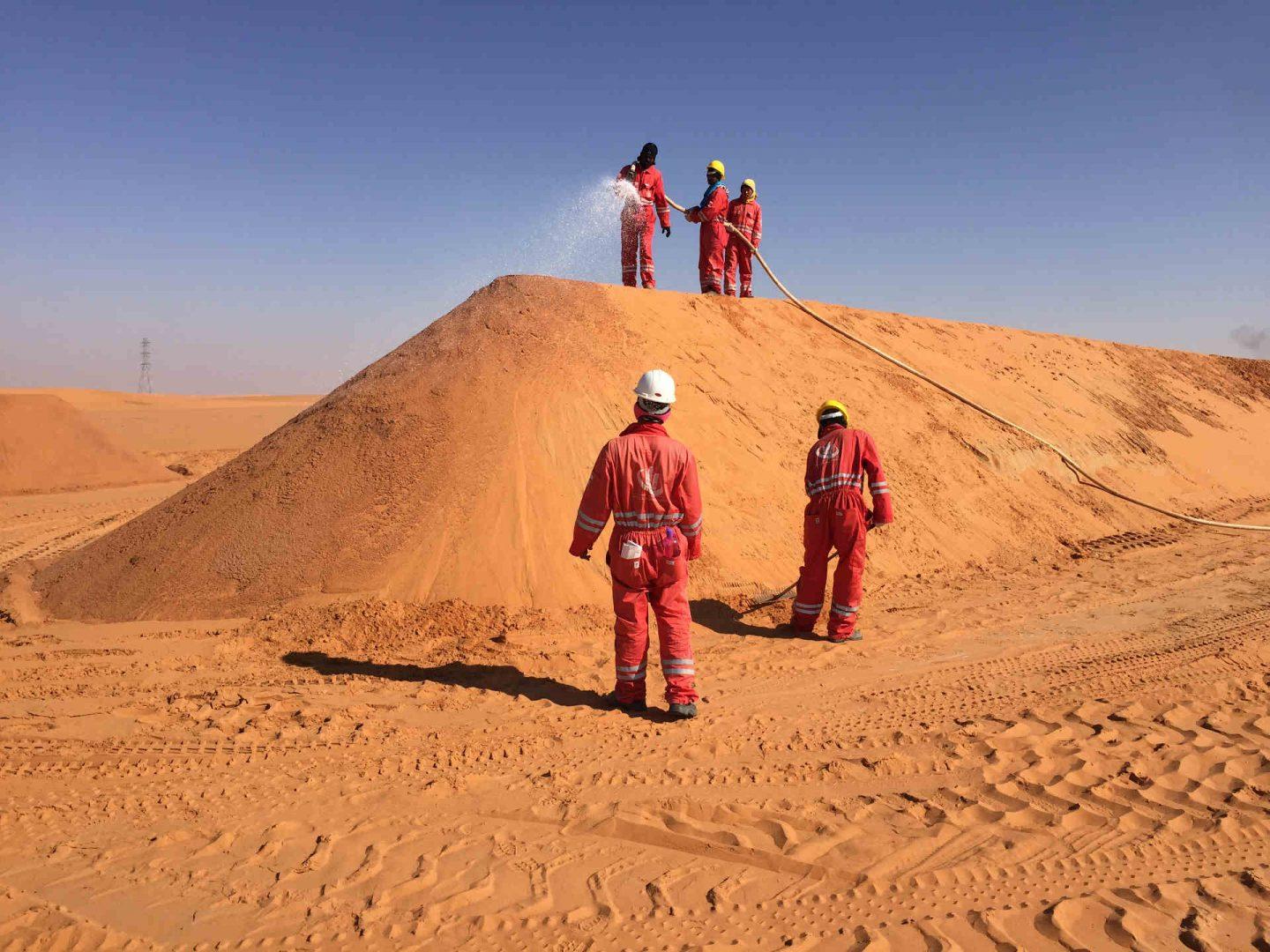 TerraFirma’s Approach: Polymer-Stabilized Berms
At TerraFirma, we leverage our proprietary TF-2000 polymer technology to harden berm surfaces in Saudi Arabia’s harsh climate. The process involves:
- Designing the berm — determining height, slope, location relative to prevailing wind, and berm profile.
- Applying the polymer — treating the berm surface so that it cures into a durable crust, resistant to wind and weather.
- Long-term protection — once cured, the crust prevents sand from encroaching on roads or railways, redirecting sediment to the berm’s base instead.
This hardened crust dramatically reduces the frequency and volume of sand removal operations. In many cases, what used to require weekly clearing can be deferred to a 6-month or longer cycle, saving manpower, equipment, and operational disruption.
Benefits & Strategic Value
- Increased safety: Less sand on surfaces means fewer accidents and safer transit corridors.
- Cost efficiency: Infrastructure maintenance budgets stretch further as intervention frequency drops.
- Sustainability: Polymer solutions are designed to be water-based, environmentally compatible, and regionally produced.
- Adaptability: TerraFirma tailors each berm solution based on local weather, soil type, and terrain.
Conclusion
In Saudi Arabia’s desert environment, berm sand control is not optional — it’s essential. When combined with TerraFirma’s advanced polymer stabilization, berms become robust, low-maintenance defenders against drifting sands. For roadways, rail corridors, industrial zones, or pipeline routes, such solutions deliver resilience, safety, and long-term savings.