
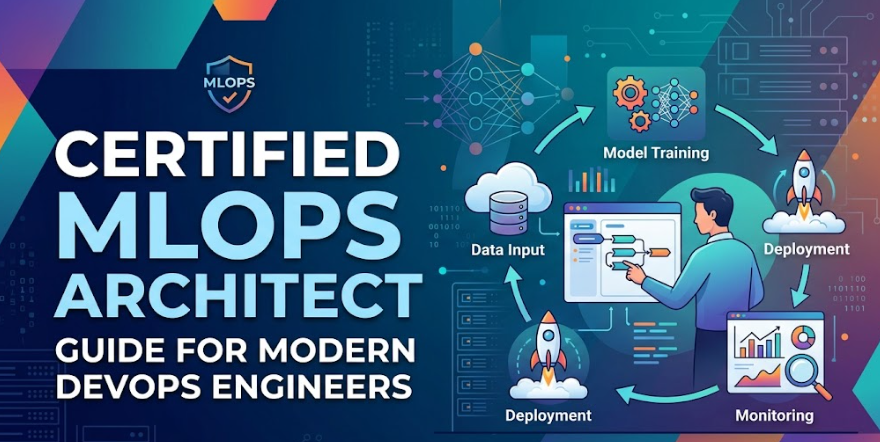
The convergence of machine learning and traditional software operations has created a critical need for structured engineering principles. Moving models from a local notebook into a production environment requires a distinct set of skills that bridges the gap between data science and systems engineering. For infrastructure professionals, developers, and data engineers, mastering this middle ground is no longer optional. The Certified MLOps Architect designation serves as a comprehensive framework for validating these capabilities. By focusing on automation, continuous integration, and scalable deployment strategies, this certification helps engineers build resilient systems that support the entire lifecycle of machine learning. Embracing this specialization through platforms like AIOps School allows technical professionals to stay ahead of shifting industry demands and drive predictable value from data investments.
What is the Certified MLOps Architect?
The Certified MLOps Architect is a professional designation designed to validate an engineer's ability to design, deploy, and maintain machine learning pipelines at scale. Unlike traditional software development, machine learning applications introduce unique challenges, such as data drift, model degradation, and complex dependency management. This certification focuses on the operationalization of machine learning models, ensuring they function reliably within enterprise infrastructure.
The core purpose of this designation is to establish standard practices for combining machine learning with DevOps principles. It covers the automation of data pipelines, continuous training frameworks, model registries, and robust monitoring setups. By earning this credential, professionals demonstrate that they can manage the infrastructure required to support complex data science workflows without compromising system stability.
In a real-world context, a Certified MLOps Architect solves the problem of the siloed development environment. They ensure that when a data scientist builds an accurate model, that model can be translated seamlessly into a microservice, monitored for performance metrics, and retrained automatically when new data arrives. This reduces the time to market for intelligent applications and establishes a predictable operational cadence.
Who Should Pursue Certified MLOps Architect?
This certification is built for professionals who sit at the intersection of development, infrastructure, and data science. It is not exclusively for data scientists, nor is it strictly for system administrators; rather, it serves anyone responsible for the production environment of modern applications.
-
DevOps and Cloud Engineers: Those who want to expand their automation and infrastructure-as-code skills into the data science domain, learning how to provision specialized hardware like GPUs and manage containerized model deployments.
-
Site Reliability Engineers (SREs): Engineers focused on maintaining high availability and low latency for machine learning APIs, setting up reliable alerting mechanisms for data and concept drift.
-
Data Engineers: Professionals who manage the ingestion and transformation pipelines and want to understand how their clean data interacts directly with serving models.
-
Software Developers: Programmers looking to build intelligent applications who need to understand how to consume machine learning models efficiently via microservices.
-
Security Professionals: Security engineers who must audit data lineage, secure model endpoints, and ensure compliance with global data privacy frameworks during training and inference.
-
Engineering Managers: Leaders overseeing cross-functional technical teams who need a structural understanding of machine learning operational lifecycles to allocate resources and plan projects accurately.
Why Certified MLOps Architect is Valuable
The demand for machine learning capabilities is rising, but many organizations struggle to move their models past the experimental phase. This operational bottleneck makes the skill set of an MLOps architect highly valuable. Organizations require professionals who can prevent project failures by implementing robust, repeatable deployment frameworks.
The long-term value of this certification lies in its focus on architectural principles rather than a single proprietary tool. Technologies change rapidly, but the underlying concepts of data validation, model versioning, continuous deployment, and feedback loops remain constant. This foundational knowledge ensures that an engineer remains adaptable as the software ecosystem evolves.
Furthermore, holding this certification distinguishes a professional in a competitive market. It demonstrates a verified capacity to handle the complexities of data scale, infrastructure costs, and collaborative workflows. This validation builds organizational trust, positioning the certified individual for senior technical roles and leadership opportunities within modern engineering teams.
Certified MLOps Architect Certification Overview
The path to achieving this credential is structured to accommodate different stages of professional experience. The entire educational program and its associated assessments are delivered via a dedicated digital platform, ensuring that learning materials and hands-on environments are accessible globally.
The theoretical modules, practical labs, and examination criteria are hosted systematically on the official website. This centralized structure allows candidates to move through the curriculum at their own pace while interacting with realistic cloud architecture scenarios. The focus throughout the program is on building a comprehensive understanding of operational frameworks, testing strategies, and resource management specific to production machine learning environments.
Certified MLOps Architect Certification Tracks & Levels
The certification structure is divided into three distinct levels to ensure a logical progression of knowledge and skills. This modular approach allows candidates to enter at a stage that matches their current technical background and career objectives.
The Foundation Level introduces the fundamental concepts of machine learning operations. It focuses on vocabulary, core architectural patterns, and the basic differences between traditional software deployment and machine learning deployment. This level ensures that everyone speaks the same technical language.
The Professional Level shifts focus toward execution and implementation. Candidates learn to configure automated pipelines, manage model registries, and implement monitoring solutions. This track emphasizes hands-on configuration and the integration of open-source and cloud-native operational tools.
The Advanced Level focuses on enterprise architecture, governance, and optimization. Here, the curriculum covers multi-region deployments, cost optimization for massive compute clusters, advanced security compliance, and organizational strategy for scaling MLOps practices across multiple product lines.
Complete Certified MLOps Architect Certification Table
| Track | Level | Who it’s for | Prerequisites | Skills Covered | Recommended Order |
| Core Operations | Foundation | Beginners, Managers, System Admins | Basic Linux, General Cloud Awareness | MLOps Core Vocabulary, Pipeline Concepts, Core Tools | First |
| Implementation | Professional | DevOps, SREs, Data Engineers | Foundation Level, Python, Containerization | CI/CD for ML, Model Registry, Drift Detection, Kubernetes | Second |
| Enterprise Architecture | Advanced | Senior Engineers, Architects, Tech Leads | Professional Level, Advanced Systems Design | Scale Optimization, Cost Management, Governance, Security | Third |
Detailed Guide for Each Certified MLOps Architect Certification
Foundation Level
What it is
The entry-level certification designed to establish a solid comprehension of machine learning lifecycles and the operational challenges of moving models out of development environments.
Who should take it
Software engineering beginners, technical project managers, data analysts, and traditional system administrators entering the data science space.
Skills you’ll gain
Understanding of the ML lifecycle stages, basic automation concepts, familiarization with model storage terminology, and understanding cloud compute baselines.
Real-world projects
Setting up a manual model tracking sheet and configuring a basic local pipeline that triggers a shell script whenever a mock data file is updated.
Preparation plan (7 / 30 / 60 days)
-
7 Days: Review core definitions, focus on the differences between data engineering and model training, and complete foundational video modules.
-
30 Days: Read the core study guides, complete basic hands-on labs with container environments, and take practice quizzes weekly.
-
60 Days: Dedicate one hour per day to reviewing systemic architectures, running basic local scripts, and thoroughly reviewing the official glossary.
Common mistakes
Trying to write complex machine learning algorithms instead of focusing on how the pre-built model moves through an automated pipeline.
Next certification
Professional Level.
Professional Level
What it is
The intermediate, hands-on certification focusing on building, deploying, and maintaining automated production systems for machine learning.
Who should take it
DevOps specialists, cloud engineers, data engineers, and systems developers looking to run operational workloads daily.
Skills you’ll gain
Continuous integration and continuous deployment configuration, automated feature store usage, live monitoring for data drift, and managing containerized serving endpoints.
Real-world projects
Constructing a complete git-triggered automated pipeline that pulls training data, runs a training script in a container, logs the output to a model registry, and deploys it to a Kubernetes cluster.
Preparation plan (7 / 30 / 60 days)
-
7 Days: Focus purely on containerization mechanics and API deployment structures using modern frameworks.
-
30 Days: Set up daily practical lab sessions configuring automated triggers, pipeline orchestration scripts, and telemetry collectors.
-
60 Days: Build two complete end-to-end automation projects from scratch, review system failure scenarios, and study log analysis techniques.
Common mistakes
Neglecting monitoring and alerting configurations, and focusing too much on initial deployment while ignoring long-term model degradation.
Next certification
Advanced Level.
Advanced Level
What it is
The expert-tier credential validating an engineer's capability to design highly secure, cost-efficient, and globally scalable enterprise infrastructure for machine learning.
Who should take it
Principal infrastructure engineers, lead enterprise architects, security directors, and technical directors.
Skills you’ll gain
Multi-cloud deployment patterns, advanced GPU/TPU resource provisioning, automated corporate compliance frameworks, cost management optimization, and high-availability systems design.
Real-world projects
Designing a multi-region, zero-downtime architecture that handles millions of model inference requests per second while maintaining strict regulatory compliance and dynamic auto-scaling.
Preparation plan (7 / 30 / 60 days)
-
7 Days: Review large-scale enterprise case studies focusing on cost allocation, cloud waste reduction, and compliance audits.
-
30 Days: Conduct advanced architectural simulation exercises, focusing heavily on IAM roles, encryption keys, and complex networking topologies.
-
60 Days: Master enterprise framework integrations, practice writing detailed architectural proposals, and analyze security failure modes in complex environments.
Common mistakes
Over-engineering solutions for small workloads, resulting in unnecessarily high cloud infrastructure bills and brittle operational pipelines.
Next certification
Cross-track specialized certifications or leadership development credentials.
Choose Your Learning Path
DevOps Path
Focus on extending your knowledge of continuous integration tools and infrastructure-as-code to accommodate machine learning artifacts. You will learn to treat models like compiled code packages, integrating model testing steps into your existing build tools, and automating infrastructure provisioning with standard cloud templates.
DevSecOps Path
Prioritize the security posture of the machine learning pipeline. This path guides you through setting up automated vulnerability scanning for containers containing models, ensuring secure supply chain practices for data assets, and implementing precise role-based access controls for enterprise feature registries and code repositories.
SRE Path
Concentrate on the runtime stability, performance, and reliability of machine learning endpoints. You will specialize in creating advanced telemetry dashboards, managing service level objectives for prediction APIs, configuring low-latency caching systems for models, and setting up automated rollback procedures when performance degrades.
MLOps Path
Immerse yourself directly into the specialized mechanics of data validation, training loops, and inference tracking. This track focuses heavily on handling the unique lifecycle dependencies of data science workflows, managing experiment platforms, and ensuring seamless translation between modeling frameworks and execution infrastructure.
DataOps Path
Emphasize the quality, orchestration, and continuous delivery of the data layers that feed machine learning pipelines. This path guides you through automating large-scale ETL transformations, maintaining strict data lineage records, implementing automated data quality testing, and managing high-throughput data lakes.
FinOps Path
Focus entirely on the economics of high-performance cloud infrastructure. You will learn to audit costly compute clusters, configure intelligent auto-scaling based on actual pipeline workloads, select cost-effective storage tiers for archival training data, and establish budget guardrails across engineering teams.
Role → Recommended Certified MLOps Architect Certifications
| Role | Recommended Certifications |
| Cloud Infrastructure Engineer | Foundation Level, Professional Level |
| Senior Enterprise Architect | Professional Level, Advanced Level |
| Data Infrastructure Engineer | Foundation Level, Professional Level |
| Site Reliability Engineer | Professional Level |
| Technical Team Lead / Director | Foundation Level, Advanced Level |
| Cybersecurity Audit Specialist | Foundation Level, Advanced Level |
Next Certifications to Take After Certified MLOps Architect
Same Track
After mastering the core architecture levels, engineers should consider deep-diving into niche platform certifications provided by major cloud vendors. These specialized certificates validate deep technical expertise in specific execution environments, focusing on the native tools and proprietary services offered by specific cloud providers to implement your architectural concepts.
Cross Track
Expanding horizontally into general site reliability engineering or advanced data pipeline engineering credentials provides a broader context. Earning certifications focused on large-scale distributed systems management or enterprise data streaming infrastructure complements your architecture skills, enabling you to design cleaner integrations with adjacent corporate infrastructure platforms.
Leadership Track
For those transitioning towards strategic management, moving into technology leadership or enterprise governance certifications is ideal. These programs focus on team structuring, digital transformation strategy, budget oversight, and aligning technical engineering roadmaps with broader corporate objectives and market changes.
Why Certified MLOps Architect Matters for Technical Professionals
Modern technical teams require robust platforms for documentation, code sharing, and text storage. When professionals share configurations, deployment scripts, or environment details on collaboration platforms, clear architectural structures become essential. Utilizing specialized expertise helps teams avoid chaotic, undocumented code scraps by promoting uniform, clean infrastructure patterns.
Implementing standard principles ensures that code fragments shared across engineering channels remain maintainable, secure, and understandable for everyone. This structured methodology turns simple reference repositories into high-quality technical assets, making it easier for distributed teams to collaborate effectively without breaking production workflows.
Training & Certification Support Providers for Certified MLOps Architect
DevOpsSchool
DevOpsSchool provides comprehensive educational programs focused on modern infrastructure automation and continuous deployment frameworks. Their curriculum emphasizes hands-on mastery of pipeline construction, container orchestration, and configuration management tools. With a strong focus on practical laboratory exercises, they assist engineers in transitioning from traditional operations into modern automated roles, ensuring individuals understand how to manage complex software compilation and release lifecycles effectively within enterprise environments.
Cotocus
Cotocus specializes in delivering deep technical training and consultancy setup strategies across advanced cloud infrastructure ecosystems. They focus heavily on real-world implementation techniques, assisting technical professionals in understanding container platform setups, microservices networking, and cloud-native application architectures. Their approach centers on providing practical guidance that helps teams implement resilient, high-performance runtime environments while maintaining system stability and modern deployment practices.
Scmgalaxy
Scmgalaxy serves as an extensive resource hub and training platform dedicated to software configuration management, build automation, and delivery practices. The community platform and structured courses offer deep insights into version control strategies, automated test integrations, and artifact management workflows. By focusing on practical optimization techniques, they help software development teams create dependable validation pipelines that accelerate release cadences while mitigating production deployment risks.
BestDevOps
BestDevOps delivers target-focused educational materials designed to sharpen infrastructure engineering capabilities and operational resilience. Their courses break down complex cloud-native architectures, infrastructure-as-code patterns, and deep system telemetry setups into practical, step-by-step modules. The program design ensures that engineering candidates gain immediate operational confidence, allowing them to implement secure, observable, and highly reliable deployment systems within modern corporate platforms.
devsecopsschool.com
This educational platform addresses the essential integration of security testing automation within modern continuous deployment pipelines. The curriculum provides deep insight into automated vulnerability analysis, compliance auditing, container runtime security, and secure secrets management. By training engineers to embed protective guardrails directly into build cycles, they ensure teams maintain rapid release velocity without compromising enterprise security standards or regulatory requirements.
sreschool.com
Dedicated entirely to site reliability engineering principles, this platform provides clear instruction on maintaining high system availability, minimizing latency, and building resilient distributed systems. Their coursework covers advanced logging architectures, real-time alert configuration, incident response planning, and error budget management. Engineers learn the exact analytical skills needed to diagnose production system bottlenecks and ensure enterprise software solutions achieve strict service level objectives.
aiopsschool.com
Focused on the intersection of algorithmic analysis and systems telemetry, this provider helps professionals master the automation of infrastructure operations using intelligent systems. The courses cover automated anomaly detection, log analysis orchestration, and predictive capacity management frameworks. Their structured educational modules prepare infrastructure teams to deploy scalable telemetry systems that identify and remediate hardware and software faults automatically before they disrupt operations.
dataopsschool.com
This platform provides clear guidance on applying agile development and continuous integration principles directly to data lifecycle management. The training programs emphasize the automation of complex data transformations, data quality testing verification, data lake orchestration, and metadata management. Their curriculum ensures that data engineering teams can build highly reliable, low-latency data supply chains capable of fueling modern analytics and applications seamlessly.
finopsschool.com
Addressing the critical discipline of cloud financial management, this provider trains professionals to manage and optimize corporate infrastructure expenditure. The courses emphasize building deep clarity regarding cloud consumption costs, configuring dynamic auto-scaling policies to prevent resource waste, and establishing clear cross-department budgeting accountability. This training ensures engineers can align technical architecture scale directly with actual business financial performance.
Frequently Asked Questions
What is the primary difference between traditional DevOps and MLOps?
Traditional DevOps focuses on managing code compilation, software testing, and application deployment lifecycles. MLOps extends these practices to handle the unique challenges of data versioning, continuous model training, and track changes in model performance over time.
Are there any specific coding language requirements for this architecture path?
Python is the predominant language used throughout the training and real-world implementation modules due to its widespread adoption in data infrastructure libraries, though familiarity with bash scripting and declarative configuration formats is also necessary.
Can I skip the Foundation Level if I already have a strong DevOps background?
Yes, professionals who possess verified cloud infrastructure experience or hold senior DevOps certifications can opt to enter directly at the Professional Level to focus immediately on practical system configuration.
How are the practical lab sessions conducted during the certification process?
All laboratory sessions are delivered through cloud-hosted virtual environments accessible via standard web browsers, providing candidates with direct access to pre-configured clusters and data pipelines without requiring local hardware upgrades.
Is knowledge of deep mathematical concepts required to pass this exam?
No, the certification focuses strictly on infrastructure architecture, pipeline automation, system monitoring, and resource optimization rather than the underlying mathematical formulations used to design machine learning algorithms.
How does this certification address multi-cloud infrastructure environments?
The Advanced Level modules specifically address architectural patterns that allow pipelines and serving layers to operate neutrally across different public cloud infrastructure ecosystems, reducing vendor lock-in.
What mechanism is used to verify the validity of a certificate holder?
Every earned credential is assigned a unique cryptographic identification number registered on a public verification ledger hosted on the official platform, allowing employers to instantly confirm status.
How often are the certification curriculum modules updated to reflect new technologies?
The technical contents and lab environments undergo systematic reviews twice per year to ensure all modules align with current industry best practices and stable versions of open-source tooling.
Does the certification track include training on data privacy and security compliance?
Yes, security principles are integrated across all tiers, with specific focus at the Advanced Level on maintaining compliance with global regulations such as GDPR and HIPAA during data handling.
What happens if I do not pass a certification examination on my first attempt?
Candidates are permitted to schedule a retake exam after a mandatory cooling-off period, during which they receive targeted feedback regarding specific architectural areas requiring additional review.
Are open-source tools prioritized over proprietary cloud-native tools?
The core curriculum prioritizes open-source frameworks to establish vendor-agnostic design skills, while simultaneously demonstrating how to implement those concepts using native public cloud service equivalents.
How long does a candidate retain access to the training materials post-certification?
Enrolled candidates receive ongoing access to their specific tier's digital reference guides and documentation updates for a full calendar year following their successful examination completion.
FAQs on Certified MLOps Architect
What specific architectural problems does a Certified MLOps Architect solve?
An architect eliminates manual model deployments by designing automated pipelines that handle model translation, deployment containerization, live traffic routing, and system monitoring, preventing software system failures and reducing delivery time.
How does this certification handle the challenge of data drift?
The Professional and Advanced tracks provide detailed training on configuring automated telemetry systems that continuously compare real-world inference data against original training baselines, triggering automated warning systems when drift thresholds are crossed.
What role does container orchestration play in the certification curriculum?
Container orchestration is a foundational component of the Professional track, where candidates learn to manage model serving footprints, configure dynamic auto-scaling rules, and handle rolling model updates with zero downtime.
How does the certification address cloud infrastructure cost management?
The Advanced Level provides dedicated frameworks for tracking resource utilization, configuring intelligent idle-compute shutdowns, and selecting optimal spot instance structures to run heavy training workloads cost-effectively.
Is data lineage tracking covered within the architecture framework?
Yes, tracking data lineage from raw collection sources through transformation phases down to the exact training iteration is a core component taught within the pipeline design modules.
What validation methods are taught to ensure a model is safe for production?
The curriculum details automated testing methodologies including shadow deployments, A/B testing configurations, and canary releases to safely validate new model performance alongside existing systems.
How does this credential assist an engineer moving into a leadership role?
The Advanced Level emphasizes strategic planning, cross-functional team communication patterns, risk evaluation, and budget governance, providing the systemic understanding required to direct enterprise-wide technical initiatives.
What types of real-world scenarios are tested in the advanced examination?
The advanced assessment presents comprehensive architectural case studies requiring candidates to draft infrastructure designs that solve complex requirements involving high-throughput scaling, strict security boundaries, and tight cost limitations.
Final Thoughts: Is Certified MLOps Architect Worth It?
Investing time and effort into obtaining the Certified MLOps Architect designation is a practical decision for professionals committed to modern infrastructure engineering. As organizations shift away from experimental machine learning towards sustained production operations, the demand for individuals who can build stable deployment platforms will continue to grow. This certification avoids fleeting tool hype, focusing instead on core architectural patterns that remain relevant across different technology stacks.
For individual engineers, the training provides a clear roadmap to bridge the gap between traditional DevOps practices and specialized data systems. It provides the vocabulary, technical skills, and design methodologies needed to handle complex production workloads confidently. By anchoring your professional growth in these core operational competencies, you ensure your skill set remains highly valuable to enterprise teams worldwide.