
Introduction
Machine learning is no longer limited to notebooks, experiments, and research teams. Today, companies want machine learning models that work reliably in production. They want models that can be trained, tested, deployed, monitored, improved, and governed like any serious software system.
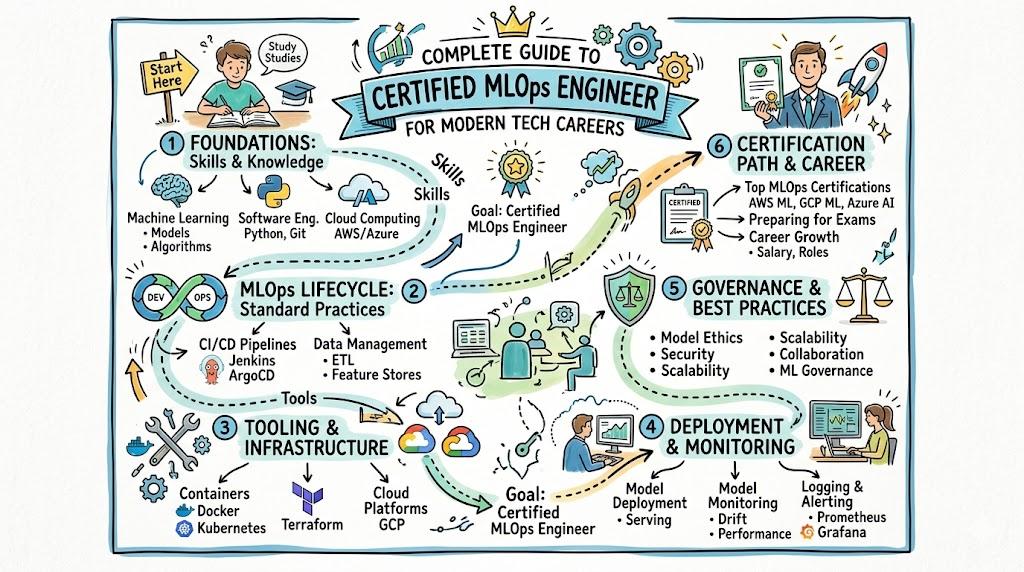
This is where MLOps becomes important.A Certified MLOps Engineer is a professional who understands how to connect machine learning, DevOps, data engineering, automation, cloud infrastructure, containers, monitoring, and production reliability. This role is becoming important for software engineers, DevOps engineers, data engineers, platform engineers, SRE teams, and engineering managers who work with AI and ML systems.
The Certified MLOps Engineer certification from AIOpsSchool helps professionals understand how to build, deploy, and manage production-ready machine learning systems. It focuses on practical engineering skills rather than only theory.This guide explains the certification, who should take it, what skills it covers, how to prepare, what mistakes to avoid, and which career path you can follow after completing it.
About Certified MLOps Engineer
The Certified MLOps Engineer is a mid-level certification designed for professionals who want to work at the intersection of machine learning, software engineering, DevOps, and infrastructure.
It validates your ability to design and manage ML pipelines, model deployment workflows, feature stores, data pipelines, model serving systems, containerized ML workloads, and production monitoring practices.
Certification Overview
| Area | Details |
|---|---|
| Certification Name | Certified MLOps Engineer |
| Track | AIOps / MLOps / Machine Learning Engineering |
| Level | Mid-Level |
| Provider | AIOpsSchool |
| Who It’s For | Software engineers, DevOps engineers, ML engineers, data engineers, SREs, platform engineers, and technical managers |
| Prerequisites | Basic knowledge of Python, machine learning workflow, CI/CD, Docker, Kubernetes, cloud or infrastructure concepts |
| Skills Covered | ML CI/CD, model serving, feature stores, data pipelines, container orchestration, testing, validation, monitoring |
| Recommended Order | Learn DevOps basics first, then MLOps foundation, then Certified MLOps Engineer |
Why Certified MLOps Engineer Matters
Many organizations build machine learning models, but only a few teams know how to run them properly in production. A model that works in a notebook may fail when real users, real data, scale, latency, security, and monitoring come into the picture.
Therefore, companies need engineers who can make ML systems stable, repeatable, and production-ready.
A Certified MLOps Engineer helps bridge this gap. The role focuses on turning machine learning experiments into reliable business systems.
For working engineers, this certification can help build confidence in ML infrastructure, automation, model deployment, and production operations. For managers, it helps understand how ML delivery should be structured inside modern engineering teams.
What It Is
The Certified MLOps Engineer certification validates your ability to build and manage machine learning infrastructure for production environments.
It focuses on ML pipelines, model serving, feature stores, container orchestration, data validation, testing, deployment automation, and monitoring.
It is useful for professionals who want practical, job-ready MLOps skills.
Who Should Take It
This certification is suitable for professionals who already understand software delivery, infrastructure, data systems, or machine learning basics.
It is especially useful for:
- Software engineers who want to move into AI and ML infrastructure
- DevOps engineers who want to support ML workloads
- ML engineers who want to deploy models into production
- Data engineers who want to build ML-ready data pipelines
- SREs who want to manage reliability for AI systems
- Platform engineers who want to build internal ML platforms
- Engineering managers who want to guide AI engineering teams
- Cloud engineers who want to support scalable ML deployments
This certification is also useful for Indian and global professionals who want to prepare for modern AI-driven engineering roles.
Skills You’ll Gain
After preparing for the Certified MLOps Engineer certification, you should gain practical understanding of:
- ML pipeline design
- CI/CD for machine learning
- Data validation and testing
- Model training automation
- Model registry concepts
- Model deployment workflows
- Model serving architecture
- REST and gRPC-based inference
- Batch and real-time inference
- Feature store implementation
- Training-serving consistency
- Docker-based ML packaging
- Kubernetes-based ML deployment
- GPU workload basics
- ML workflow orchestration
- Data pipeline monitoring
- Model performance monitoring
- Model drift and data drift awareness
- Production troubleshooting for ML systems
- End-to-end MLOps project planning
Real-World Projects You Should Be Able to Do After It
After completing this certification, you should be able to work on practical MLOps projects such as:
- Build an automated ML training pipeline
- Create a CI/CD workflow for model deployment
- Package an ML model using Docker
- Deploy an ML inference service on Kubernetes
- Build a batch inference workflow
- Set up a basic feature store workflow
- Add data validation checks before model training
- Design a model registry workflow
- Monitor model prediction quality
- Detect data drift and model drift
- Automate retraining triggers
- Create an end-to-end MLOps architecture diagram
- Deploy a model using a REST API
- Build a pipeline with testing, validation, and approval gates
- Support ML workloads in a cloud or hybrid environment
These projects are important because real companies do not only need model builders. They need engineers who can make models work safely and repeatedly in production.
Core Topics Covered in Certified MLOps Engineer
CI/CD for Machine Learning
Traditional CI/CD focuses on application code. However, ML CI/CD also deals with data, models, experiments, features, metrics, and retraining.
In MLOps, you must understand how to automate model testing, model packaging, model validation, deployment approval, and rollback planning.
This helps teams release ML models faster while reducing production risk.
Model Serving and Inference
Model serving means making a trained model available for real use. This may happen through APIs, batch jobs, streaming systems, or edge environments.
A Certified MLOps Engineer should understand how to design serving systems that handle latency, traffic, scaling, reliability, and versioning.
Feature Stores
Feature stores help teams manage reusable features for training and inference. They reduce duplication and improve consistency between training data and production data.
This topic is important because feature mismatch is one of the common reasons ML models behave badly after deployment.
Containerization and Orchestration
MLOps engineers often use Docker and Kubernetes to package, deploy, and scale ML workloads.
Containerization helps keep environments consistent. Kubernetes helps manage scaling, resource allocation, and workload scheduling.
For production ML, this skill is very important.
Data Pipeline Engineering
A machine learning model is only as good as the data pipeline behind it. Therefore, MLOps engineers need to understand data ingestion, transformation, validation, schema checks, and pipeline monitoring.
Reliable data pipelines help prevent poor model performance and incorrect business decisions.
Testing and Validation
Testing in ML is different from normal software testing. You need to test code, data, model behavior, pipeline logic, and output quality.
A strong MLOps engineer knows how to add validation checks before models reach production.
Preparation Plan
7–14 Days Plan
This plan is best for professionals who already have DevOps, cloud, data engineering, or ML deployment experience.
Day 1–2: Understand MLOps basics
- Review the difference between ML, DevOps, and MLOps
- Understand ML lifecycle stages
- Study training, validation, deployment, and monitoring flow
Day 3–4: Learn ML CI/CD
- Study CI/CD pipeline structure for ML
- Understand model registry and approval gates
- Learn testing stages in ML workflows
Day 5–6: Study containers and Kubernetes
- Revise Docker fundamentals
- Understand Kubernetes deployment basics
- Learn how ML services are deployed and scaled
Day 7–8: Learn model serving
- Study REST inference
- Understand batch inference
- Learn model versioning and rollback concepts
Day 9–10: Study feature stores and data validation
- Understand offline and online features
- Learn training-serving consistency
- Review data validation practices
Day 11–12: Practice scenarios
- Review production troubleshooting cases
- Practice architecture-based questions
- Build a small model deployment workflow
Day 13–14: Revision
- Revise all key topics
- Practice exam-style questions
- Review mistakes and weak areas
30 Days Plan
This plan is suitable for working engineers who can study 1–2 hours daily.
Week 1: Foundation
- Understand ML lifecycle
- Learn MLOps principles
- Review Python, Git, CI/CD, Docker, and cloud basics
- Study model training and deployment concepts
Week 2: Pipeline and Deployment
- Learn CI/CD for ML
- Study model registry workflows
- Practice Docker packaging
- Understand Kubernetes deployment patterns
- Learn model serving basics
Week 3: Data, Features, and Monitoring
- Study data pipelines
- Learn feature stores
- Understand data validation
- Study model monitoring
- Learn drift detection basics
Week 4: Practice and Revision
- Build an end-to-end sample project
- Review architecture scenarios
- Practice troubleshooting questions
- Revise exam topics
- Prepare notes for quick revision
60 Days Plan
This plan is best for beginners or professionals moving from software, DevOps, or data roles into MLOps.
Days 1–10: Build basic foundation
- Learn ML lifecycle basics
- Understand model training and evaluation
- Revise Python basics
- Study Git, Linux, and shell scripting
Days 11–20: Learn DevOps for ML
- Study CI/CD concepts
- Learn Docker
- Understand Kubernetes basics
- Learn infrastructure and deployment patterns
Days 21–30: Learn MLOps pipelines
- Study ML pipeline design
- Understand workflow orchestration
- Learn model registry concepts
- Practice automated training workflows
Days 31–40: Learn data and feature engineering
- Study data ingestion
- Learn data validation
- Understand feature stores
- Learn training-serving consistency
Days 41–50: Learn serving and monitoring
- Study REST model serving
- Learn batch inference
- Understand model monitoring
- Study drift detection and rollback
Days 51–60: Project and exam preparation
- Build a small end-to-end project
- Create architecture diagrams
- Practice scenario-based questions
- Revise all topics
- Attempt mock tests
Common Mistakes
Many learners fail to understand MLOps because they treat it as only model training or only DevOps. In reality, MLOps combines multiple disciplines.
Avoid these common mistakes:
- Learning ML theory without learning deployment
- Learning DevOps tools without understanding ML lifecycle
- Ignoring data validation
- Ignoring model monitoring
- Not understanding feature stores
- Not practicing Docker and Kubernetes
- Thinking CI/CD is the same for ML and normal applications
- Ignoring model versioning
- Not understanding rollback strategy
- Skipping real-world projects
- Focusing only on tools instead of workflow design
- Not preparing for scenario-based questions
- Ignoring security and governance basics
- Not learning how data drift affects production models
Best Next Certification After This
After completing Certified MLOps Engineer, the best next certification depends on your career direction.
If you want to grow deeper into production ML systems, your next step can be an advanced MLOps or ML platform certification.
If you want to move toward AI reliability and intelligent operations, an AIOps-related certification can be useful.
If you want to manage infrastructure reliability, SRE certification can be a good next step.
If your goal is leadership, you can also move toward architect-level certification in MLOps, cloud, DevOps, or AI engineering.
A practical next order can be:
- MLOps Foundation
- Certified MLOps Engineer
- Certified MLOps Professional
- MLOps Architect or AI Platform Architect
- AIOps or SRE advanced certification
Choose Your Path
Different professionals should approach the Certified MLOps Engineer certification differently. Your background decides what you should focus on first.
1. DevOps Path
If you are a DevOps engineer, you already understand CI/CD, automation, infrastructure, containers, and deployment.
Your main focus should be ML lifecycle, model registry, feature stores, data validation, model serving, and drift monitoring.
You should learn how ML delivery is different from normal software delivery. In normal DevOps, code is the main artifact. In MLOps, code, data, model, metrics, and features all matter.
2. DevSecOps Path
If you are from DevSecOps, your focus should be secure ML pipelines, model governance, access control, secrets management, compliance, and secure deployment.
Machine learning systems introduce new risks such as data leakage, model misuse, insecure APIs, and weak governance.
You should learn how to add security checks into ML pipelines without slowing down delivery.
3. SRE Path
If you are an SRE, your strength is reliability, monitoring, incident response, SLIs, SLOs, and production operations.
Your focus should be model serving reliability, inference latency, error rates, drift monitoring, rollback, scaling, and incident handling for ML systems.
You should learn how model behavior can fail even when infrastructure looks healthy.
4. AIOps / MLOps Path
If you already work in AI, ML, or AIOps, this certification can help you structure your production engineering knowledge.
Your focus should be end-to-end ML pipelines, automation, feature stores, monitoring, orchestration, model governance, and production troubleshooting.
This path is ideal for professionals who want to become MLOps engineers, ML platform engineers, or AI infrastructure specialists.
5. DataOps Path
If you are from DataOps or data engineering, your strength is data pipelines, data quality, schema management, and workflow automation.
Your focus should be model training pipelines, feature engineering, feature stores, data validation, training-serving consistency, and pipeline monitoring.
This path is powerful because high-quality ML depends heavily on reliable data operations.
6. FinOps Path
If you are from FinOps, your focus should be cost optimization for ML workloads.
ML systems can become expensive because of GPU usage, storage, training jobs, large datasets, and inference traffic.
You should learn how to monitor ML infrastructure cost, optimize compute usage, plan resource allocation, and balance performance with budget.
How Managers Should Look at This Certification
Engineering managers should not view this certification only as a technical badge. They should see it as a way to build better ML delivery capability inside teams.
A manager with MLOps awareness can ask better questions:
- Is the model deployment automated?
- Is the training data validated?
- Can the team roll back a bad model?
- Is model performance monitored?
- Are features consistent between training and production?
- Are infrastructure costs controlled?
- Is the ML system secure and compliant?
- Do teams understand ownership after deployment?
These questions help reduce project failure and improve business outcomes.
For managers in India and global teams, MLOps knowledge also helps in hiring, project planning, vendor evaluation, and team upskilling.
Job Roles Connected With Certified MLOps Engineer
This certification can support many modern roles, including:
- MLOps Engineer
- ML Platform Engineer
- ML Infrastructure Engineer
- DevOps Engineer for AI systems
- Data Engineer working on ML pipelines
- Cloud Engineer supporting ML workloads
- SRE for AI platforms
- AI Platform Engineer
- Machine Learning Deployment Engineer
- Technical Lead for AI engineering teams
- Engineering Manager handling ML products
The role may differ by company, but the core responsibility remains similar: make machine learning reliable, automated, scalable, and production-ready.
Practical Learning Roadmap
A good roadmap for Certified MLOps Engineer should include both concepts and hands-on practice.
Step 1: Learn the ML Lifecycle
Start with data collection, data preparation, model training, validation, deployment, monitoring, and retraining.
Step 2: Learn DevOps Basics
Understand Git, CI/CD, Docker, Kubernetes, Linux, cloud basics, and automation.
Step 3: Learn ML Pipeline Design
Study how ML pipelines connect data, training, testing, registry, approval, deployment, and monitoring.
Step 4: Learn Model Serving
Understand how models are served through APIs, batch jobs, and scalable inference systems.
Step 5: Learn Feature Stores
Study why reusable and consistent features are important for production ML.
Step 6: Learn Monitoring
Learn infrastructure monitoring, data drift, model drift, prediction quality, latency, and business-level metrics.
Step 7: Build a Project
Build one end-to-end project where you train, package, deploy, and monitor a model.
Top Institutions That Provide Help in Training cum Certifications
DevOpsSchool
DevOpsSchool is known for professional learning programs in DevOps, DevSecOps, SRE, cloud, containers, automation, and related engineering practices.
For Certified MLOps Engineer preparation, it can help learners strengthen CI/CD, Docker, Kubernetes, infrastructure automation, and production deployment concepts.
It is useful for software engineers and DevOps engineers who want to move toward MLOps roles.
Cotocus
Cotocus focuses on technology consulting, training, and engineering enablement across modern IT practices.
For MLOps learners, Cotocus can help connect theoretical learning with practical enterprise use cases.
It can be useful for teams that want structured guidance on automation, DevOps maturity, and ML infrastructure adoption.
Scmgalaxy
Scmgalaxy has experience in software configuration management, DevOps, build and release engineering, and automation learning.
For Certified MLOps Engineer learners, it can help build a strong foundation in version control, pipeline automation, release management, and tool-based workflows.
This is useful because MLOps depends strongly on repeatable and traceable engineering practices.
BestDevOps
BestDevOps is focused on DevOps-related knowledge, certifications, career guidance, and professional learning support.
For MLOps preparation, it can help learners understand how DevOps principles apply to AI and machine learning systems.
It is useful for professionals who want to compare certification paths and plan a career roadmap.
devsecopsschool
devsecopsschool focuses on security-driven engineering practices, DevSecOps, compliance, and secure software delivery.
For MLOps engineers, security is becoming important because ML systems handle sensitive data, models, APIs, and production workloads.
This institution can help learners understand how security fits into ML pipelines and AI infrastructure.
sreschool
sreschool focuses on site reliability engineering, observability, incident management, reliability practices, and production operations.
For MLOps learners, SRE knowledge is very valuable because ML systems must be monitored and supported after deployment.
It is useful for professionals who want to manage model serving reliability, latency, errors, scaling, and operational risk.
aiopsschool
aiopsschool is the provider of the Certified MLOps Engineer certification and focuses on AIOps, MLOps, AI engineering, automation, and intelligent operations.
It is directly relevant for learners preparing for this certification.
Professionals can use the official certification page to understand the certification structure, exam details, skills covered, and preparation direction.
dataopsschool
dataopsschool focuses on DataOps, data pipelines, data quality, data automation, and data engineering practices.
For MLOps, this is highly relevant because machine learning depends on clean, reliable, and well-managed data.
It can help learners strengthen data validation, pipeline reliability, schema management, and data workflow thinking.
finopsschool
finopsschool focuses on cloud cost management, FinOps practices, budgeting, optimization, and financial accountability in technology teams.
For MLOps engineers, FinOps knowledge is important because ML workloads can become expensive due to GPUs, storage, training cycles, and inference traffic.
It is useful for professionals who want to design cost-aware ML platforms.
Final Advice for Working Engineers
If you are a software engineer, do not think MLOps is only for data scientists. Many MLOps responsibilities need strong software engineering skills.
If you are a DevOps engineer, do not think your current skills are enough without learning ML-specific workflows. ML systems introduce new artifacts such as datasets, models, features, and metrics.
If you are a data engineer, do not ignore deployment and monitoring. Good data pipelines become more valuable when they support reliable ML systems.
If you are a manager, do not treat MLOps as a tool purchase. It is an engineering discipline that needs process, ownership, skills, automation, governance, and continuous improvement.
Conclusion
The Certified MLOps Engineer certification is a strong choice for professionals who want to build practical skills in production machine learning systems.
It helps software engineers, DevOps engineers, data engineers, SREs, platform engineers, ML engineers, and managers understand how machine learning moves from experiment to production.
The certification covers important areas such as ML CI/CD, model serving, feature stores, container orchestration, data pipelines, testing, validation, and monitoring.