
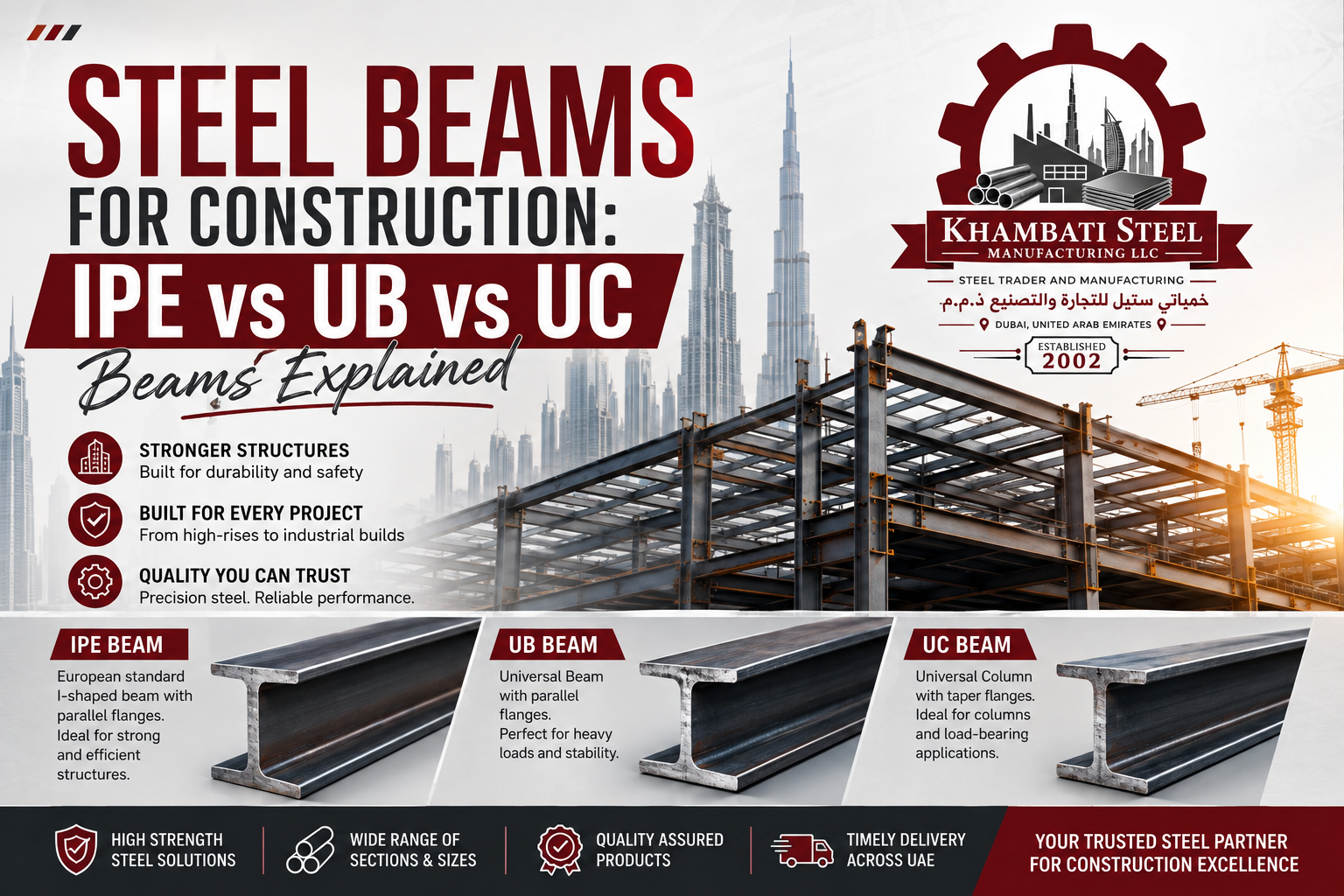
Steel Beams IPE UB UC Beams: Why Does the Difference Matter?
Think choosing the right steel beam is just about size? Think again. If you're planning a multi-story building, selecting the wrong section can affect structural performance, fabrication, and installation.
IPE, UB, and UC beams may look similar, but their profiles and typical applications are different. For engineers and contractors working with Steel beams IPE UB UC beams, understanding these differences helps you select a section that matches the load, span, and structural design.
What Are Steel Beams?
Steel beams are structural members designed to carry loads and transfer them safely through a building or structure. They can support floors, roofs, walls, equipment, and other structural components.
Their shape matters as much as the steel itself. The flange and web arrangement affects how efficiently a beam handles bending, shear, and vertical loads.
Here's the thing: you don't simply choose the biggest beam available. The section must match the structural calculations, span, loading conditions, connections, and applicable standards.
At Khambati Steel, we supply IPE, UB, and UC beam sections for different construction and structural requirements. You can also explore our steel products and structural steel range when reviewing available sections.
IPE Beams Explained
IPE stands for I-shaped European Profile. These beams have an I-shaped cross-section with relatively narrow flanges compared with heavier sections.
The narrower flanges help keep the beam relatively light while still providing useful strength for bending. This makes IPE sections practical where you need structural performance without unnecessarily increasing section weight.
IPE beams are commonly used for light to medium structural applications, including residential buildings, offices, platforms, floors, and smaller structural frames.
When would an engineer choose IPE? If you're designing a floor beam with moderate loading and a suitable span, an IPE section may provide the required bending resistance while keeping the structure relatively efficient.
A major advantage is their good strength-to-weight relationship. They can also be practical for fabrication and handling because of their comparatively lighter profile.
Their limitation is straightforward. Narrower flanges may make them less suitable for very high loads, long spans, or demanding structural conditions requiring heavier sections.
UB Beams Explained
UB means Universal Beam, and these sections are commonly described as H-shaped beams. Compared with IPE sections, UB beams generally have wider flanges and a heavier overall profile.
The wider flange provides greater structural capacity for demanding applications. When loads increase, an appropriately sized UB section can provide the additional resistance required by the design.
UB beams are commonly used in heavy structural applications, including warehouses, industrial buildings, commercial structures, bridges, and larger frames.
Imagine you're constructing a large warehouse with substantial roof loads and long spans. A suitable UB beam may be more appropriate than a lighter IPE section because the structural design requires greater load-carrying capacity.
The main advantage is their ability to handle heavier loads and demanding structural applications. The limitation is that heavier sections require greater attention during transportation, lifting, fabrication, and connection design.
UC Beams Explained
UC stands for Universal Column. These sections are particularly suited to structural applications where vertical load-bearing is important.
The key physical difference is their nearly equal flange width and balanced profile. This geometry makes UC sections particularly useful as columns carrying substantial vertical loads.
If you're designing a multi-story building, columns transfer loads from upper floors toward the foundations. UC sections are commonly considered for these vertical load-bearing roles.
They can be used in high-rise buildings, commercial structures, industrial facilities, and heavily loaded frames where column performance is critical.
Their main advantage is suitability for vertical compression and load-bearing applications. However, a UC section is not automatically the best choice for every beam application. A member primarily resisting bending across a long span may require another section.
How to Choose the Right Beam
Start with the project type, but don't stop there. A residential floor beam, warehouse frame, and high-rise column have very different requirements.
Consider the load requirements and span length. Longer spans and higher loads may require larger or heavier sections.
You also need to follow applicable local building codes, project specifications, and structural standards. Reviewing the available steel materials from Khambati Steel can help contractors and engineers identify suitable product options before final selection.
For example, if you're building a 5-story commercial building, UB beams may be suitable for certain heavily loaded horizontal members because they can provide greater load capacity. UC sections may be considered for columns where vertical loads dominate.
Most importantly, a structural engineer should confirm the final beam selection using calculations and approved drawings.
Choosing the Right Beam for Your Project
IPE, UB, and UC beams each have a role to play. The right choice depends on what the member needs to carry, how far it spans, and whether it functions primarily as a beam or column.
For Steel beams IPE UB UC beams, a reliable supplier can help you source the required sections consistently. At Khambati Steel, we provide all three beam types for different construction and structural requirements.
The goal is simple: choose the section that meets the engineering requirements and performs reliably throughout the project.