
Walk past almost any dairy, juice factory, or bottling plant, and you'll spot them: big, shiny metal tanks standing outside the building or tucked into a corner of the production floor. They don't look like much at first glance. But storage tanks are quietly one of the most important pieces of equipment a food plant owns. Here's what they actually do, and why no serious food operation can run without them.
So, What Exactly Is a Storage Tank?
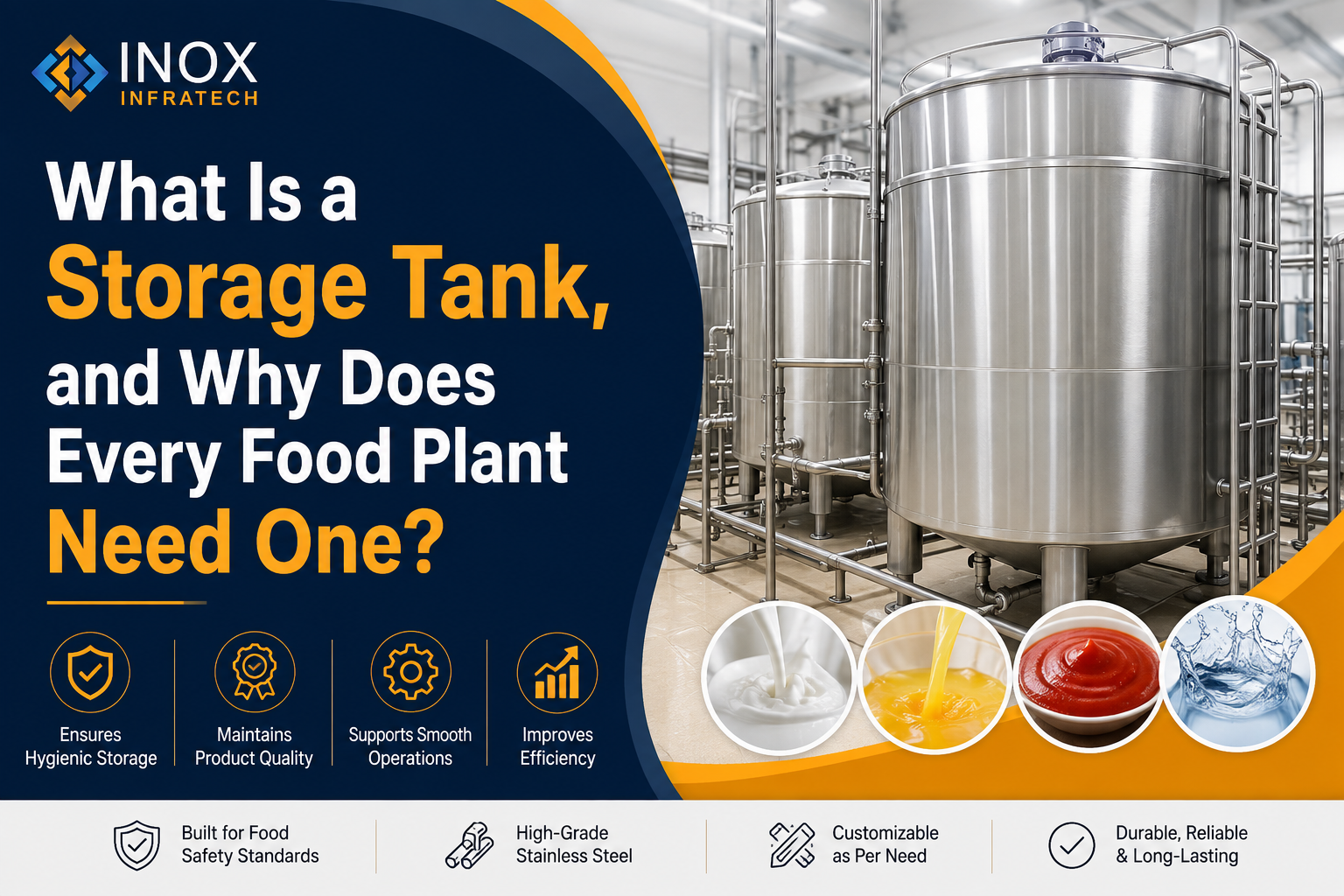
At its simplest, a storage tank is just a large container for holding liquids, semi-liquids, or sometimes powders, for however long a plant needs them held. In a food facility, that might be milk, juice, cooking oil, syrup, water really any raw ingredient or finished product waiting for its turn in the process.
That said, calling it "just a big metal drum" undersells the engineering that goes into one. Manufacturers cut and roll steel plates, weld them together under controlled, qualified procedures, and add internal stiffeners, external ribs, and dished ends depending on how much pressure and volume the tank has to handle. What comes out the other end is a vessel strong enough to hold its shape, leak-proof enough to trust with food product, and durable enough to run for years without giving anyone headaches.
Tanks show up in different shapes vertical, horizontal, rectangular different materials, and wildly different sizes. Some hold barely 1,000 litres. Others hold half a million.
Why Food Plants Can't Really Skip This
Food and beverage manufacturing runs on tighter margins for error than most industries, and storage tanks end up doing a lot of the heavy lifting behind the scenes.
They keep products safe to eat and drink. Milk, juice, edible oils these spoil or pick up contamination fast if they're sitting in the wrong container. Stainless steel tanks (usually SS304 or SS316) don't react with food products and hold up against corrosion, so taste, safety, and shelf life all stay where they should.
They keep production moving. A plant doesn't process everything the second it walks in the door. Milk comes in from farms in batches. Juice needs to rest before bottling. Syrups get blended before packaging starts. Tanks act as a buffer between these steps, so the line doesn't have to stop and restart every time something's waiting.
They help plants pass inspection. Food facilities get audited regularly, and storage equipment is very much part of that. A stainless tank with a smooth, polished interior is easy to sanitize and doesn't give bacteria anywhere to hide in scratches or seams. Many can even be fitted with Clean-in-Place (CIP) systems that wash the tank out automatically between batches, without anyone having to climb inside.
They save money by cutting waste. Poor storage means spoilage, contamination, and inconsistent supply, all of which cost real money. A well-built tank shields the product from temperature swings, moisture, dust, pests- all the things that quietly eat into a plant's margins.
They're not all doing the same job. A single plant might use several types at once:
-
Raw material tanks, holding incoming milk, oil, or water before anything happens to it
-
Process or mixing tanks, where ingredients get blended, heated, or cooled
-
Buffer or holding tanks, sitting between two stages of production
-
Finished product tanks, waiting for packaging or dispatch
-
Dosing tanks, for small, precise additions like flavourings or preservatives
Because each one plays a different role, most plants end up working with a manufacturer who can build to spec rather than settling for something off the shelf.
What Actually Matters When You're Buying One
If you're setting up a new line, or just replacing an old tank, a few things are worth checking before you sign off:
-
Material. Stainless steel SS304 or SS316 is the standard for anything food-grade, mainly because it resists corrosion and cleans up easily.
-
Capacity. Size it to your actual daily volume, and build in some buffer room rather than cutting it close.
-
Design standard. Look for tanks built to IS, ASME, or API codes, especially if regulators are going to be checking your paperwork.
-
Finish. A polished, food-grade interior keeps bacteria from getting a foothold and makes cleaning far less of a chore.
-
Accessories. Manholes, baffles, ladders, platforms, venting these small details end up mattering a lot once the tank's in daily use.
-
Room to customize. Every plant's layout is a little different, so being able to get a tank built around your actual site, rather than the other way around, is worth something.
Why Inox Infratech Is Worth a Look for UAE Food Plants
If your plant is based in the UAE, or anywhere in the wider Gulf region, Inox Infratech is a name that keeps coming up for good reason.
Inox Infratech Metal Industries L.L.C. is part of the Ferrotech Group and has an active presence across the UAE, Oman, Qatar, Saudi Arabia, and a handful of African markets. Everything runs out of a 50,000 sq. ft. integrated manufacturing facility in Umm Al Quwain, meaning tanks are designed, fabricated, and finished in-house rather than passed between subcontractors, which tends to mean tighter quality control and fewer surprises on delivery.
Here's what that translates to for a food or beverage plant specifically:
-
Food-grade materials. Tanks come in SS304 and SS316, the grades used worldwide for anything touching food.
-
A genuinely wide capacity range. From 1 KL right up to 500 KL and beyond on request enough range for a mid-sized dairy or a large bottling operation alike.
-
Choice of shape and finish. Vertical, horizontal, or rectangular tanks, with finishes running from pickled and polished stainless steel to epoxy-painted or hot-dip galvanized mild steel for the non-food-contact side of a plant.
-
Standards-compliant fabrication. Tanks are built to IS, ASME, or API codes where relevant, useful when a regulator wants to see the paper trail.
-
Real customization. Manholes, internal baffles, ladders, platforms, insulation, and anchoring built around your site conditions rather than forced to fit them.
-
Regional coverage that actually helps with lead times. With operations spanning the UAE, Oman, Qatar, and Saudi Arabia, Inox Infratech can serve Gulf projects without the long wait that comes with importing standard tanks from further afield.
-
More than just tanks. Mixing vessels, dosing tanks, CIP tanks, process vessels, hygienic processing tables, stainless piping a plant can source most of its process equipment from a single supplier rather than juggling several.
For an engineer or owner planning a build-out in the UAE, working with a local manufacturer like this usually means shorter lead times, more direct back-and-forth during design, and equipment that's actually built with Gulf conditions and regulations in mind not a standard tank shipped in from somewhere it wasn't really designed for.
The Bottom Line
A storage tank doesn't look like much from the outside just a big metal container, easy to overlook. But inside a food plant, it's doing real work: protecting product quality, keeping the line moving, and helping the facility stay on the right side of hygiene regulations. Getting the material, size, and design right isn't a small decision, and it's usually worth the extra time it takes to get it right with an experienced manufacturer.
If you're planning a new line or upgrading storage capacity in the UAE, it's worth reaching out to Inox Infratech for a consultation on what would actually fit your operation.