
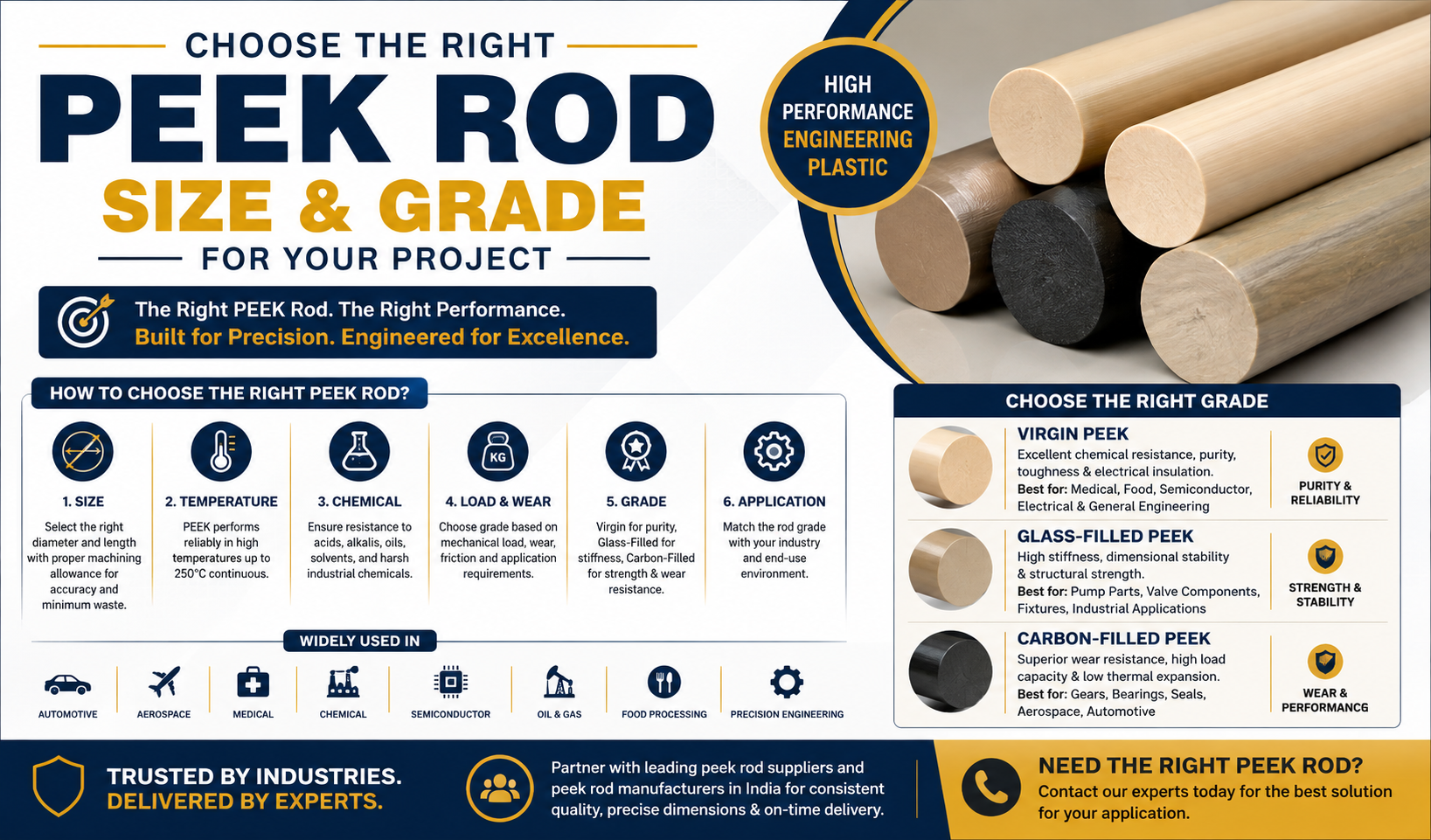
Choose the right PEEK rod by evaluating six factors: the required diameter, rod length, operating temperature, mechanical load, chemical exposure, and the appropriate material grade. Virgin PEEK is ideal for general engineering and chemical applications, Glass-Filled PEEK provides greater stiffness and dimensional stability, while Carbon-Filled PEEK is best for high-load and wear-resistant components. Working with reliable peek rod suppliers and peek rod manufacturers in India helps ensure consistent quality and precise dimensions.
Introduction
Selecting the correct PEEK rod is one of the most important decisions in precision manufacturing. Whether you are producing automotive components, medical devices, aerospace parts, semiconductor fixtures, or industrial machinery, the performance of your final product depends heavily on choosing the right rod size and material grade.
PEEK, or Polyether Ether Ketone, is a premium engineering thermoplastic known for its exceptional strength, outstanding heat resistance, excellent chemical stability, and long service life. Unlike conventional plastics, PEEK maintains its mechanical properties even in demanding industrial environments where high temperatures, continuous loads, and aggressive chemicals are common.
The growing demand for advanced engineering plastics has increased the number of peek rod manufacturers in Mumbai and across India, giving buyers access to multiple grades, custom sizes, and CNC-ready stock. However, choosing the correct material requires understanding much more than price alone.
What Is a PEEK Rod?
A PEEK rod is a solid round engineering plastic bar manufactured through an extrusion process using high-performance Polyether Ether Ketone resin. It is commonly machined into precision components such as gears, bearings, bushes, seals, valve seats, electrical insulators, compressor parts, and pump components.
PEEK is widely preferred because it combines the lightweight benefits of plastic with mechanical properties that often rival metal in demanding applications. It also offers low moisture absorption, excellent dimensional stability, and outstanding resistance to steam, oils, fuels, and industrial chemicals.
Why Is Choosing the Correct PEEK Rod Important?
Many buyers simply purchase the nearest available diameter without considering machining allowance or material grade. This often leads to unnecessary waste, higher machining costs, poor dimensional accuracy, or premature component failure.
Selecting the appropriate PEEK rod improves manufacturing efficiency, extends component lifespan, reduces maintenance expenses, and ensures reliable performance under extreme operating conditions. For OEM manufacturers and industrial engineers, choosing the correct grade is an investment in long-term product reliability rather than just material procurement.
Step 1: Choose the Right PEEK Rod Diameter
Diameter is the first specification you should determine before purchasing a PEEK rod. The rod should always be slightly larger than the finished component to provide sufficient machining allowance for turning, drilling, and finishing operations.
For example, if your finished part requires a diameter of 28 mm, selecting a 30 mm rod provides adequate material for precision machining. Similarly, a 48 mm component is typically manufactured from a 50 mm rod to achieve better surface finish and tighter tolerances.
Using the correct machining allowance minimizes material waste while ensuring dimensional accuracy throughout production.
|
Finished Component |
Recommended PEEK Rod |
|---|---|
|
8 mm |
10 mm |
|
18 mm |
20 mm |
|
28 mm |
30 mm |
|
48 mm |
50 mm |
|
75 mm |
80 mm |
Step 2: Select the Appropriate Rod Length
PEEK rods are available in multiple standard lengths, with custom cutting also offered by many peek rod suppliers. The ideal length depends on your production volume, machining setup, and inventory strategy.
Prototype development generally requires shorter rods, while high-volume manufacturing often benefits from longer stock lengths that reduce cost per kilogram and improve material utilization. Purchasing rods that closely match your production requirements can significantly reduce scrap during CNC machining.
|
Application |
Typical Length |
|---|---|
|
Prototype Development |
300 mm |
|
Small Production |
500 mm |
|
Industrial Manufacturing |
1000 mm |
|
OEM Projects |
Custom Length |
Step 3: Understand the Different PEEK Grades
Choosing the correct material grade is just as important as selecting the correct size. Although different grades may appear identical, their mechanical and thermal properties vary considerably.
Virgin PEEK
Virgin PEEK is manufactured from pure, unfilled resin and offers the best combination of toughness, chemical resistance, electrical insulation, and purity. It is widely used in medical equipment, food processing machinery, semiconductor fixtures, pharmaceutical components, and electrical applications where contamination must be minimized.
If your project requires excellent chemical resistance and reliable machining performance, Virgin PEEK is usually the safest choice.
Glass-Filled PEEK
Glass-Filled PEEK contains reinforcing glass fibers that increase stiffness and improve dimensional stability. This grade performs exceptionally well in structural applications where components experience continuous mechanical loads and elevated temperatures.
It is commonly used in valve bodies, compressor parts, industrial fixtures, pump housings, and precision mechanical assemblies where rigidity is more important than flexibility.
Carbon-Filled PEEK
Carbon-Filled PEEK provides superior wear resistance, higher mechanical strength, lower thermal expansion, and excellent fatigue performance. It is frequently selected for gears, bearings, sliding components, aerospace assemblies, and automotive engineering where long-term durability is essential.
This grade is particularly effective in applications involving continuous friction and heavy mechanical loading.
Which PEEK Grade Is Best for Your Project?
|
Project Requirement |
Recommended Grade |
|---|---|
|
General Engineering |
Virgin PEEK |
|
Chemical Processing |
Virgin PEEK |
|
Electrical Insulation |
Virgin PEEK |
|
Structural Components |
Glass-Filled PEEK |
|
Dimensional Stability |
Glass-Filled PEEK |
|
Heavy Mechanical Load |
Carbon-Filled PEEK |
|
Wear Resistance |
Carbon-Filled PEEK |
|
Low Thermal Expansion |
Carbon-Filled PEEK |
Understanding these differences allows engineers to optimize both performance and manufacturing costs before contacting peek manufacturers for quotations.
Step 4: Match the Grade to Your Industry
Different industries demand different material characteristics, making application-based selection essential.
In the automotive industry, Carbon-Filled PEEK is commonly used for bearing cages, gears, seals, and transmission components because it offers excellent wear resistance while reducing overall weight.
Medical manufacturers generally prefer Virgin PEEK because it can withstand repeated sterilization and provides exceptional purity for surgical instruments and medical devices.
Chemical processing equipment often uses Virgin PEEK for seals, valve seats, manifolds, and pump components due to its outstanding resistance to aggressive chemicals and steam.
Semiconductor manufacturers rely on Virgin PEEK because of its low moisture absorption, electrical insulation, and dimensional stability during precision manufacturing processes.
Food processing machinery also benefits from Virgin PEEK, especially in hygienic environments where frequent steam cleaning and high operating temperatures are common.
Step 5: Consider Operating Temperature
Temperature is one of the most critical factors when selecting an engineering plastic. Many conventional materials begin losing strength as temperatures rise, but PEEK continues delivering reliable mechanical performance in extreme environments.
PEEK can operate continuously at temperatures approaching 250°C, making it suitable for industrial ovens, heat exchangers, compressor systems, aerospace equipment, and high-temperature manufacturing processes.
If your application regularly exceeds 150°C, PEEK is often a significantly better alternative than nylon, acetal, or UHMW polyethylene.
Step 6: Evaluate Chemical Resistance
Industrial components are frequently exposed to oils, fuels, acids, alkalis, alcohols, solvents, and steam. Choosing a material without adequate chemical resistance can result in swelling, cracking, or premature failure.
PEEK is highly resistant to a wide range of industrial chemicals, making it ideal for pharmaceutical machinery, laboratory equipment, oil and gas systems, chemical reactors, and precision fluid handling equipment.
Always verify compatibility with the exact chemicals used in your manufacturing environment before finalizing the material grade.
How to Calculate the Ideal Rod Size
A practical engineering rule is to add a small machining allowance to the finished component diameter.
For example, a finished shaft measuring 38 mm is typically machined from a 40 mm PEEK rod. Likewise, a 58 mm finished component is usually produced from a 60 mm rod. This additional material allows for accurate turning, surface finishing, and dimensional correction during CNC machining.
Proper sizing improves machining efficiency while reducing unnecessary material waste.
Should You Buy from Indian PEEK Manufacturers?
The Indian engineering plastics industry has grown considerably, and several established peek rod manufacturers in India now produce high-quality extruded rods in Virgin, Glass-Filled, and Carbon-Filled grades.
Purchasing from domestic manufacturers offers several advantages, including faster delivery, lower transportation costs, easier technical support, custom cutting services, and improved availability of standard stock sizes. Many peek rod manufacturers in Mumbai also provide CNC-ready rods with consistent tolerances for OEM production.
For businesses focused on reducing lead time and maintaining reliable supply chains, sourcing from experienced Indian manufacturers is often the most practical solution.
How to Choose Reliable PEEK Rod Suppliers
Selecting the right supplier is about more than comparing prices. Material consistency and manufacturing quality have a direct impact on the performance of precision components.
A dependable supplier should offer certified raw materials, accurate dimensional tolerances, multiple material grades, custom sizing options, quality documentation, and technical support for engineering applications. These factors become especially important for export-oriented manufacturers and industries requiring strict quality standards.
Common Mistakes to Avoid
One of the most common mistakes is selecting Virgin PEEK for applications involving continuous friction, where Carbon-Filled PEEK would provide much better wear resistance.
Another frequent error is purchasing oversized rods without considering machining yield, which unnecessarily increases material costs. Some buyers also overlook operating temperature or chemical compatibility, resulting in reduced component life despite using a premium engineering plastic.
Careful evaluation of application requirements before ordering helps eliminate these costly mistakes.
Conclusion
Choosing the right PEEK rod requires balancing size, material grade, temperature resistance, mechanical strength, chemical compatibility, and machining requirements. Virgin PEEK remains the preferred choice for general engineering, medical, electrical, and chemical applications, while Glass-Filled PEEK excels in structural components and Carbon-Filled PEEK delivers superior performance in wear-intensive environments.
By working with experienced peek rod suppliers, peek rod manufacturers, peek manufacturers, peek rod manufacturers in India, and peek rod manufacturers in Mumbai, businesses can obtain high-quality materials that improve machining accuracy, extend component life, and enhance overall manufacturing efficiency.
Frequently Asked Questions (FAQs)
1. What is the best PEEK rod grade for CNC machining?
Virgin PEEK is generally the best choice because it offers excellent machinability, chemical resistance, and dimensional stability for precision components.
2. Which PEEK rod is suitable for gears and bearings?
Carbon-Filled PEEK is recommended for gears, bearings, and sliding parts because of its superior wear resistance and high mechanical strength.
3. How do I choose the correct PEEK rod diameter?
Select a rod slightly larger than the finished component to allow sufficient machining stock for turning and finishing operations.
4. What is the maximum operating temperature of PEEK?
PEEK can continuously operate at temperatures close to 250°C while maintaining excellent mechanical performance.
5. Is Glass-Filled PEEK stronger than Virgin PEEK?
Glass-Filled PEEK is stiffer and offers better dimensional stability, while Virgin PEEK provides better toughness and electrical insulation.
6. Which industries commonly use PEEK rods in India?
Automotive, aerospace, medical, pharmaceutical, semiconductor, food processing, chemical processing, and precision engineering industries are major users of PEEK rods.
7. Are custom PEEK rod sizes available?
Yes. Many peek rod manufacturers in India provide custom diameters, lengths, and cut-to-size rods for OEM and industrial applications.
8. Is PEEK better than nylon for high-temperature applications?
Yes. PEEK offers significantly better heat resistance, mechanical strength, and dimensional stability than nylon in demanding environments.
9. How do I identify reliable peek rod suppliers?
Choose suppliers that provide certified materials, consistent tolerances, multiple grades, technical support, and dependable stock availability.
10. Why are PEEK rods widely used in precision engineering?
PEEK rods combine exceptional strength, chemical resistance, heat resistance, low moisture absorption, and excellent machinability, making them ideal for manufacturing high-performance precision components.